
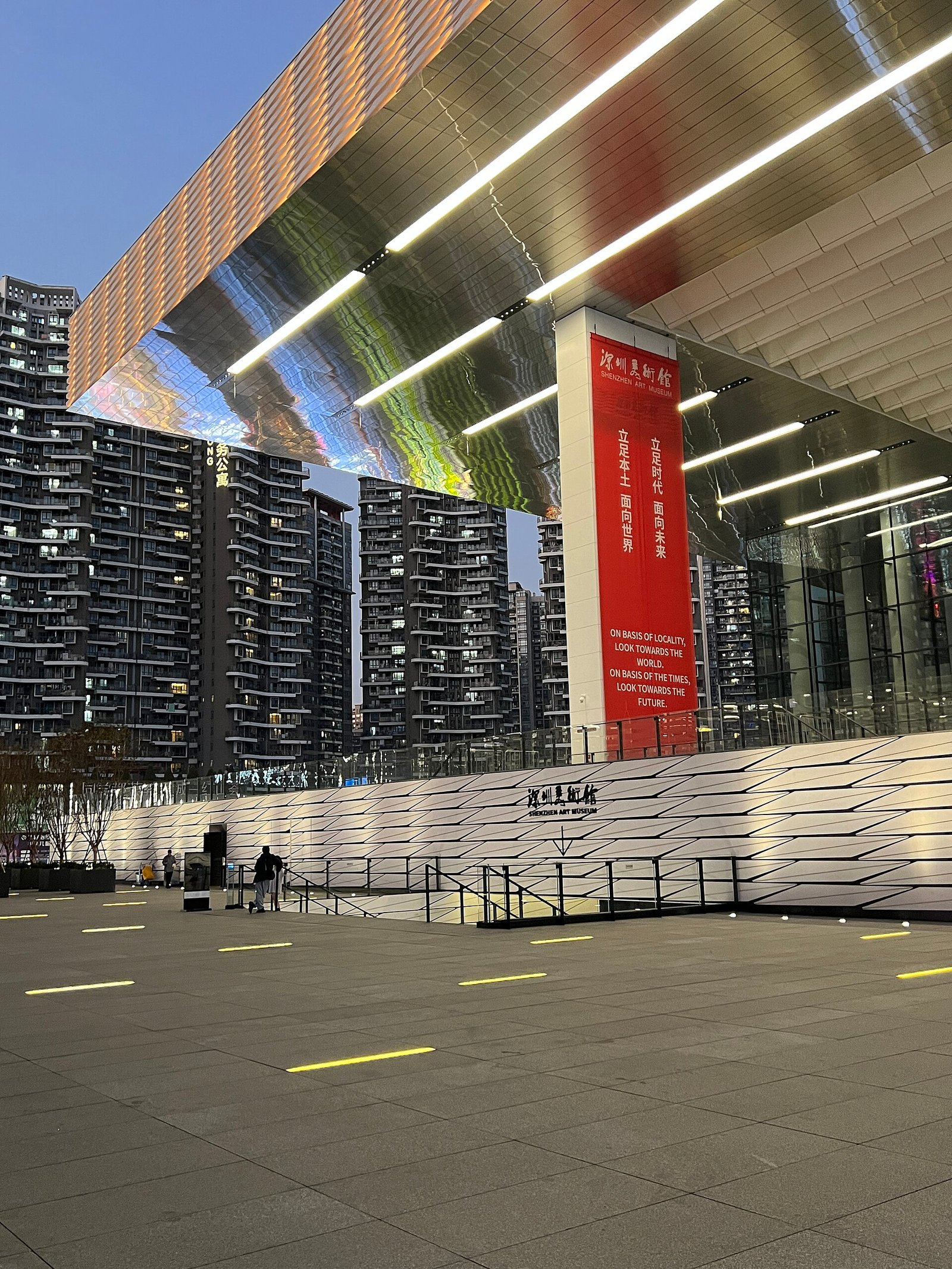
A major public art institution tracing Shenzhen’s cultural development from its emergence as a special economic zone to its present identity as a global creative centre.
At a glance
Shenzhen Art Museum is the city’s principal venue for contemporary and historical art. The museum operates two locations: a main facility in Longhua District and an earlier venue in Luohu District. Both serve as anchors for the city’s expanding cultural infrastructure.
History
Founded in 1976 as the Shenzhen Exhibition Hall, the institution was renamed Shenzhen Art Museum in 1987—a moment that reflected the city’s growing ambitions in the visual arts. The museum has evolved alongside Shenzhen itself, documenting and exhibiting the creative output of a metropolis that transformed from a fishing village into one of China’s most dynamic urban centres.
What you see
The museum’s architectural identity spans two distinct venues. The main Longhua location represents contemporary museum design suited to a modern metropolis, while the Donghu site in Luohu District preserves the institution’s earlier chapter. Together they accommodate diverse exhibitions and collections.
Cultural significance
As Shenzhen’s primary art museum, the institution plays a vital role in exhibiting local, national and international artists. It documents the visual culture of a city defined by rapid transformation and serves both established and emerging creators seeking a platform in one of Asia’s most important art markets.
Key facts
- Country: China
- City: Shenzhen, Guangdong Province
- Founded: 1976 (as Shenzhen Exhibition Hall)
- Renamed: 1987 (Shenzhen Art Museum)
- Main venue: Longhua District
- Historic venue: Luohu District (Donghu)
- Coordinates: 22.573884, 114.142241
Practical information & getting there
You can access detailed visitor information through the museum’s official channels. Shenzhen’s efficient metro system connects both venues to the city’s wider transport network.
Sources & resources
Find it on the map
See this place and what’s around it →📷 Become a Cultural Heritage Online photographer
Share your photos of places: they stay published under your name as the author. The more they're seen, the more you get noticed — and soon a contest will reward the most appreciated photos.
Log in or sign up free to add a photoIs this page about you?
This page is read by travellers and heritage enthusiasts who find it on Google. Tell us how you are connected to this place and we will take it from there.