
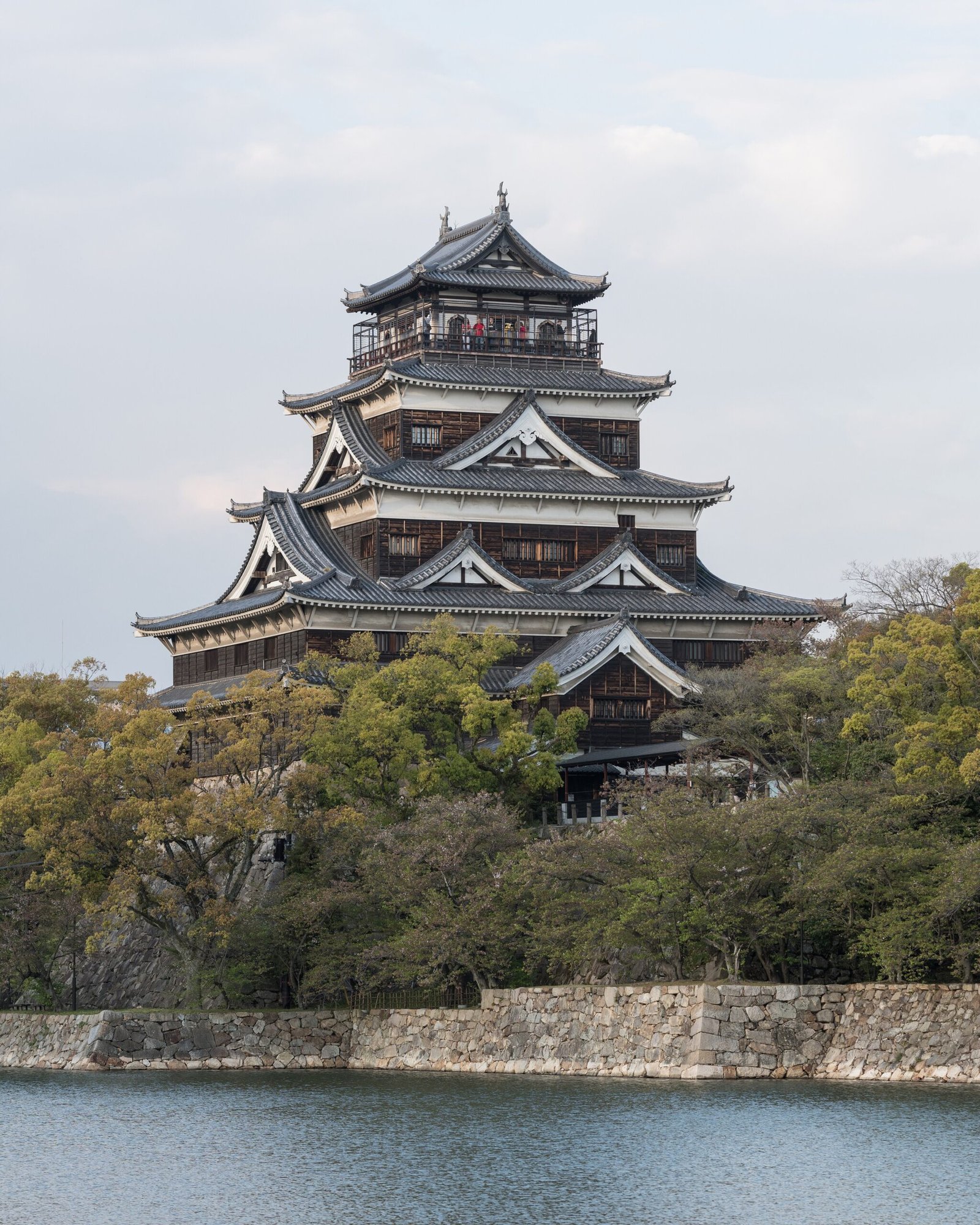
Built on a river delta by one of Toyotomi Hideyoshi’s Five Elders, this castle rose, fell to the atomic bomb, and rose again in concrete as a monument to memory.
At a glance
Hiroshima Castle, sometimes called Carp Castle, stands where five villages once met the Otagawa river. Mōri Terumoto raised it between 1589 and 1599 as the seat of a domain spanning much of western Japan. Destroyed in 1945, its tower was rebuilt in 1958 and now houses a history museum.
History
Terumoto began construction in 1589, moving his court from Yoshida-Kōriyama Castle. The site had no name worth keeping. Officials coined “Hiroshima” from family and clan names, later reinterpreted as “wide island” for the delta’s scattered landforms. After Sekigahara in 1600, Terumoto lost the castle to Fukushima Masanori, whose repairs after a 1619 flood violated shogunate restrictions on castle building. Asano Nagaakira took over that same year, and his descendants held it until the Meiji Restoration in 1869. The Imperial General Headquarters occupied the grounds during the First Sino-Japanese War. By 1945 it served as headquarters for the 2nd General Army and Fifth Division. The atomic bombing on August 6 destroyed the tenshu and its surrounding structures. Long assumed to have been blown apart instantly, evidence found in 2010 suggests the lower pillars failed first, and the tower collapsed under its own weight moments later.
What you see
The original wooden keep, completed between 1592 and 1599, once carried attached wings to the east and south. It earned National Treasure status in 1931, a designation lost with its destruction. The current tower is concrete, five storeys rising 26.6 meters above a stone base itself 12.4 meters high. In 1994 a gate and three yagura in the ninomaru were reconstructed using traditional wooden methods, a rare concession to authenticity amid the concrete. Hiroshima Castle is a hirajiro, a flatlands fortress, and once relied on three concentric moats plus the river itself for defense. Two outer moats vanished under 19th- and 20th-century urban expansion. Inside the remaining moat sits Hiroshima Gokoku Jinja, a Shinto shrine relocated here after the war. Within the Honmaru, a eucalyptus, a willow, and a holly survived the blast at distances of 740 and 935 meters from the hypocenter. A concrete bunker nearby held the first radio broadcast to leave Hiroshima after the bombing.
Cultural significance
The castle anchored a domain governing millions of koku in rice yield and provincial authority. Its later military role made it a target, and its destruction ties the site directly to the atomic bombing’s history. The surviving trees and the reconstructed keep together turn the grounds into both a memorial and a museum of pre-war Hiroshima.
Key facts
- Original construction: 1589–1599, by Mōri Terumoto
- Destroyed: August 6, 1945, atomic bombing
- Rebuilt tower: 1958, reinforced concrete
- Wooden gate and yagura reconstructed: 1994
- Tower height: 26.6 m above a 12.4 m stone foundation
- Type: hirajiro (flatlands castle)
Practical information & getting there
The castle sits in central Hiroshima, within walking distance of the Peace Memorial Park. You can reach the grounds easily by streetcar or on foot from Hiroshima Station. The reconstructed tower functions as a museum, and the surrounding park includes the shrine, the surviving trees, and remnants of the old military headquarters.
Sources & resources
Find it on the map
See this place and what’s around it →📷 Become a Cultural Heritage Online photographer
Share your photos of places: they stay published under your name as the author. The more they're seen, the more you get noticed — and soon a contest will reward the most appreciated photos.
Log in or sign up free to add a photoIs this page about you?
This page is read by travellers and heritage enthusiasts who find it on Google. Tell us how you are connected to this place and we will take it from there.