
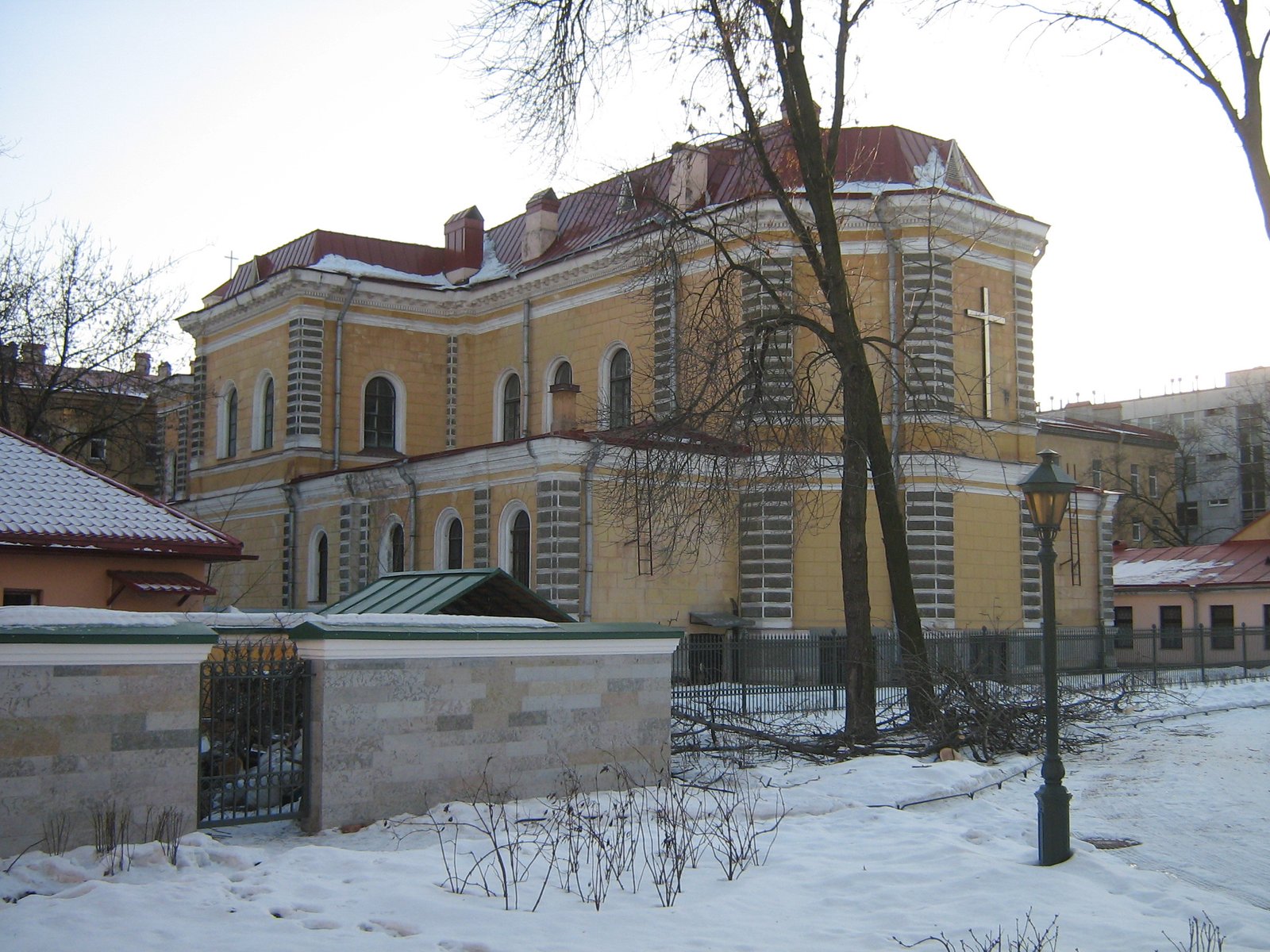
A Latin-cross church raised for St. Petersburg’s Catholic minority, once the seat of the Archbishop of Mogilev and now a working parish beside Russia’s only Catholic seminary.
At a glance
Built between 1870 and 1873 in a restrained neoclassical idiom, the cathedral served as the episcopal church of the Catholic Archdiocese of Mogilev, the body governing Catholics across the Russian Empire. It stands set back from the street, screened by the seminary building of Mary Queen of the Apostles. Today it functions as a parish church within the Archdiocese of Moscow.
History
The archbishop’s seat moved to St. Petersburg from Mogilev in 1849, though the diocese kept its old name. A first residence had already been built near the Church of St Stanisław in 1783. Construction of the new cathedral itself followed in 1870, designed originally by Vasily Ivanovich Sobolschikov. He died before completion. Evgraf S. Vorotilov finished the building, and Archbishop Anthony Fialkovsky consecrated it on 12 April 1873. Growth soon outpaced the space. Between 1896 and 1897 the church was enlarged, side chapels added, altars replaced and decorated with bronze statues, raising capacity from 750 to 1,500. It was reconsecrated on 23 December 1897. By 1917 the parish counted some 15,000 to 20,000 members. The Revolution reversed this. The seminary closed in 1918; the cathedral itself held out until 1930. Wartime bombing damaged the structure further, and Soviet authorities converted it into a design office. Restitution came slowly after 1991. The parish reformed in 1994, the building and adjoining seminary were returned in 1995, and services resumed in 1997 before full reconsecration by Archbishop Tadeusz Kondrusiewicz on 24 May 1998.
What you see
The plan follows a Latin cross, its nave joined directly to the single-signed seminary block behind. Little of the exterior faces the street directly. Instead the seminary building screens the church from passers-by, giving the ensemble a withdrawn, institutional presence rather than a monumental civic front. Inside, the 1890s remodeling left its mark: expanded chapels, altered signature details, and bronze-adorned side altars replacing the originals. The postwar conversion to office use and the subsequent two-year restoration after 1995 mean that much of what visitors see today reflects careful late-twentieth-century reconstruction layered over the surviving nineteenth-century fabric.
Cultural significance
For over half a century this was the central church of Catholicism across the Russian Empire, seat of the archbishop who oversaw a vast and scattered flock. Its closure in 1930 mirrored the wider suppression of religious institutions under Soviet rule. Its reopening in the 1990s, alongside the return of the adjoining seminary, marked a visible restoration of Catholic institutional life in post-Soviet Russia. The cathedral now hosts regular concerts of sacred music, adding a cultural dimension to its religious role.
Key facts
- Location: St. Petersburg, Russia
- Constructed: 1870–1873; expanded 1896–1897
- Original architect: Vasily Ivanovich Sobolschikov; completed by Evgraf S. Vorotilov
- Style: Neoclassical
- Cathedral status: 1873–1926, seat of the Archdiocese of Mogilev
- Closed by Soviet authorities: 1930; returned to the Church: 1995
- Reconsecrated: 24 May 1998, by Archbishop Tadeusz Kondrusiewicz
- Heritage-listed building
Practical information & getting there
The church sits south of the Polish Garden in central St. Petersburg, adjoining the Mary Queen of the Apostles seminary. You can attend regular services or one of the sacred music concerts held in the church; check the parish website for current schedules, as opening times are not fixed for casual visits. The seminary building itself is not open to the public in the same way as the church.
Sources & resources
Find it on the map
See this place and what’s around it →📷 Become a Cultural Heritage Online photographer
Share your photos of places: they stay published under your name as the author. The more they're seen, the more you get noticed — and soon a contest will reward the most appreciated photos.
Log in or sign up free to add a photoIs this page about you?
This page is read by travellers and heritage enthusiasts who find it on Google. Tell us how you are connected to this place and we will take it from there.