
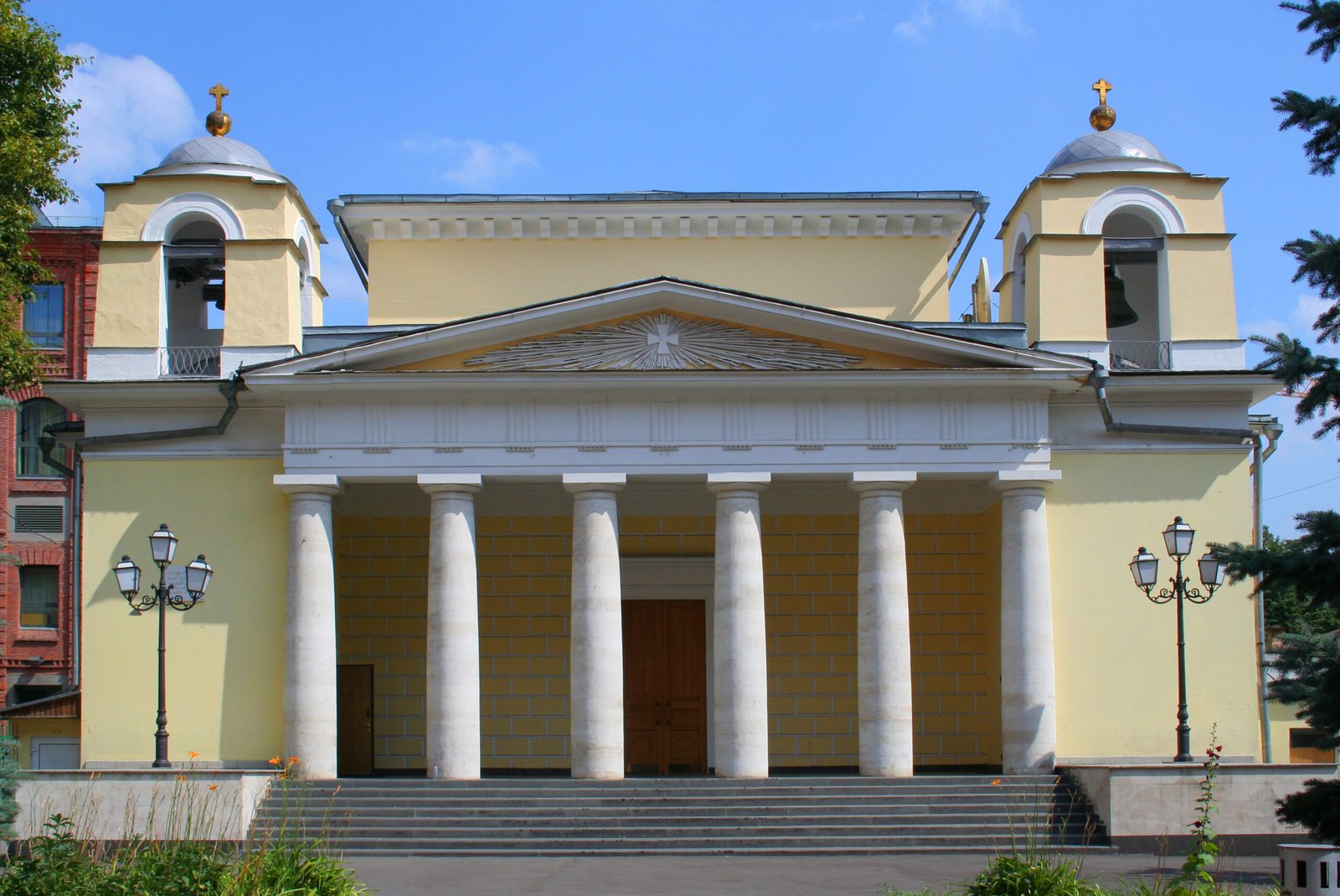
A modest Empire-style church near the Lubyanka that has served Moscow’s Catholic community, French and otherwise, since the reign of Catherine the Great.
At a glance
Tucked between Malaya Lubyanka Street and Milyutinsky Lane, the Church of St. Louis of the French is one of only three Catholic churches active in Moscow today. It began life as a small wooden chapel in 1791 and was rebuilt in stone in the 1830s. Masses here are said in Russian, French, English, Italian and Vietnamese, a reflection of the parish’s long international life.
History
French merchants in Moscow had worshipped for decades at the Church of Saints Peter and Paul before petitioning, in 1789, for a parish of their own. Empress Catherine II approved the plan, and a wooden church consecrated to Louis IX opened on this site in March 1791. Politics soon intruded. News of Louis XVI’s execution in 1793 prompted Catherine to strip the church of its French designation and expel its first rector, Pem de Matignicourt. Boundaries between Moscow’s Catholic parishes shifted again in 1812, this time restoring the church’s French character. The 1812 fire spared the building entirely. Contributions from parishioners, plus a state loan, funded a stone replacement designed by architect Domenico Gilardi; it rose between 1827 and 1830, though consecration waited until 1849. Schools and a shelter for children clustered around the parish through the late 19th century. The 1917 revolution brought nationalization, searches and the closure of the attached schools by 1919. After Soviet authorities shut Moscow’s two other Catholic churches in the 1930s, St. Louis became the city’s sole functioning Catholic church, and one of only two in the entire Russian republic. American priest Leopold Brown served through the Second World War, reporting on the Church’s situation to the Vatican before leaving in 1945. The 1990s brought a new administrative role: in 1991 Pope John Paul II’s newly created apostolic administration for European Russia was installed here, and the interior underwent major reconstruction.
What you see
The building reads as restrained Empire-style church architecture, built of stone in place of the original timber structure. A marble plaque inside the altar area, inscribed in Latin, still records the delayed 1849 consecration. Roof and façade work in 2017 was followed by an extensive interior restoration the following year, so much of what visitors encounter today is recently refreshed rather than untouched 19th-century fabric. The church shares its grounds, in spirit if not in stone, with a former shelter building and a red-brick school house that once stood nearby on Milyutinsky Lane.
Cultural significance
Few buildings in Moscow trace Catholic-Orthodox and Franco-Russian relations so directly. The church survived imperial decrees, a citywide fire, revolution and decades of Soviet restriction. It sheltered a secret episcopal ordination in 1926, performed by Bishop Michel d’Herbigny without Soviet knowledge. Today it functions as parish home to both a French- and English-speaking congregation and a Russian-speaking one tied to the suppressed Peter and Paul church, making it, in effect, a stand-in for a lost neighbor as well as its own historic self.
Key facts
- Location: Lubyanka district, central Moscow
- Original wooden church consecrated: 1791
- Stone church built: 1827–1830s, architect Domenico Gilardi
- Style: Empire style
- Status: heritage-listed; one of three active Catholic churches in Moscow
- Languages of Mass: Russian, French, English, Italian, Vietnamese
Practical information & getting there
You will find the church a short walk from Lubyanka metro station, in the streets around Malaya Lubyanka and Milyutinsky Lane. Masses run in several languages across the week, so check the parish’s own schedule before visiting. The church remains an active place of worship rather than a museum, so quiet, respectful visits between services are the norm.
Sources & resources
Find it on the map
See this place and what’s around it →📷 Become a Cultural Heritage Online photographer
Share your photos of places: they stay published under your name as the author. The more they're seen, the more you get noticed — and soon a contest will reward the most appreciated photos.
Log in or sign up free to add a photoIs this page about you?
This page is read by travellers and heritage enthusiasts who find it on Google. Tell us how you are connected to this place and we will take it from there.