
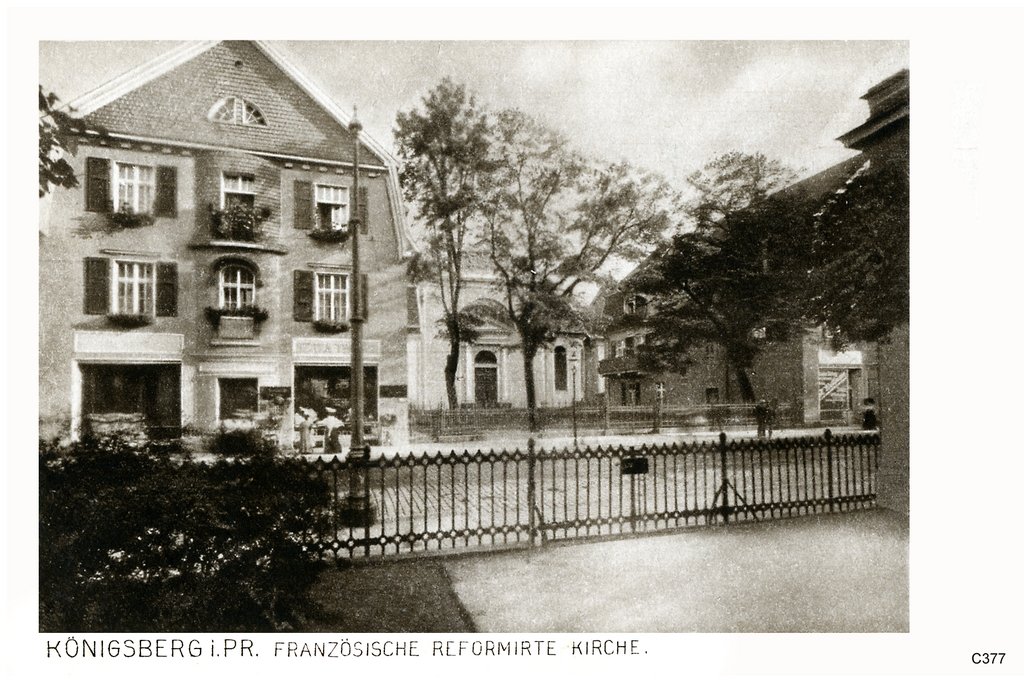
A Rococo house of worship built for Königsberg’s Huguenot community, raised at royal expense and lost to war and demolition within two centuries.
At a glance
The French Reformed Church stood at the corner of Königstraße and Landhofmeister-Straße in the Neue Sorge district of Königsberg. Built between 1733 and 1736 to designs by Joachim Ludwig Schultheiß von Unfriedt, it served the city’s French-speaking Calvinist congregation. Nothing remains today. The ruins, still standing after 1945, were cleared away by 1968 in what is now Kaliningrad.
History
King Frederick William I of Prussia, himself a Calvinist, put up 12,000 of the 18,687 Thaler needed to build the church. It was dedicated on 29 July 1736, with the king present. The congregation traced its roots to Huguenot refugees, and French remained the language of the pulpit for generations. History passed through its doors directly. During the 1807 negotiations for the Treaty of Tilsit, Pastor La Canal and Commerce Councilor Prin persuaded Napoleon to cut Prussia’s war indemnity from 20 million to 12 million francs. By the nineteenth century the parish had grown fluent in German. From 1817 German sermons were introduced once a month; by 1831 the ratio had reversed, with French reduced to a single Sunday. Tradition, not necessity, kept the old language alive. Pastor Louise Guillaume Daniel Detroit later denounced the Athanasian Creed in 1847 and was removed from office in 1852, a sign of theological strain within the Huguenot legacy.
What you see
Von Unfriedt designed the church as an elongated decagon, an unusual plan that gave the building an airy, graceful profile. A square central space opened onto elliptical side aisles carried on columns, blurring the line between nave and gallery. Light would have moved differently through such a shape than through a conventional basilica. Inside stood a wooden pulpit dated 1737 and an organ from 1739, decorated with tassels. Surviving liturgical objects, now held in the central archive of the Evangelical Church in Germany in Berlin, include a gilded silver goblet made by Paul Müller in 1690, a 1749 copy of that goblet by Cornelius Muerkerk, and a gilded silver ciborium, also by Müller, from 1699.
Cultural significance
The church embodied Prussia’s tolerance policy toward Huguenot exiles, a royal investment in religious minorities made visible in stone and timber. Its role in the Tilsit negotiations shows a modest parish reaching into high politics. The building’s slow linguistic shift from French to German mirrors the broader assimilation of Huguenot descendants into Prussian society, even as they kept ceremonial ties to their origins. Its destruction in 1944–45 and final demolition in the 1960s mark it as one of many losses from Königsberg’s built heritage, remembered now mainly through archival objects and documentary record.
Key facts
- Built 1733–1736; dedicated 29 July 1736
- Architect: Joachim Ludwig Schultheiß von Unfriedt
- Style: Rococo, elongated decagon plan
- Location: former Neue Sorge district, Königsberg (now Kaliningrad, Russia)
- Destroyed: 1944 bombing and 1945 Battle of Königsberg; ruins demolished 1967–1968
- Surviving artifacts held by the central archive of the Evangelical Church in Germany, Berlin
Practical information & getting there
No structure survives at the site, which lies within present-day Kaliningrad near the coordinates 54.712°N, 20.521°E. Visitors interested in the church’s history should plan on archival research rather than an on-site visit. The relevant liturgical objects can be traced through the Evangelical Church in Germany’s central archive in Berlin.
Sources & resources
Find it on the map
See this place and what’s around it →📷 Become a Cultural Heritage Online photographer
Share your photos of places: they stay published under your name as the author. The more they're seen, the more you get noticed — and soon a contest will reward the most appreciated photos.
Log in or sign up free to add a photoIs this page about you?
This page is read by travellers and heritage enthusiasts who find it on Google. Tell us how you are connected to this place and we will take it from there.