
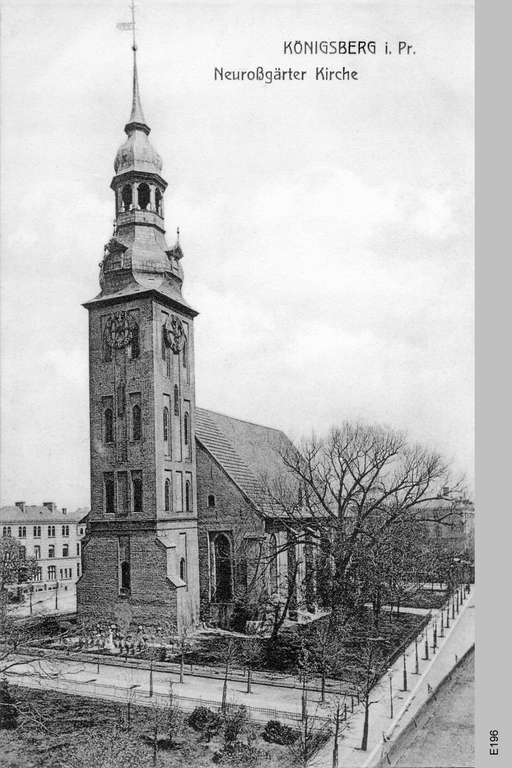
A Baroque Protestant church once rose above the Neurossgarten suburb of Königsberg, its copper steeple guiding ships long before the city became Kaliningrad.
At a glance
Neurossgarten Church served the growing Altstadt district of Königsberg from the mid-17th century. Built to relieve an overcrowded parish, it stood for roughly three centuries before war and postwar demolition erased it entirely. Nothing of the structure remains today; its memory survives only in records, drawings and photographs.
History
Church authorities approved the new parish in 1643, responding to overflow from Altstadt Church. Construction began on 31 May 1644 in the Neurossgarten suburb. The Altstadt pastor Martin Wolder dedicated the finished building on 5 December 1647. Its steeple, completed in 1695, cost 30,000 guilders and rose 90 metres, making the church the tallest structure in Königsberg for generations. A turret clock followed in 1697. Georg Sigismund Caspari built the organ between 1734 and 1737. Lightning struck the steeple in 1817, prompting the addition of a rod. From 1782 the future Protestant archbishop Ludwig Ernst von Borowski served as pastor here, and in 1907 sculptor Stanislaus Cauer added a bust of him to the northern exterior. Allied bombing in 1944 and the 1945 Battle of Königsberg left the building badly damaged. Soviet authorities cleared the remaining ruins in 1975.
What you see
The church had no choir. A wide hall carried a wooden barrel ceiling, decorated with lunettes and, notably, a painted 17th-century scheme depicting biblical scenes. Light would have played across carved surfaces inside. The pulpit, dated 1648 and made by an unknown master, showed expressive figures alongside a Salvator Mundi. A crucifix on the gallery near the chalice side was designed by Isaak Riga the Younger together with his father. The baptismal chamber portrayed Christ as a friend to children and included images of seven virtues. Nearby stood a confessional from 1662 and, from 1666, an angel holding a hand towel, carved by Michael Doebel the Elder. Inside hung a painting by Andreas Knorre. None of this survives above ground.
Cultural significance
For much of its existence, the church’s steeple defined the Königsberg skyline and served sailors as a navigational landmark. Its interior brought together several generations of regional sculptors and painters, from the Riga family to Doebel and Knorre. The tenure of Ludwig Ernst von Borowski linked the building to a significant figure in Prussian Protestant history. Today the church stands as one marker among many of Königsberg’s vanished built heritage, its loss tied directly to the city’s wartime destruction and postwar transformation into Kaliningrad.
Key facts
- Location: former Neurossgarten suburb, Königsberg (now Kaliningrad, Russia)
- Construction began: 31 May 1644
- Dedicated: 5 December 1647
- Style: Baroque
- Steeple height: 90 metres, completed 1695
- Organ built by Georg Sigismund Caspari, 1734–1737
- Destroyed: bombing of 1944, Battle of Königsberg 1945; ruins demolished 1975
Practical information & getting there
No trace of the church remains at its former site in present-day Kaliningrad. Visitors interested in Königsberg’s lost churches will find the area absorbed into the modern city, with no marker or ruin to visit. Those researching the site may rely on archival photographs and historical maps rather than an on-site visit.
Sources & resources
Find it on the map
See this place and what’s around it →📷 Become a Cultural Heritage Online photographer
Share your photos of places: they stay published under your name as the author. The more they're seen, the more you get noticed — and soon a contest will reward the most appreciated photos.
Log in or sign up free to add a photoIs this page about you?
This page is read by travellers and heritage enthusiasts who find it on Google. Tell us how you are connected to this place and we will take it from there.