
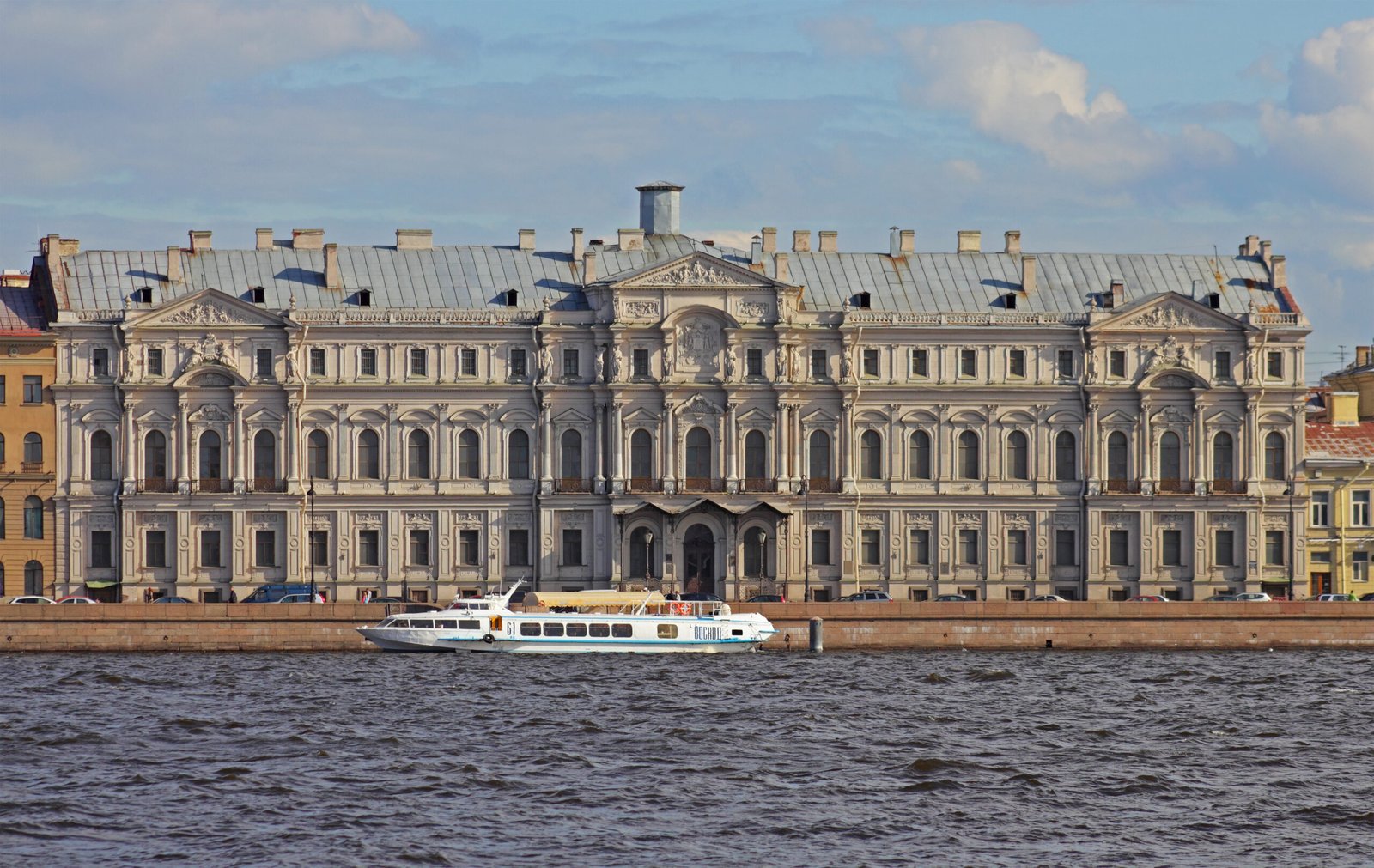
On the Palace Embankment, wedged between the Hermitage and the Marble Palace, Andrei Stackenschneider’s third grand-ducal commission mixes Renaissance, Baroque, and Louis XVI quotations behind a Carrara-marble façade.
At a glance
Built 1857–1862 for Grand Duke Michael Nikolaevich, the New Michael Palace was the last of three Saint Petersburg residences Stackenschneider designed for the children of Nicholas I. Its riotous Rococo-Renaissance-Baroque façade conceals interiors that were, by the standards of the day, technically advanced: metal roof rafters, air heating, and indoor plumbing. Today it houses the Institute of Oriental Manuscripts, custodian of roughly a million Oriental books and manuscripts.
History
The commission followed Michael Nikolaevich’s wedding to Cecilie of Baden on 18 August 1857. A residence befitting a grand duke needed a central address. The site chosen sat almost opposite the Peter and Paul Fortress, across the Neva. Older structures on the plot were cleared, a routine practice in the capital at the time. Construction ran five years and cost 993,525 rubles. The palace was electrified in 1889. After the Revolution it briefly housed a branch of the Communist Academy; since 1949 it has belonged to the Institute of Oriental Studies and its successor bodies. A major restoration between 2005 and 2009 secured the building’s survival, and the former stables were later rebuilt, with funding from Qaboos bin Said al Said, to store the institute’s manuscript collection.
What you see
The main façade, facing the embankment, is organized around three risalites topped by pediments, the central one raised above its neighbours. Terracotta figures by David Jensen animate the upper storey: caryatids in varied poses support gables and cornices, flanking a marble coat of arms and the Grand Duke’s monogram. Corinthian pilasters and columns divide the ground level, their rhythm continued upward by more caryatids. Inside, the Grand Staircase is marble; one of its walls is glass, opening a view onto the Winter Garden below. State rooms on the first floor include an oak Dining Room with a carved fireplace and leather-clad walls, and a double-height Dance Hall ringed by a two-tiered Corinthian colonnade. A private bathing room, since lost, once had walls of pink imitation marble and dolphin-figured doors. The Equerry Wing along Millionnaya Street is quieter in decoration, its curved Italianate façade rooted in an earlier Baroque palace attributed to Pyotr Yeropkin.
Cultural significance
The palace records a moment when Saint Petersburg’s imperial architecture absorbed new building technology without abandoning historicist ornament. Its house church, consecrated in December 1861 to the Archangel Michael, once bore murals “with golden arabesques on a blue background” by A. E. Beideman. Nationalised and closed in 1917, the church lost its iconostasis, its murals, and its gilded cupola. What remains is a shell of ceremonial rooms repurposed for scholarship. As home to the Institute of Oriental Manuscripts, the building now serves a mission distant from its origin: preserving texts rather than hosting court life.
Key facts
- Location: Palace Embankment, Saint Petersburg, Russia
- Built: 1857–1862
- Architect: Andrei Stackenschneider
- Style: Rococo, with Renaissance, Baroque and Louis XVI elements
- Sculptor: David Jensen (terracotta façade figures)
- Painters: Michael Zichy, N. I. Tikhobrazov, A. E. Beideman (house church)
- Current occupant: Institute of Oriental Manuscripts
- Restoration: 2005–2009
- Heritage status: Listed
Practical information & getting there
The palace stands on Palace Embankment between the Hermitage complex and the Marble Palace, an easy walk from Palace Square. As it functions as a research institute rather than a museum, interior access is limited; check ahead before planning a visit inside. The exterior, especially the marble risalites and caryatid friezes, rewards a slow walk along the embankment at any time of day.
Sources & resources
Find it on the map
See this place and what’s around it →📷 Become a Cultural Heritage Online photographer
Share your photos of places: they stay published under your name as the author. The more they're seen, the more you get noticed — and soon a contest will reward the most appreciated photos.
Log in or sign up free to add a photoIs this page about you?
This page is read by travellers and heritage enthusiasts who find it on Google. Tell us how you are connected to this place and we will take it from there.