
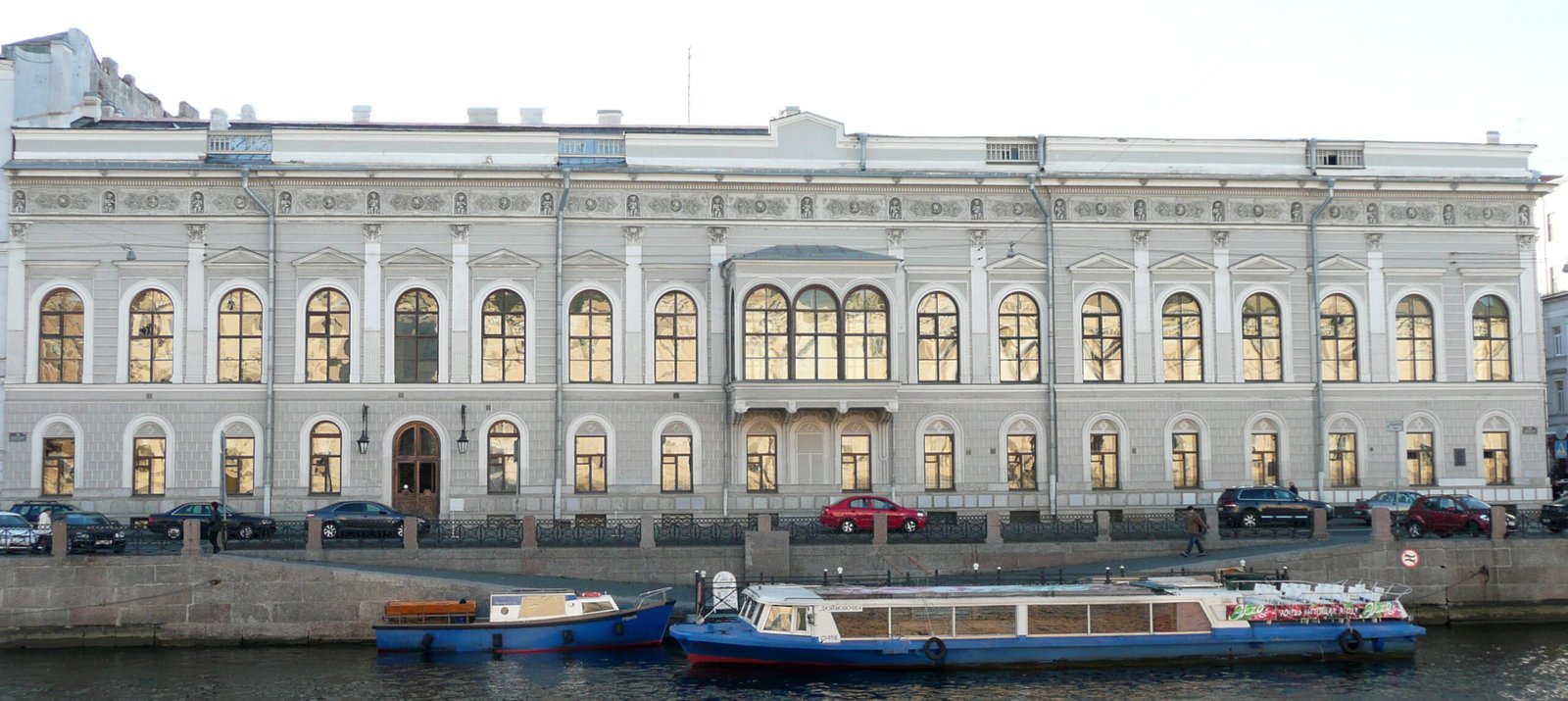
A Neoclassical palace on the Fontanka Embankment, once the glittering stage for imperial society, now home to the Fabergé Museum.
At a glance
Built around 1790, possibly to a design by Giacomo Quarenghi, the palace passed from the Vorontsov family to the Naryshkins and later the Shuvalovs. It stands heritage-listed today. Since 2013 it has housed the Fabergé Museum, giving the building a second life as one of the city’s most visited cultural sites.
History
The exact circumstances of construction are lost to record. What survives is the outline: a late 18th-century Neoclassical house on the Fontanka, first owned by Count and Countess Vorontsov. In 1799, Maria Naryshkina bought it. Her husband Dmitri filled the rooms with marble, gems, coins and weapons, turning the palace into the center of Saint Petersburg society. The White Column Hall hosted balls for up to a thousand guests, including a famous 1834 celebration for the future Alexander II’s sixteenth birthday. A major mid-century renovation, tied to the 1846 marriage of Sofia Naryshkina to Count Pyotr Shuvalov, reworked the interiors in neo-Renaissance style under Bernard de Simone and Nikolai Yefimov, continuing until 1859. War arrived twice. In 1914 the last owner, Yelizaveta Shuvalova, converted the house into a military hospital; the ballroom became an officers’ ward. Nationalized in 1918, the palace later gave up hidden troves of art, discovered as late as 1919 beneath a fireplace in the Blue Room. It briefly held a “Museum of Aristocratic Life,” then served as a print house and design institute. Siege-era bombing in 1941 destroyed the courtyard wing and gutted the Alexander Hall by fire.
What you see
The exterior reads as restrained Neoclassicism along the Fontanka. Inside, the story is layered. Nineteenth-century neo-Renaissance decoration overlays the original 18th-century plan, the result of decades of renovation rather than a single design campaign. The White Column Hall remains the emotional center, its scale still legible as a room built for hundreds of dancing guests. Damage from 1941 means much of what stands has been repaired or rebuilt, a fact worth noticing rather than hiding.
Cultural significance
Few buildings compress so much of Russia’s social and political history into one address. The palace witnessed the private world of a tsar’s mistress, a noble wedding that renamed the house, and the violent end of aristocratic Petersburg. Its post-revolutionary afterlife as a museum of “aristocratic life” is a rare, almost self-aware artifact of Soviet cultural policy. Today’s Fabergé Museum continues that museological thread, filling rooms once stripped of their treasures with another era’s decorative artistry.
Key facts
- Location: Fontanka Embankment, Saint Petersburg, Russia
- Style: Neoclassical architecture
- Constructed: circa 1790, possibly by Giacomo Quarenghi
- Major renovation: 1844–1859, by Bernard de Simone and Nikolai Yefimov
- Nationalized: 1 August 1918
- Current use: Fabergé Museum, since 2013
- Heritage status: Listed
Practical information & getting there
The palace sits on the Fontanka Embankment in central Saint Petersburg, an easy walk from the city’s main historic core. You can visit the interior as part of the Fabergé Museum, which occupies the building and displays its collection within the restored halls. Check current opening times and ticketing before arriving, as museum hours vary by season.
Sources & resources
Find it on the map
See this place and what’s around it →📷 Become a Cultural Heritage Online photographer
Share your photos of places: they stay published under your name as the author. The more they're seen, the more you get noticed — and soon a contest will reward the most appreciated photos.
Log in or sign up free to add a photoIs this page about you?
This page is read by travellers and heritage enthusiasts who find it on Google. Tell us how you are connected to this place and we will take it from there.