
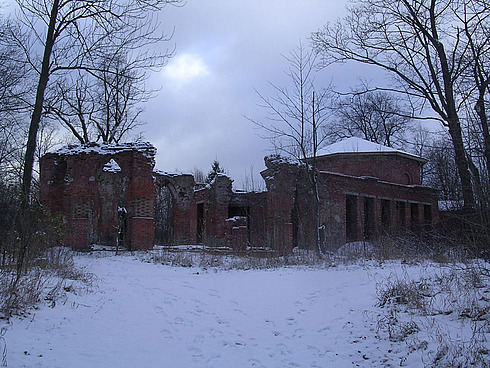
A ruined Gothic Revival retreat on the edge of Babolovsky Park, remembered chiefly for the colossal granite bath still lodged in its broken shell.
At a glance
Babolovo, sometimes called Babolovka, began as a private dacha gifted by Catherine II to Prince Potemkin in 1780. Ilya Neyelov rebuilt it in stone between 1782 and 1785. Vasily Stasov later reworked it for Alexander I. Today it stands roofless and empty, its most famous feature a single monolithic bath.
History
Catherine II granted Potemkin land adjoining the Catherine and Alexander Parks in 1780. A wooden palace went up first, built for discreet meetings. Construction on its stone replacement started on 2 November 1782, to Neyelov’s design. The one-storey house rose on a hill above the Silver Pond, asymmetrical in plan. Alexander I later used the palace for his own liaisons, with Sophia Velho, a banker’s daughter. He commissioned Stasov to remodel it. Engineer Agustín de Betancourt oversaw the installation of a new granite bath before the surrounding walls were even finished. After 1917 the estate fell into neglect. It has never been restored.
What you see
Two main volumes converge at an angle, joined by an octagonal tower under a hipped roof. Neo-Gothic detailing runs through the façades. Parapets mimic battlements. Red brick walls were plastered white and rusticated, save for the anteroom and bathroom pavilion, left bare. The plinth and cornices use light Putilov stone, with door and window surrounds finished in either painted plaster or pale Pudost stone. Under Stasov’s remodeling, the octagonal tower was removed to make way for the bath chamber. What replaced it is astonishing: a single block of red granite, hollowed into a tub, 196 centimetres high and weighing 48 tons. It still sits in situ, exposed to the elements.
Cultural significance
Babolovo’s fame rests less on its architecture than on that bath. Pushkin referenced the granite basin in one of his earliest poems, folding an imperial curiosity into Russian literary memory. The palace also documents the private, unofficial architecture of Tsarskoe Selo, spaces built for romance rather than ceremony. Its decline mirrors the fate of many minor imperial structures after 1917. The surviving fragments, an 1770s aqueduct and Adam Menelaws’ gate between the two parks, hint at a much larger landscape now mostly vanished.
Key facts
- Location: Babolovsky Park, Tsarskoe Selo, Russia
- Style: Gothic Revival
- Architects: Ilya Neyelov (1782–1785); remodeled by Vasily Stasov
- Notable feature: the “Tsar Bath,” a 48-ton red granite monolith, 196 cm high
- Engineer of the bath installation: Agustín de Betancourt
- Condition: ruined, unrestored since the Russian Revolution
- Heritage status: listed
Practical information & getting there
Babolovsky Park lies south of the main Tsarskoe Selo ensemble, within the wider Pushkin district near Saint Petersburg. The park covers roughly 300 hectares, largely wooded and informal. You should expect no signage, ticket office, or restored interiors; the palace is a ruin, viewed from outside. Sturdy footwear helps, since paths around the Silver Pond can be uneven. Combine a visit with the better-known Catherine and Alexander Parks nearby, entering through Menelaws’ surviving gate where the estates meet.
Sources & resources
Find it on the map
See this place and what’s around it →📷 Become a Cultural Heritage Online photographer
Share your photos of places: they stay published under your name as the author. The more they're seen, the more you get noticed — and soon a contest will reward the most appreciated photos.
Log in or sign up free to add a photoIs this page about you?
This page is read by travellers and heritage enthusiasts who find it on Google. Tell us how you are connected to this place and we will take it from there.