
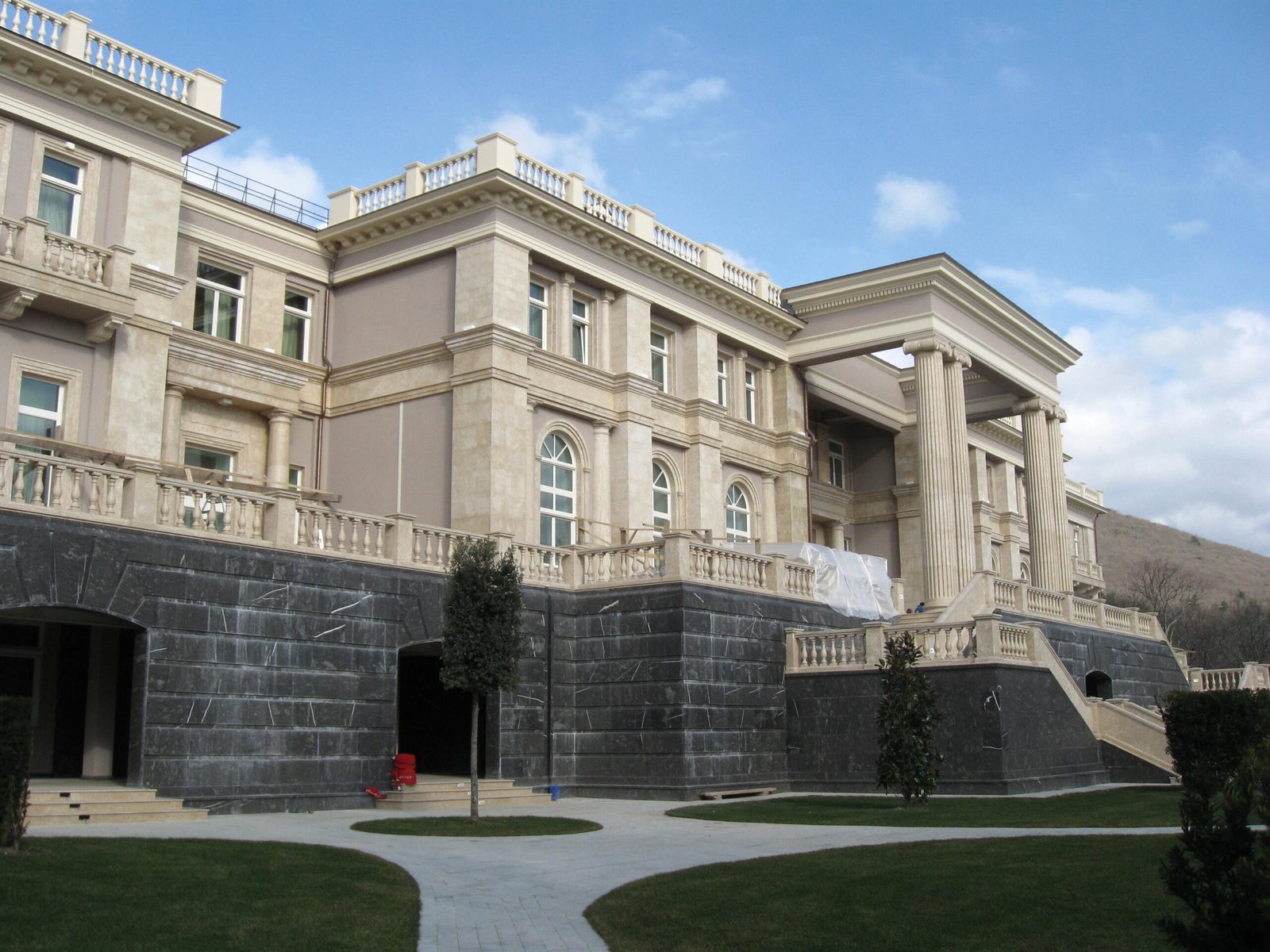
On a forested headland above the Black Sea sits an Italianate complex of disputed ownership, known to the world through leaked photographs and a whistleblower’s letter rather than any official tour.
At a glance
Perched on Cape Idokopas near the village of Praskoveyevka, the complex occupies some 74 hectares of cliff-lined pine forest overlooking the sea. Its main house alone covers 17,700 square metres. Designed by Italian architect Lanfranco Cirillo, construction began in 2005 under a state investment agreement and has continued, in various forms, ever since.
History
Work started quietly. In June 2005 Russia’s Presidential Property Management Department signed an agreement with several state and private entities to build a “boarding house” near Gelendzhik. By 2008 a federal security unit had taken over as client. Eco-activists first noticed a fenced construction site advertised as a children’s camp.
The project entered public consciousness in December 2010, when St. Petersburg businessman Sergei Kolesnikov posted an open letter to President Dmitry Medvedev. He described a financing scheme running through the company Petromed and later Rosinvest, allegedly steered by Putin ally Nikolai Shamalov for Putin’s benefit. No reply ever came. A 2014 Reuters investigation traced diverted healthcare funds into the same construction. The story exploded again in 2021, when Alexei Navalny’s Anti-Corruption Foundation released a documentary estimating the build’s cost above 100 billion rubles and reconstructing interiors from photographs and 3D models. Arkady Rotenberg later claimed ownership; the Kremlin insists the property belongs to unnamed private businessmen.
What you see
The scale is theatrical. Reported features include an indoor pool with an “aquadiscotheque,” Turkish baths, a wine cellar, a theatre, a casino, a hookah lounge, and roughly a dozen guest bedrooms. The master bedroom alone measures 260 square metres. Beyond the main house stand an arboretum, a greenhouse, a helipad, an ice palace, a church, an amphitheatre, a guest “tea house,” and an 80-metre bridge. A tunnel bored into the mountain leads to a private tasting room. Investigators noted heavy gilding and repeated double-headed eagle motifs throughout the interiors.
Cultural significance
Few buildings anywhere carry so much political weight while remaining officially unnamed. The palace has become shorthand, in Russian opposition discourse, for elite enrichment shielded by state secrecy. Its no-fly zone, justified by the FSB as border protection, only sharpened public curiosity. In 2024, reporting by Proekt described entertainment spaces such as the casino and a miniature-railroad room being converted into lounges and a chapel dedicated to Saint Volodymyr of Kiev — a quiet, telling revision of the building’s public face.
Key facts
- Location: Cape Idokopas, near Gelendzhik, Krasnodar Krai, Russia
- Architect: Lanfranco Cirillo
- Style: Italianate architecture
- Construction began: 2005
- Site area: approximately 74 hectares
- Main house area: 17,700 square metres
Practical information & getting there
There is no public access. The complex sits within a restricted no-fly zone patrolled by Russian federal security services, and the surrounding waters are hazardous due to an offshore reef. What is known of the palace comes entirely from leaked photographs, investigative journalism, and archival documents, not from any visitor experience.
Sources & resources
Find it on the map
See this place and what’s around it →📷 Become a Cultural Heritage Online photographer
Share your photos of places: they stay published under your name as the author. The more they're seen, the more you get noticed — and soon a contest will reward the most appreciated photos.
Log in or sign up free to add a photoDo you manage this place?
This page is read by travellers and heritage enthusiasts who find it on Google. Keep it accurate — and make it work for you. Free for non-profit heritage institutions.