
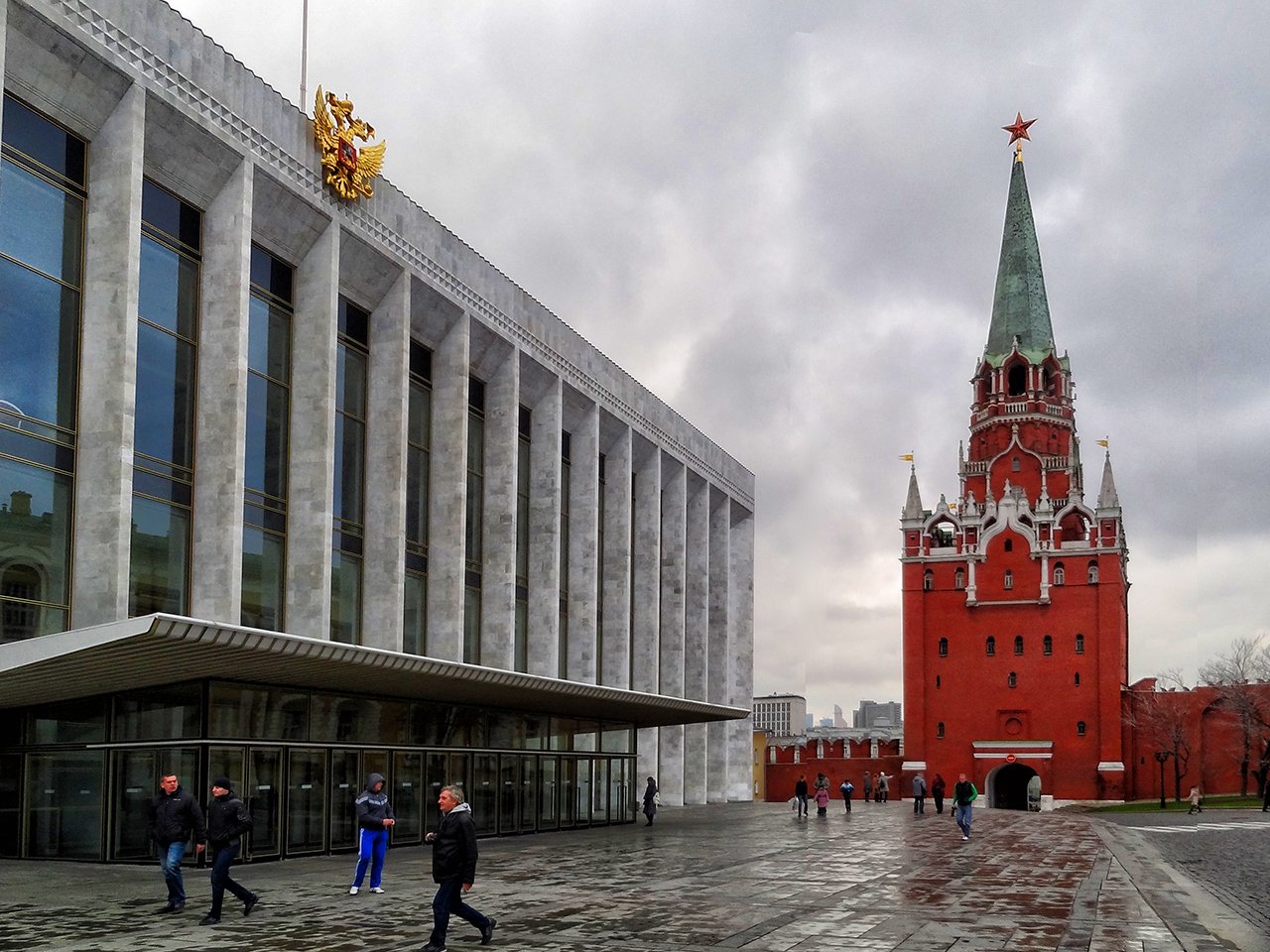
A glass-and-marble intrusion into the Kremlin’s medieval skyline, built by Khrushchev’s order to house Communist Party congresses and now given over to concerts.
At a glance
Raised between 1959 and 1961 inside the Kremlin walls, the State Kremlin Palace was conceived as a modern arena for Soviet political theatre. Designed by architects Mikhail Posokhin, Ashot Mndoyants, Evgeny Stamo and Pavel Shteller in a Soviet Modernist idiom, it stands apart from the fortress’s onion domes and brick towers. Today it functions mainly as a concert hall.
History
Nikita Khrushchev wanted a stage worthy of the Communist Party’s twenty-second congress. To get it, planners cleared away older Kremlin structures, including the neoclassical State Armoury building and rear sections of the Great Kremlin Palace. The Chudov and Ascension cloisters had already been razed under Stalin. New laws by the mid-1950s barred demolition of historic buildings, which made this project contentious, arguably illegal by its own government’s rules. Work still went ahead, and the hall opened on October 17, 1961, timed to the 22nd Congress. For decades it hosted the great set-piece gatherings of Soviet political life. Its use has since shifted entirely toward performance, with Mariah Carey, Tina Turner, Cher, A-ha and Leonard Cohen all having played there.
What you see
Nearly half the building sits below ground, sunk 17 metres so as not to overwhelm its historic neighbors. White Ural marble sheathes the exterior, paired with anodised aluminium and tinted, reflective glass that throws back distorted images of the older Kremlin architecture nearby. The volume is enormous, some 40,000 cubic metres, holding more than 800 rooms behind a rectangular envelope. At the center sits an auditorium seating 6,000, once a congress hall and now a concert venue. Inside, red Karbakhta granite, Koelga marble, patterned Baku tuff and varied woods line the halls. Architectural historian Andrey Ikonnikov described a “shimmering construction of space” in the transitions between foyer and lobbies, a nod to 1920s Soviet avant-garde experiments. Artist Alexander Deineka contributed mosaic emblems for the banquet hall and a frieze for the foyer. A gilded Soviet emblem by sculptor Alexei Zelenski once crowned the main entrance; it was later replaced by the coat of arms of the Russian Federation.
Cultural significance
Few buildings so bluntly announce a political rupture. Its modernist glass and concrete sit against centuries of masonry, a deliberate architectural argument for Soviet progress within a sacred precinct. The palace later became fixed in fiction as well as fact: Tom Clancy’s 1986 novel Red Storm Rising imagines it bombed in a false-flag operation blamed on West Germany, used as a fictional meeting place for the Council of Ministers. That the building could stand in for Soviet governmental authority in popular imagination speaks to how thoroughly it displaced older symbols of Kremlin power for much of the twentieth century.
Key facts
- Location: Moscow Kremlin, Russia
- Built: 1959–1961
- Architects: Mikhail Posokhin, Ashot Mndoyants, Evgeny Stamo, Pavel Shteller
- Style: Soviet Modernist architecture
- Auditorium capacity: approximately 6,000 seats
- Volume: about 40,000 m³, over 800 rooms
- Heritage status: listed
Practical information & getting there
The palace stands within the Moscow Kremlin complex, reachable via the Kremlin’s designated visitor entrances near Red Square. Access depends heavily on scheduled events, as the building functions today as a working concert and event venue rather than a standing museum exhibit. Check the official site before planning a visit, since programming and entry rules change with each performance.
Sources & resources
Find it on the map
See this place and what’s around it →📷 Become a Cultural Heritage Online photographer
Share your photos of places: they stay published under your name as the author. The more they're seen, the more you get noticed — and soon a contest will reward the most appreciated photos.
Log in or sign up free to add a photoIs this page about you?
This page is read by travellers and heritage enthusiasts who find it on Google. Tell us how you are connected to this place and we will take it from there.