
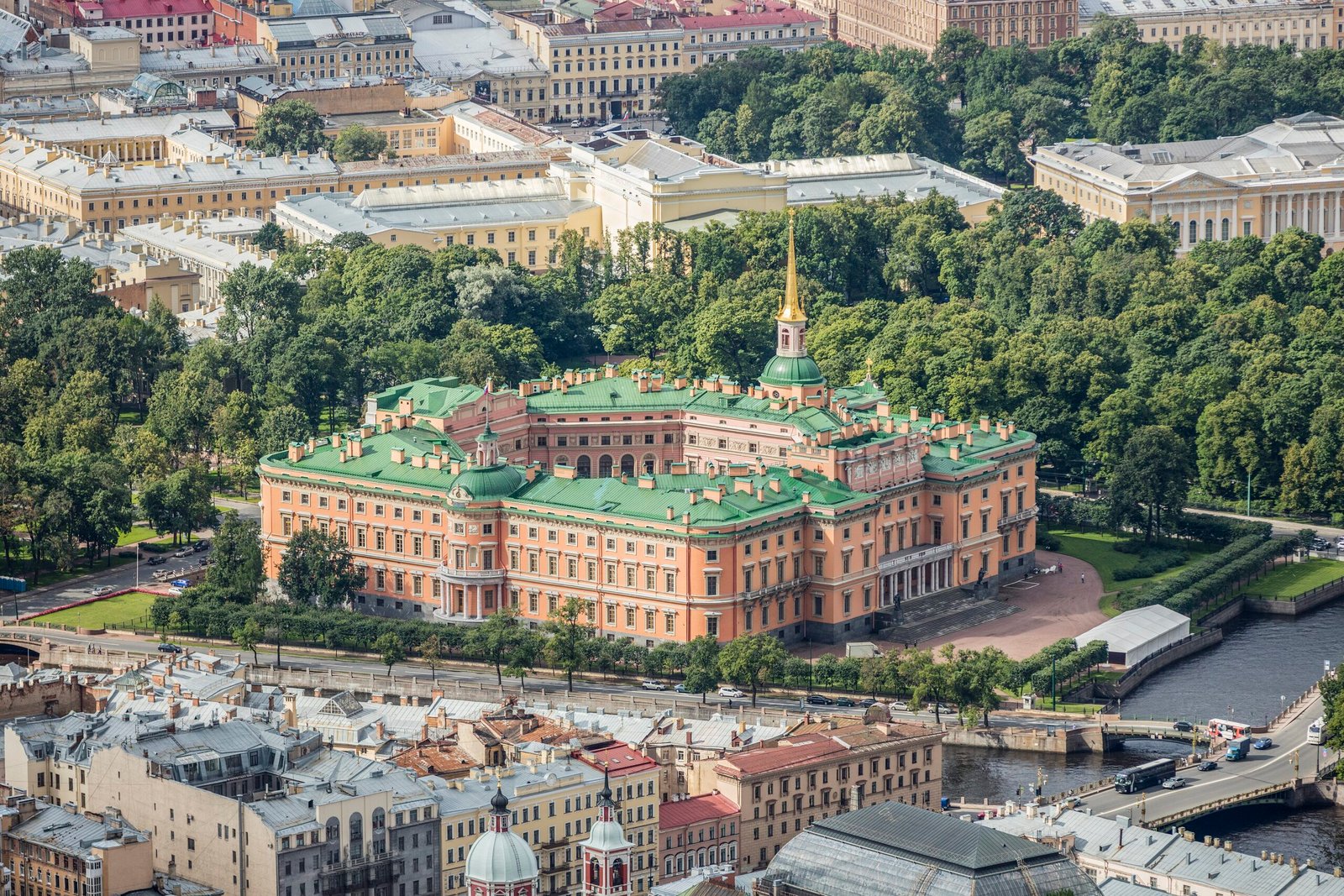
A fortress-like imperial residence built for Emperor Paul I, this anomalous palace combines French, Italian and Gothic motifs within a moated compound designed to shield its paranoid occupant from assassination.
At a glance
Saint Michael’s Castle stands in central Saint Petersburg as a singular work of imperial paranoia. Architects Vincenzo Brenna and Vasily Bazhenov designed it to resemble a medieval fortification rather than the palatial grandeur typical of Russian royal residences. Surrounded by waters and connected only by drawbridges, the castle embodied Emperor Paul I’s obsessive fear of conspiracy.
History
Construction began on 26 February 1797, replacing Empress Elizabeth Petrovna’s wooden palace south of the Summer Garden. Paul I commissioned the fortress after decades of unease in the Winter Palace, where he felt perpetually unsafe. The castle was solemnly consecrated on 8 November 1800—St Michael’s Day in the Orthodox calendar—though interior work continued until March 1801.
Tragedy followed swiftly. On 12 March 1801, only 40 nights after Paul I moved in, a group of dismissed officers led by General Bennigsen murdered him in his bedroom. The conspirators forced him to sign his abdication; when he resisted, they struck him with a sword, strangled and trampled him to death. His son Alexander I succeeded him and learned of his accession from General Zubov, one of the assassins, while present in the palace.
After Paul’s death, the imperial family abandoned the castle for the Winter Palace. In 1823, the army converted it into the Main Engineering School, establishing its alternative name: the Engineers’ Castle. From the early 1990s, it served as a branch of the Russian Museum, displaying its renowned Portrait Gallery of emperors and dignitaries from the 17th to early 20th centuries.
What you see
The castle’s distinctive silhouette shifts with each facade. Brenna and Bazhenov deliberately mixed architectural vocabularies—French Classicism, Italian Renaissance, and Gothic elements—refusing stylistic consistency. Rounded corner towers and crenellated walls evoke medieval fortifications rather than neoclassical restraint.
An octagonal courtyard lies at its heart, surrounded by the Moika and Fontanka rivers plus two specially excavated canals—the Church and Sunday canals—creating an artificial island. Drawbridges provided the sole means of entry, transforming the castle into a literal stronghold.
Before the castle stands Bartolomeo Rastrelli’s bronze equestrian Monument to Peter the Great, cast in 1747. The pedestal bears the inscription “From Great Grandson to Great Grandfather” and bas-reliefs depicting Russian victories over Sweden during the Great Northern War.
Cultural significance
Saint Michael’s Castle remains a unique artifact of its era—less a celebration of imperial power than an architectural expression of psychological disturbance. Paul I’s fortress betrays the paranoia and medieval fascination that defined his brief, turbulent reign. Its very existence testifies to the interior anxieties of absolute monarchy.
Key facts
- Country: Russia
- City: Saint Petersburg
- Architects: Vincenzo Brenna and Vasily Bazhenov
- Construction: 1797–1801
- Consecrated: 8 November 1800
- Coordinates: 59.9404°N, 30.3377°E
Practical information & getting there
The castle occupies a central location in Saint Petersburg’s historic district. A branch of the Russian Museum has occupied the building since the early 1990s. Major renovation work began in 1991 and was expected to conclude in 2024. Consult the Russian Museum website for current visiting hours and exhibition details.
Sources & resources
Find it on the map
See this place and what’s around it →📷 Become a Cultural Heritage Online photographer
Share your photos of places: they stay published under your name as the author. The more they're seen, the more you get noticed — and soon a contest will reward the most appreciated photos.
Log in or sign up free to add a photoIs this page about you?
This page is read by travellers and heritage enthusiasts who find it on Google. Tell us how you are connected to this place and we will take it from there.