
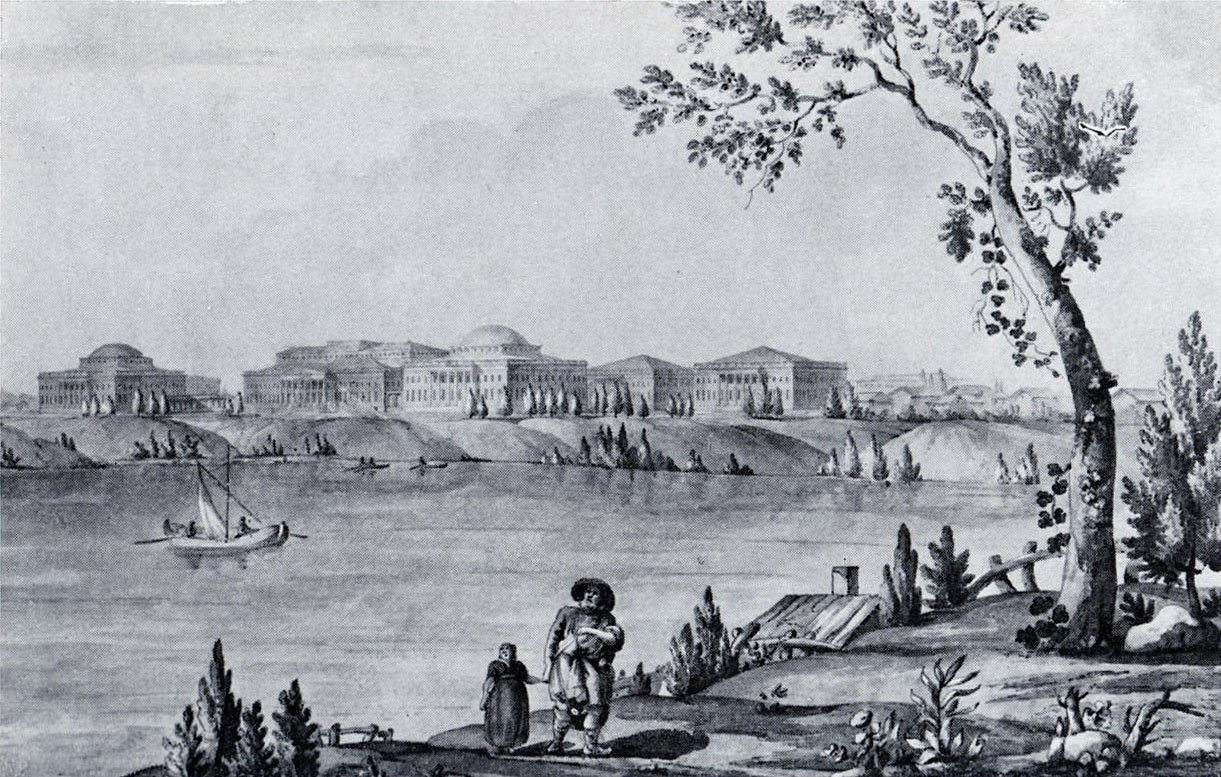
Catherine the Great’s vanished monument to her grandson’s destiny, a Neoclassical palace so vast it was never finished, and so resented by her son that he had it torn down within a decade.
At a glance
Pella Palace stood on the left bank of the Neva, roughly 30 km east of Saint Petersburg, on land now occupied by the town of Otradnoye. Begun in 1785 to a Neoclassical design by Ivan Starov, it was conceived as the largest imperial palace in Russia. Construction stopped before completion. Demolition followed soon after.
History
Catherine II adored her grandson Alexander and imagined him as a second Alexander the Great. In November 1784 she bought the estate of Ivanovskaya Myza, already fitted with a wooden manor and a modest park. She renamed it Pella in 1785, after the Macedonian king’s birthplace. Ground was broken on July 17, 1785, with Starov’s design for a palace evoking the rulers of ancient Macedon already approved that March. Giacomo Quarenghi advised throughout, and English gardener John Bush arrived in 1787 to lay out the grounds. War changed everything. The Russo-Turkish conflict of 1787–1792 halted works on November 3, 1789, after Catherine had spent 823,000 roubles. Her son Paul I, resentful of his mother’s legacy, ordered Pella demolished on December 7, 1796. Demolition began in 1797 and continued into Alexander’s own reign, with materials reused for Saint Michael’s Castle in St. Petersburg.
What you see
Nothing remains of the palace itself. Its riverside front once ran for 500 metres. Starov modeled the scheme on Étienne-Louis Boullée’s unbuilt project for Versailles, arranging a core palace encircled by eight auxiliary residences and sixteen service buildings in Palladian style, all linked by double colonnaded galleries. Nine core buildings and two galleries were finished before work stopped; the service buildings never rose at all. The project had already consumed 25 million bricks and over 1,300 cubic sazhen of granite cladding, with 350 heating ovens installed and furniture supplied by David Roentgen. One structure survives today: the former post office, also built by Starov in the 1780s, which echoed Pella’s plan in miniature with a rotunda hall and curving galleries, though later alterations added chimneys and new windows and removed most of its wings.
Cultural significance
Catherine called Pella her “rising phoenix,” a phrase meant to signal Alexander’s ascent after her death. She wrote to Melchior Grimm that her other residences were mere huts beside it. That confidence makes its erasure notable. Few images survive: some facade elevations, watercolors by Quarenghi, and a drawing on Catherine’s own fan. Pella now stands as a case study in dynastic rivalry, where architecture became a target for a son settling accounts with his mother’s memory.
Key facts
- Architect: Ivan Starov, with consultancy from Giacomo Quarenghi
- Style: Neoclassical
- Construction: 1785–1789 (partial), demolished from 1797
- Location: left bank of the Neva, near present-day Otradnoye, Russia
- Coordinates: 59.7648, 30.7733
- Heritage status: listed
Practical information & getting there
No palace survives to visit. The site lies within Otradnoye, on the Neva east of Saint Petersburg, where you can still see the surviving post-office building attributed to Starov. There are no formal visitor facilities on site, so plan this as a stop connected to broader exploration of the Ladoga region’s historic estates.
Sources & resources
Find it on the map
See this place and what’s around it →📷 Become a Cultural Heritage Online photographer
Share your photos of places: they stay published under your name as the author. The more they're seen, the more you get noticed — and soon a contest will reward the most appreciated photos.
Log in or sign up free to add a photoDo you manage this place?
This page is read by travellers and heritage enthusiasts who find it on Google. Keep it accurate — and make it work for you. Free for non-profit heritage institutions.