
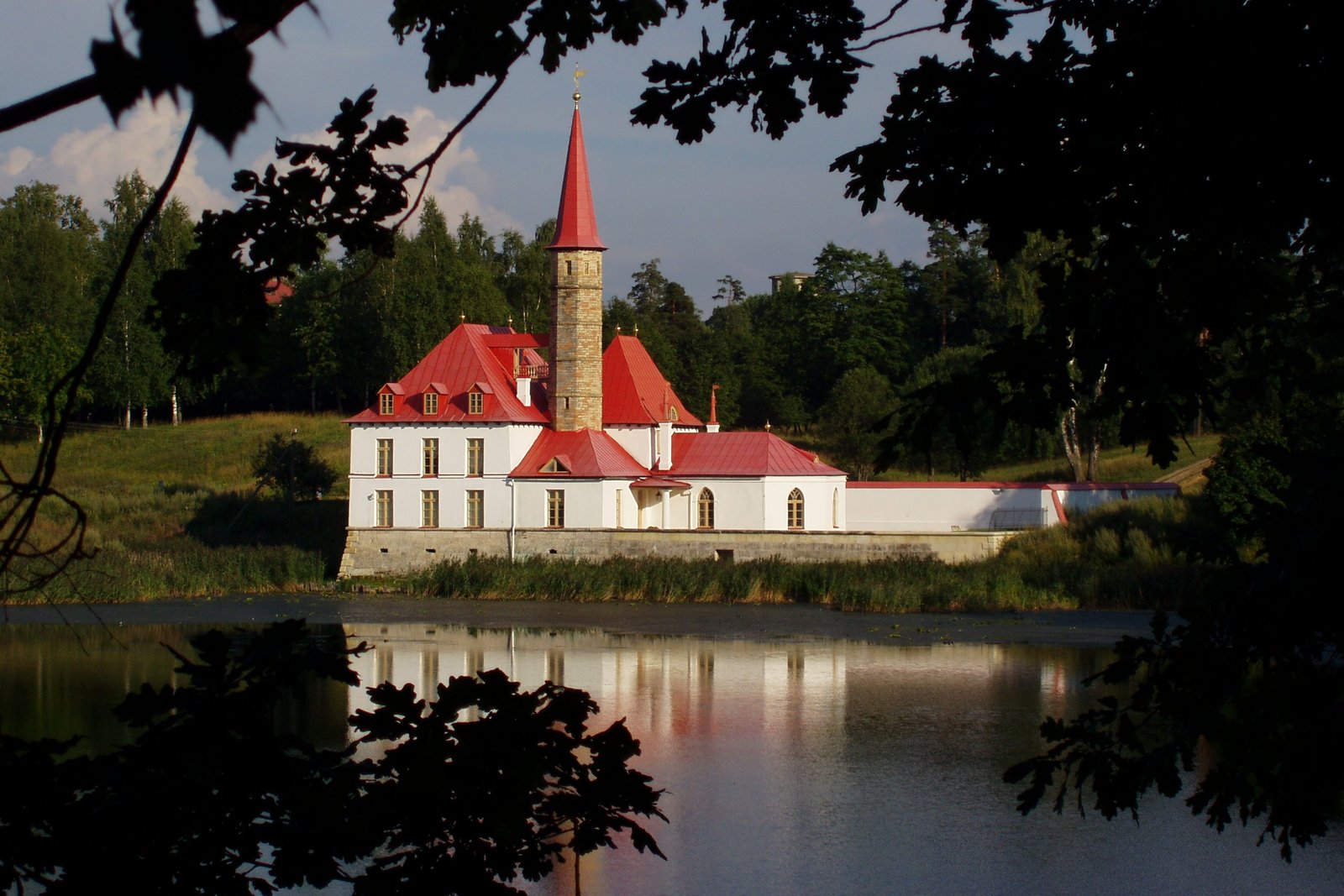
On the shore of the Black Lake near Saint Petersburg stands a palace built not of brick or stone but of compacted earth, raised for a chivalric order that would soon lose its throne.
At a glance
Priory Palace was designed by the architect and polymath Nikolay Lvov and completed around 1797–1799 in Gatchina, then a royal town outside Saint Petersburg. Paul I of Russia had it built for the Russian Grand Priory of the Order of St John, formally presenting the building to the Order by decree on August 23, 1799. It is heritage-listed today.
History
Paul I held a genuine, if brief, fascination with the Knights of Malta. He styled himself Grand Master of the Order and wanted Gatchina to house its Russian priory in fitting style. Lvov, better known for verse and for experiments in fireproof and rammed-earth construction, was given the commission. The result was unusual from the outset. It was less a conventional royal residence than a working demonstration of a building method Lvov championed elsewhere in Russia. Paul’s own tenure as Grand Master proved short-lived; his assassination in 1801 and shifting political winds curtailed the Order’s Russian ambitions, but the palace remained.
What you see
The palace is Russia’s only surviving major monument built primarily by earthwork technique. Layers of compacted loam were poured with lime mortar to form the walls, the surrounding fence, and the court outbuildings. A retaining wall along the lakeshore uses Pudost stone, the same soft, easily carved local material found throughout Gatchina’s palaces and churches. Researchers who have studied the building point to the precision of its layout and to an original compositional idea. Lvov deliberately avoided symmetry, breaking from the formal classical norms of his contemporaries. The effect is a low, irregular silhouette set against still water, closer in spirit to a picturesque folly than a palace.
Cultural significance
Priory Palace matters as much for its material as for its history. Rammed earth was, and remains, a marginal building technique in Russian architecture. That a structure using it has survived intact for over two centuries makes the building a rare technical document as well as an aesthetic one. It also stands as physical evidence of Paul I’s brief, eccentric attempt to fold a medieval Catholic military order into the fabric of the Russian court. Few other buildings anywhere tie architecture so directly to that particular episode of European dynastic and religious politics.
Key facts
- Location: Gatchina, Leningrad Oblast, Russia, on the shore of the Black Lake
- Architect: Nikolay Alexandrovich Lvov
- Built: circa 1797–1799
- Commissioned for: the Russian Grand Priory of the Order of St John, by decree of Paul I, August 23, 1799
- Notable feature: primary construction in compacted-earth (rammed earth) technique, unique in Russia
- Materials: earthwork walls with lime mortar; Pudost stone retaining wall
- Heritage status: listed monument
Practical information & getting there
Priory Palace sits within Gatchina, a short train ride from central Saint Petersburg, and forms part of the wider Gatchina Palace and Museum complex. You can combine a visit with the main Gatchina Palace and its parkland along the same lake system. Check the official museum site before travelling, since opening hours and access can change seasonally.
Sources & resources
Find it on the map
See this place and what’s around it →📷 Become a Cultural Heritage Online photographer
Share your photos of places: they stay published under your name as the author. The more they're seen, the more you get noticed — and soon a contest will reward the most appreciated photos.
Log in or sign up free to add a photoDo you manage this place?
This page is read by travellers and heritage enthusiasts who find it on Google. Keep it accurate — and make it work for you. Free for non-profit heritage institutions.