
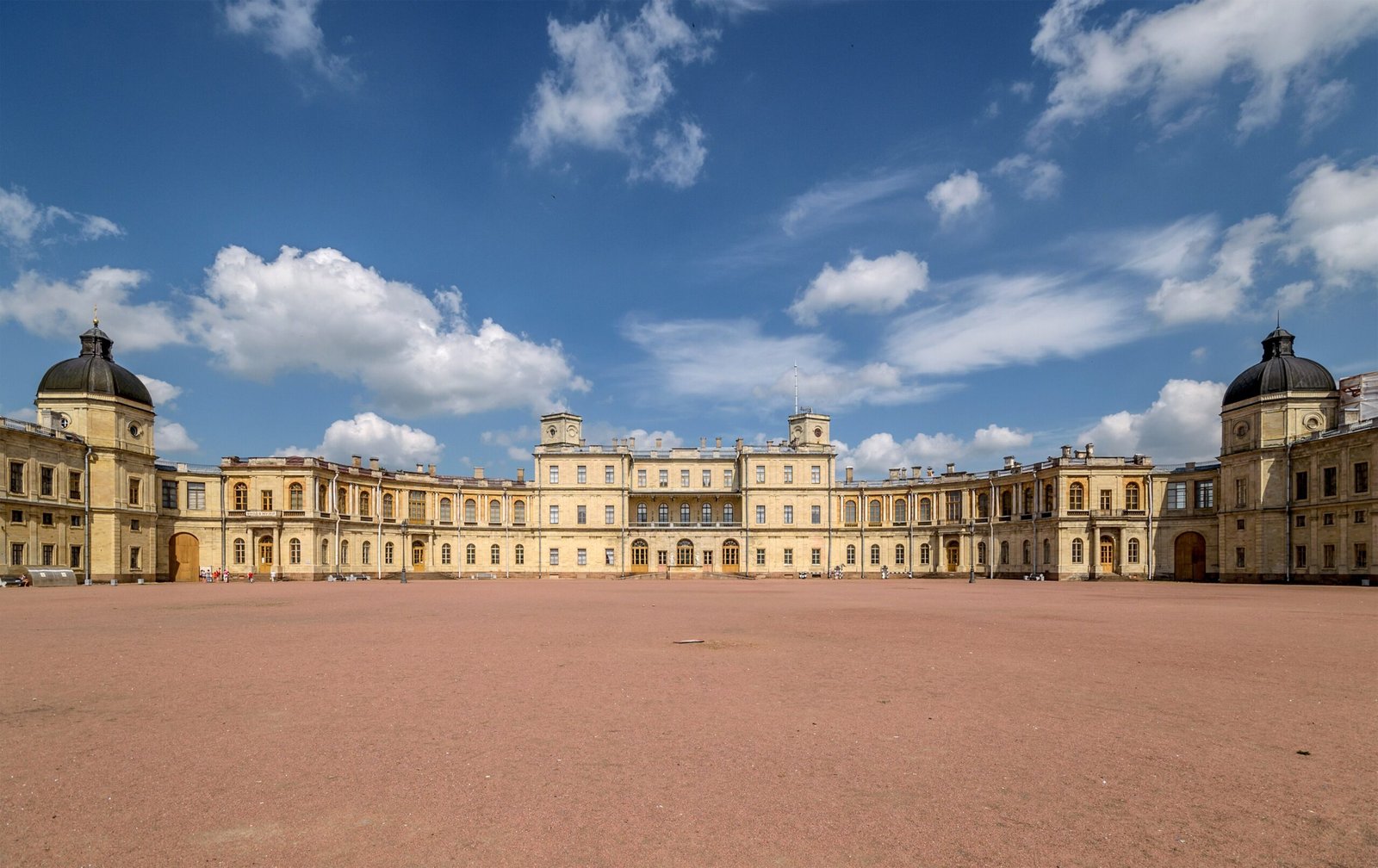
Part classical villa, part medieval castle, the Great Gatchina Palace rises above Lake Serebryany as a monument to imperial favour, later autocracy, and eventual ruin and rebirth.
At a glance
Built between 1766 and 1781 by Antonio Rinaldi for Count Grigory Orlov, the palace stands on a hill in central Gatchina, 40 kilometers south of Saint Petersburg. It later became a preferred residence of the Romanovs and, since 1917, a public museum. UNESCO recognized the site in 1990.
History
Catherine the Great gave Orlov the Gatchina estate in gratitude for his role in the coup that placed her on the throne. Rinaldi’s design fused Russian tradition with echoes of an English hunting castle. Work dragged on for fifteen years; Orlov enjoyed the finished palace only two years before his death in 1783. Catherine then bought it back and passed it to her son, the future Paul I, who expanded it with architects Vincenzo Brenna and Andrei Zakharov and named garden corners “The Isle of Love” and “The Labyrinth.” Nicholas I later ordered a sweeping mid-century reconstruction under Roman Kuzmin, raising towers and rebuilding the main square. Alexander III made it his primary home, nicknamed “The Citadel of Autocracy,” wiring it for telephones and electric light. The 1917 revolutions turned the palace into state property; art historian Valentin Zubov converted it into a museum, which opened in 1918 even as Civil War fighting reached the town.
What you see
The façades combine two local stones: pale parik limestone from Paritsy and porous pudost stone from Pudost, used for the vestibule and parapet. Towers punctuate a long, fortress-like silhouette softened by classical proportion. Inside, Neoclassical interiors from Paul’s era replaced Rinaldi’s original decoration. The parade ground once carried a marble-intended canopy, finished instead in cast iron. Nearby stands the small Priory Palace on the Black Lake, built for the Russian Grand Priory of the Order of St John.
Cultural significance
Gatchina was no mere retreat. Under Alexander III it functioned as a working seat of government, hosting decrees, diplomatic receptions, and masquerades. It shaped the childhood of Nicholas II, Russia’s last tsar. The palace’s transformation from private favourite’s gift to imperial fortress to Soviet-era museum traces the arc of Russian political history itself. Its 1990 UNESCO listing affirms that continuity.
Key facts
- Architect: Antonio Rinaldi
- Construction: 1766–1781
- Style: Classicism, with medieval castle motifs
- First owner: Count Grigory Orlov
- Museum since: 1918
- UNESCO World Heritage recognition: 1990
Practical information & getting there
Gatchina lies south of Saint Petersburg and is reachable by suburban train or road. You’ll find the palace set within its own park beside Lake Serebryany, with the Priory Palace a short walk away on the Black Lake shore. Check the official website before visiting, as museum hours and exhibition access can vary seasonally.
Sources & resources
Find it on the map
See this place and what’s around it →📷 Become a Cultural Heritage Online photographer
Share your photos of places: they stay published under your name as the author. The more they're seen, the more you get noticed — and soon a contest will reward the most appreciated photos.
Log in or sign up free to add a photoDo you manage this place?
This page is read by travellers and heritage enthusiasts who find it on Google. Keep it accurate — and make it work for you. Free for non-profit heritage institutions.