
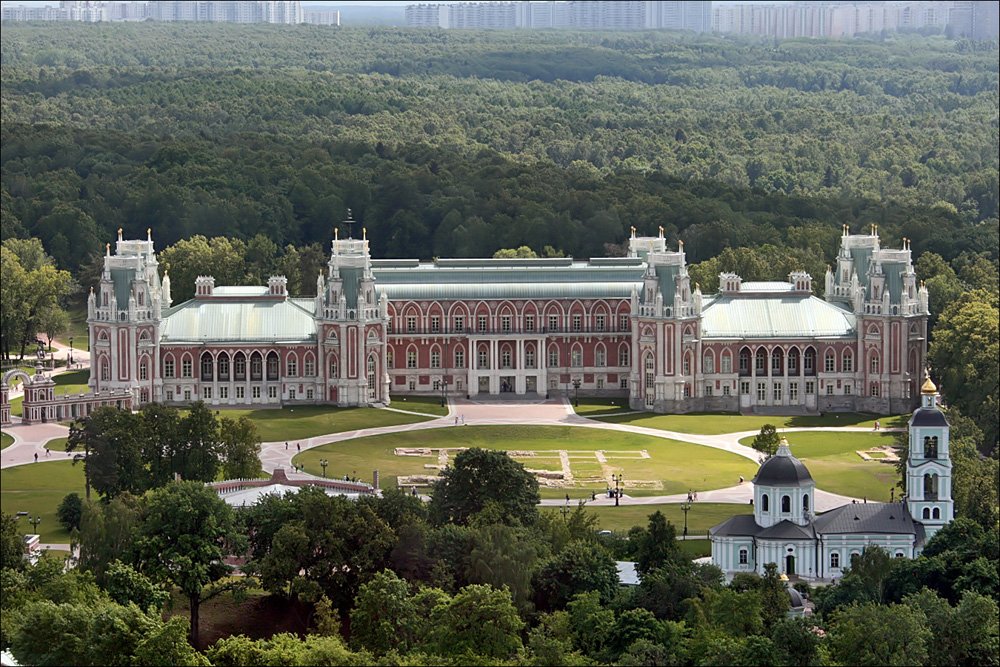
A summer residence Catherine the Great commissioned and then rejected, Tsaritsyno spent two centuries as a picturesque ruin before being rebuilt into the museum park it is today.
At a glance
Tsaritsyno is a palace and landscape park in southern Moscow, begun in 1776 for Empress Catherine II. Vasily Bazhenov designed its buildings in a mix of Neo-Gothic, Moscow Baroque and Classical forms. The empress rejected his finished work in 1785, and her replacement architect, Matvey Kazakov, never saw his own Grand Palace completed either. The site is heritage-listed and now operates as a state museum reserve.
History
The land had passed through noble hands for two centuries, including the Streshnev and Galitzine families, before Catherine bought it from Prince Cantemir in 1775. She wanted a summer residence close to Moscow and gave the commission to her court architect, Bazhenov. Construction began in May 1776 and dragged on for a decade, plagued by shortages of money and materials despite Bazhenov’s plan to finish within three years. When Catherine finally inspected the buildings in June 1785, her verdict was blunt: narrow stairs, heavy ceilings, cramped rooms, halls dark as cellars. Historians now read deeper motives into her anger. Relations with her son Paul had soured, and Bazhenov’s twin-palace layout no longer suited a court where she wanted no rival household. His Masonic ties, formalised in 1784, likely counted against him too. Bazhenov was dismissed on the spot. His former student Kazakov took over, building a single Grand Palace that stood roughly finished, under a temporary roof, when Catherine died in 1796. Paul I inspected it in 1797, disliked it, and halted all further work by decree. No emperor after Catherine lived there. The abandoned buildings crumbled into romantic ruin through the early 1800s, though under Alexander I the park opened for public walks, and architect Ivan Egotov added stone pavilions in a landscaped style. In 1860 the estate left royal ownership. A railway station opened nearby in 1865, and Tsaritsyno became a dacha colony visited by Dostoevsky, Chekhov, Tchaikovsky and other figures of the era.
What you see
Bazhenov’s design deliberately avoided a single dominant palace. Instead he scattered pavilions and outbuildings across the grounds, each an experiment in geometry. Six octagonal pavilions form a cruciform arrangement. The Small Palace curves in a semicircle. The Kitchen Building is a square with softened, rounded corners. Inside, vaulted ceilings frame round, oval and rectangular halls in careful counterpoint. Decorative stonework across the site carries lace-like patterns that scholars connect to Masonic symbolism, earning Tsaritsyno a reputation as a reference book of 18th-century Masonic emblems. Kazakov’s later Grand Palace, by contrast, consolidated the residence into one building, a very different answer to the same brief.
Cultural significance
Tsaritsyno records a rare architectural reversal at the highest level of imperial patronage. Few royal commissions were built, rejected, and rebuilt within a single reign. The site also preserves an unusually direct link to Freemasonry in Russian court architecture, visible in stone rather than archive. Its long dacha-era afterlife drew major writers and composers, folding the ruined estate into Russia’s literary and musical history well before its 21st-century restoration.
Key facts
- Location: southern Moscow, Russia
- Original architect: Vasily Bazhenov
- Construction began: 1776
- Style: Gothic Revival, alongside Moscow Baroque and Classical elements
- Second architect: Matvey Kazakov, appointed 1786
- Heritage status: listed
Practical information & getting there
Tsaritsyno sits within reach of central Moscow via the Tsaritsyno metro and rail station, a legacy of the line opened in 1865. You can walk the restored palace buildings and the wider landscape park, which still carries traces of its long ruined period alongside the 2000s reconstruction. Check the official museum site before visiting for current opening times and exhibitions.
Sources & resources
Find it on the map
See this place and what’s around it →📷 Become a Cultural Heritage Online photographer
Share your photos of places: they stay published under your name as the author. The more they're seen, the more you get noticed — and soon a contest will reward the most appreciated photos.
Log in or sign up free to add a photoIs this page about you?
This page is read by travellers and heritage enthusiasts who find it on Google. Tell us how you are connected to this place and we will take it from there.