
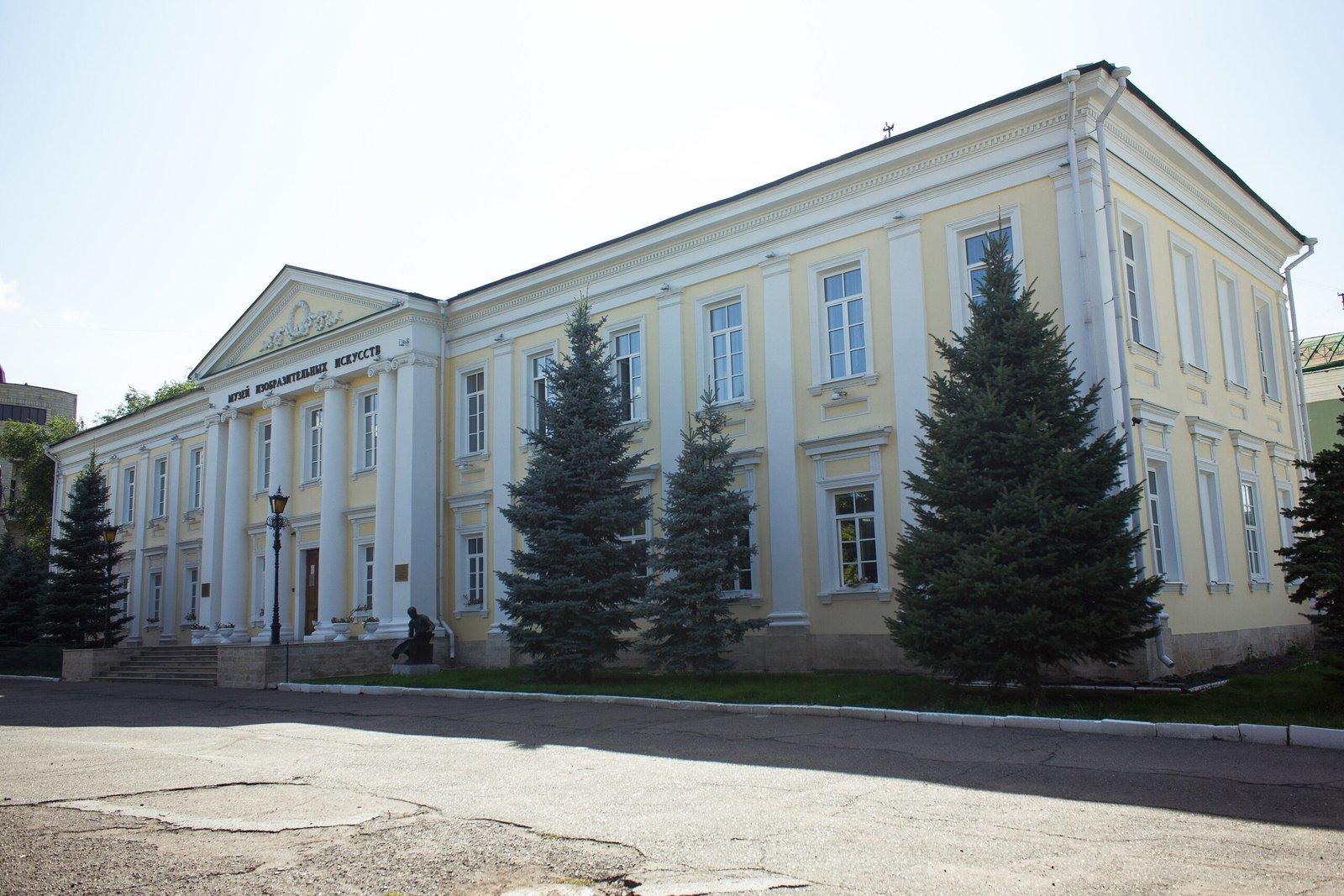
A provincial art museum built on the private holdings of one Russian academician, housed since 1961 in a classicist building from 1814.
At a glance
The Orenburg Regional Museum of Fine Arts opened its doors in 1961, a year after its founding was set in motion. It occupies a building raised in 1814 in the restrained Russian classicism typical of provincial governance and merchant architecture of that era. Inside, the collection spans Soviet, Russian, and Western European art. Its founding core came from a single source: the paintings of Lukian Vasilyevich Popov.
History
Art historian Sergey Andreevich Varlamov initiated the museum’s creation in 1960. Orenburg, a city on the edge of the Ural steppe, had lacked a dedicated fine arts institution. Varlamov’s project changed that within a year. The building chosen for it already had a long life behind it, dating to 1814, decades before any museum function was imagined for its rooms. The museum opened to the public in 1961, anchored by the collection of Popov, an academician of the Imperial Academy of Arts. That founding gift shaped the institution’s early identity and remains central to its holdings today. In 2021, the museum received the Gratitude of the President of the Russian Federation, an official recognition for its contribution to national culture and art over decades of activity.
What you see
The museum’s home is a classicist structure from the early 19th century. Its proportions and restraint reflect the architectural language favored across the Russian Empire at the time. Symmetrical façades and measured detailing speak to that period’s civic taste. Inside, visitors move through galleries holding Soviet-era canvases alongside Russian and Western European works. Popov’s paintings form a natural starting point for any circuit through the collection. The contrast between an 1814 shell and 20th-century Soviet art creates a layered visual experience, old walls framing newer visions.
Cultural significance
For Orenburg, a city often overshadowed by Moscow and St. Petersburg in cultural narratives, this museum offers a regional counterpoint. It preserves and displays work that might otherwise remain scattered or overlooked. The 2021 presidential recognition underscores its role beyond the merely local. Museums like this one sustain provincial cultural life. They keep the story of Russian and Soviet art from being told only through capital-city institutions.
Key facts
- Founded: 1960, initiated by Sergey Andreevich Varlamov
- Opened to the public: 1961
- Building constructed: 1814, Russian classicism style
- Founding collection: works of academician Lukian Vasilyevich Popov
- Collection scope: Soviet, Russian, and Western European art
- Heritage-listed status: yes
- Recognition: Gratitude of the President of the Russian Federation, March 5, 2021
Practical information & getting there
The museum sits within Orenburg, a city in the southern Ural region of Russia. You can consult the official museum page for current opening hours and exhibition details before planning a visit. Orenburg is accessible by rail and air from major Russian cities, with the museum located centrally enough to reach on foot from the city core. Check ahead, as provincial museum schedules can shift seasonally.
Sources & resources
Find it on the map
See this place and what’s around it →📷 Become a Cultural Heritage Online photographer
Share your photos of places: they stay published under your name as the author. The more they're seen, the more you get noticed — and soon a contest will reward the most appreciated photos.
Log in or sign up free to add a photoDo you manage this place?
This page is read by travellers and heritage enthusiasts who find it on Google. Keep it accurate — and make it work for you. Free for non-profit heritage institutions.