
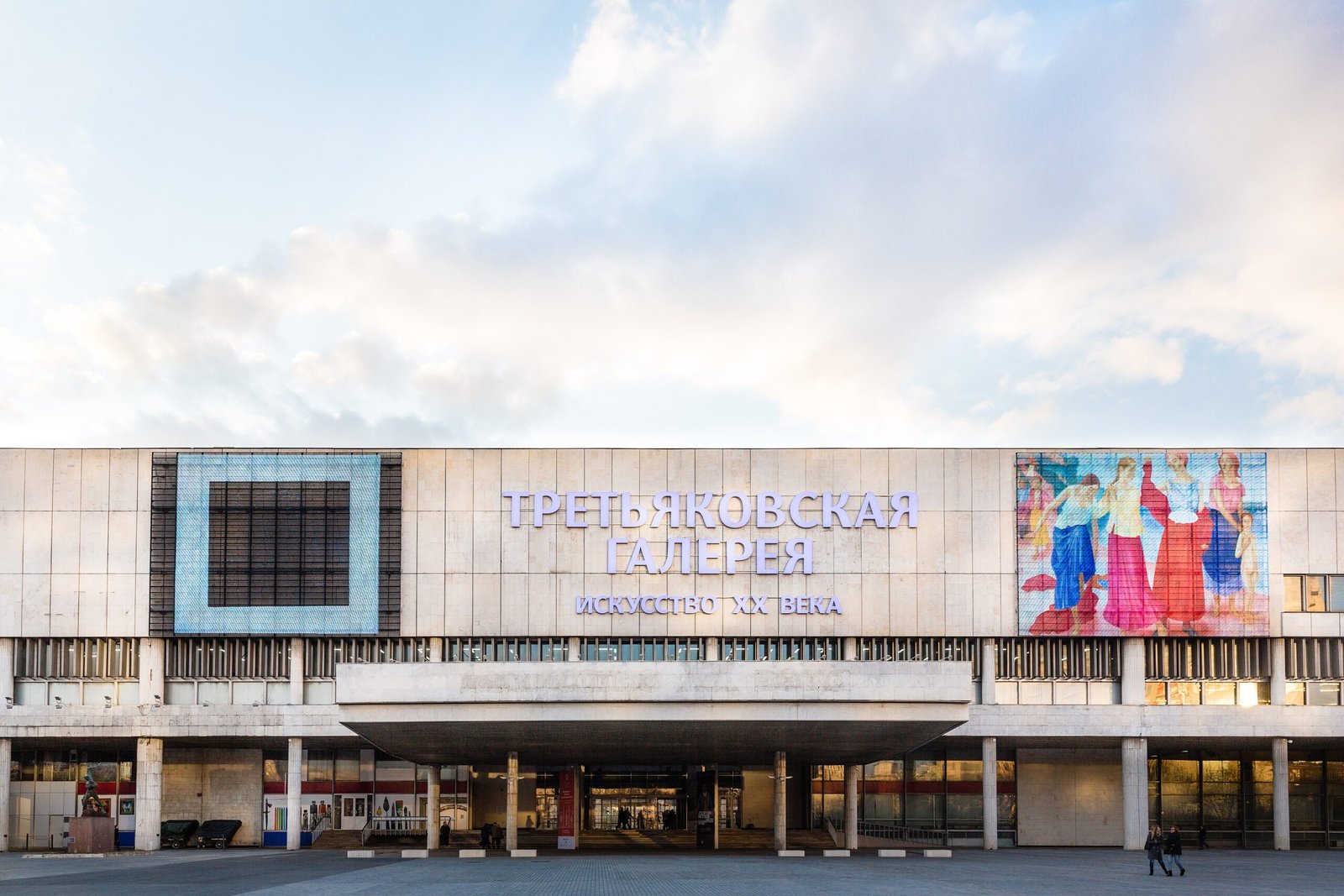
On the bank of the Moskva River, a long Soviet modernist pavilion holds Russia’s most important collection of 20th- and 21st-century art, from avant-garde canvases to Soviet-era realism.
At a glance
The New Tretyakov Gallery stands in Krymsky Val, within Museon Park, as the second building of the Tretyakov Gallery. Construction began in 1965 and finished two decades later, in 1985. Architects Yuri Sheverdyaev and Nikolai Sukoyan designed it in early Soviet modernism style, working from the Ivan Zholtovsky Architectural Workshop. The first exhibitions opened in 1986.
History
The site had a restless planning history before the gallery arrived. In the 1920s, planners imagined a park complex with a permanent agricultural exhibition. That scheme collapsed. A 1936 competition for a scientific center on the plot was won by Alexey Shchusev; construction started in 1939 but stalled when war broke out. Postwar, the project moved elsewhere. In the 1950s, Ivan Zholtovsky proposed a House of the Unions for the location, while officials separately discussed a new Tretyakov building to mark the gallery’s centenary. The site suited both ambitions and Pavel Tretyakov’s own birthplace lay nearby. Disagreements delayed things again. In 1959 the property passed to the State Art Gallery of the USSR. A 1962 decision finally combined two functions in one building: the State Picture Gallery and the Central House of Artists. Ground broke in 1965. The Artists’ Union portion opened first, in 1979; the whole structure was complete by 1985. In 1986 the State Picture Gallery merged with the Tretyakov Gallery, forming a larger association of museums and estates across Moscow.
What you see
The building was conceived as a park pavilion, oriented toward the embankment and meant to sit comfortably beside Neskuchny Garden and Gorky Park. Its original design called for a low, continuous colonnade wrapping the first floor. Exhibition space totals some 12,000 square meters, a scale that lets curators move chronologically from 1900s avant-garde through late-Soviet abstraction. Since 2016, a 4,000-square-meter courtyard added by Rem Koolhaas’s firm brings a fountain and amphitheater into the mix, used for lectures and public events. Inside, navigation follows a lettered-sector system, borrowed loosely from New York’s Metropolitan Museum.
Cultural significance
Few Russian institutions hold a comparable sweep of modern art. Malevich, Kandinsky, Chagall, Filonov and Popova anchor the avant-garde rooms. Socialist realism gets equal weight, with Pimenov’s New Moscow and Gerasimov’s Kremlin portraits among the era’s defining images. A 2019 hall honors collector George Costakis, whose gift of over 800 works, donated before his emigration, remains one of the richest troves of Russian avant-garde art anywhere. Contemporary acquisitions, including Leonid Talochkin’s 2014 donation, keep the collection reaching toward the present.
Key facts
- Location: Krymsky Val, Museon Park, Moscow, Russia
- Architects: Yuri Sheverdyaev and Nikolai Sukoyan, Ivan Zholtovsky Architectural Workshop
- Style: early Soviet modernism
- Construction: begun 1965, completed 1985; first exhibitions 1986
- Heritage-listed building
- Closed for reconstruction, 2023 to 2027–2028
Practical information & getting there
The gallery sits directly on the Moskva River embankment, adjoining Gorky Park and Museon. Public transport from central Moscow reaches it easily; the building is closed to visitors during its current reconstruction, expected to run through 2027–2028. Check the official website before planning any visit for reopening dates and hours.
Sources & resources
Find it on the map
See this place and what’s around it →📷 Become a Cultural Heritage Online photographer
Share your photos of places: they stay published under your name as the author. The more they're seen, the more you get noticed — and soon a contest will reward the most appreciated photos.
Log in or sign up free to add a photoIs this page about you?
This page is read by travellers and heritage enthusiasts who find it on Google. Tell us how you are connected to this place and we will take it from there.