
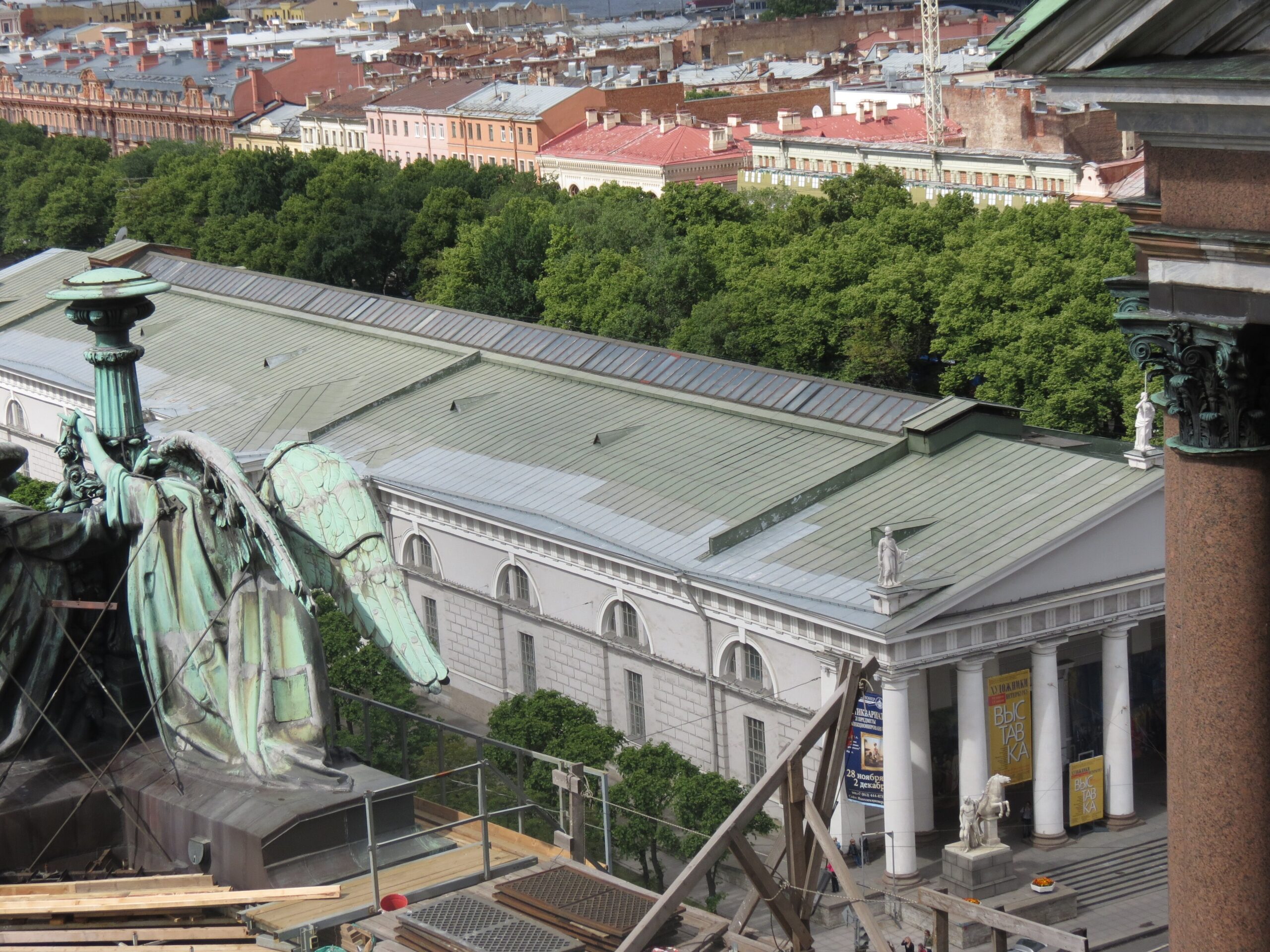
A parade-ground temple to horsemanship, built by Giacomo Quarenghi and later pressed into service as a Soviet garage and, finally, the city’s leading exhibition hall.
At a glance
Facing Saint Isaac’s Square, the Manege was raised in 1804–07 as a riding hall for the Imperial Horse Guards. Giacomo Quarenghi, near the end of his career, gave it an austere Greek Revival cast. It stands low and rectangular, its front closed off by a Doric portico that recalls a fifth-century BC Athenian temple. Today it operates as Saint Petersburg’s main exhibition hall.
History
The site once held a canal linking the Admiralty to its naval warehouses. Once filled in, it made way for the Manege. Quarenghi’s design was one of his last commissions, completed shortly before his death. The building gave its name to the adjoining Horse Guards Boulevard. After the Russian Revolution the riding academy lost its original purpose. The NKVD converted it into a garage, and in 1931 a second floor was inserted into the shell. A further reconstruction, dating to the late 1970s, adapted the building for its present role as an exhibition space.
What you see
The hall reads as a long, low block punctuated by arched openings and lunettes. Eight Doric columns carry a pediment decorated with bas reliefs, echoing classical temple fronts. Flanking the entrance stand marble statues of the Dioscuri beside their horses. Sculptor Paolo Triscornia modeled them on the Fontana dei Dioscuri in Rome. The effect is deliberately severe, stripped of ornament beyond these classical borrowings. It is neoclassicism used to dignify a working military building.
Cultural significance
The Manege belongs to the ensemble of monumental buildings framing Saint Isaac’s Square, one of Saint Petersburg’s great imperial set pieces. Quarenghi’s austere classicism helped define the city’s architectural identity under Catherine and Alexander I. The building’s later conversions, first to an NKVD garage, then to an exhibition hall, trace the shifting fortunes of Russia’s twentieth century. It survives as a rare structure that has served empire, secret police and public culture in turn.
Key facts
- Location: Saint Isaac’s Square, Saint Petersburg, Russia
- Built: 1804–1807
- Architect: Giacomo Quarenghi
- Style: Neoclassical / Greek Revival
- Original function: Riding hall for the Imperial Horse Guards
- Notable feature: Marble Dioscuri statues by Paolo Triscornia
- Heritage status: Listed heritage building
- Current use: City’s main exhibition hall
Practical information & getting there
The Manege sits on Saint Isaac’s Square, within easy walking distance of Saint Isaac’s Cathedral and the Mariinsky Palace. You can reach the area on foot from Nevsky Prospekt in about fifteen minutes. As a working exhibition venue, opening times follow the current show schedule rather than fixed museum hours, so check ahead before visiting.
Sources & resources
Find it on the map
See this place and what’s around it →📷 Become a Cultural Heritage Online photographer
Share your photos of places: they stay published under your name as the author. The more they're seen, the more you get noticed — and soon a contest will reward the most appreciated photos.
Log in or sign up free to add a photoIs this page about you?
This page is read by travellers and heritage enthusiasts who find it on Google. Tell us how you are connected to this place and we will take it from there.