
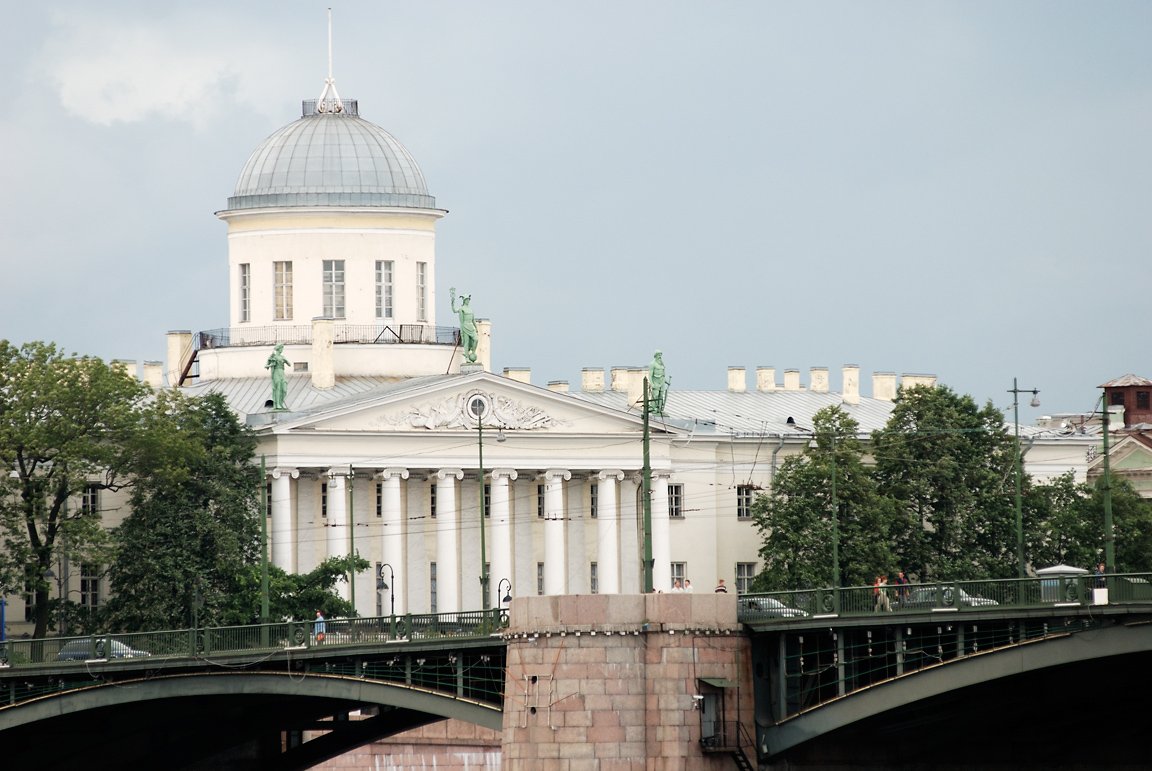
A research institute born from a debate over how to honor Alexander Pushkin, housed since 1927 in a neo-Palladian Customs House on the Strelka.
At a glance
Formally the Institute of Russian Literature, Pushkin House is part of the Russian Academy of Sciences network. It holds manuscripts, portraits and personal papers of Russia’s leading writers, alongside rare music recordings. The building itself, a former Customs House, sits near the tip of Vasilyevsky Island.
History
The idea took shape in December 1905, when a commission planning a Pushkin monument, led by Sergei Oldenburg and Aleksey Shakhmatov, proposed something bolder than a statue. Why not a museum bearing Pushkin’s name, gathering manuscripts, belongings and first editions of Russia’s great writers? Grand Duke Constantine Constantinovich backed the plan. A purpose-built Neoclassical Odeon was envisioned but never funded. In 1907 Minister of Finance Vladimir Kokovtsov proposed acquiring Alexander Onegin’s vast Pushkin collection, assembled in Paris since 1879; negotiations dragged on until Onegin’s death in 1925, though most of it eventually reached Russia. The Revolution shut down independent institutions, but Pushkin House survived, absorbed into the Academy of Sciences in 1918. Anatoly Lunacharsky, Lev Kamenev and Maksim Gorky served as honorary directors, shielding it through upheaval. In 1927 the institute moved from cramped Academy rooms to the Customs House on the Strelka, built to Giovanni Francesco Lucchini’s designs between 1829 and 1832. Alexander Blok’s final poem, “To Pushkin House,” addressed the earlier Kunstkamera rooms, invoking Pushkin’s legacy as a flicker of hope amid post-revolutionary chaos. The institute stayed open through the Siege of Leningrad, though staff and manuscripts were largely evacuated. Postwar scholars there included Boris Eikhenbaum and Dmitry Likhachov.
What you see
The Customs House presents a neo-Palladian facade, austere and symmetrical. Behind it, much of the collection now occupies a modern block concealed from the street. The contrast is deliberate. Grand columns face the Neva; functional storage lies unseen behind. Visitors sense two eras layered together, one built for trade, the other repurposed for literary memory.
Cultural significance
Pushkin House anchors Pushkin studies as a distinct scholarly field within Russia. Its departments span Old Russian literature, folklore, bibliography and manuscript archives, reflecting an ambition beyond a single author. Affiliated memorial houses at Mikhailovskoye, Trigorskoye, Tsarskoe Selo and the Moyka River extend its reach into sites Pushkin actually inhabited. Blok’s poem cemented the institute’s symbolic weight, casting it as a repository of cultural continuity when little else felt stable.
Key facts
- Founded: December 1905
- Formal name: Institute of Russian Literature
- Current building: former Customs House, designed by Giovanni Francesco Lucchini, 1829–1832
- Moved to current site: 1927
- Affiliation: Russian Academy of Sciences (since 1918)
- Notable scholars: Boris Eikhenbaum, Dmitry Likhachov
Practical information & getting there
Pushkin House stands near the Strelka on Vasilyevsky Island, a short walk from the Kunstkamera and the Zoological Museum. You’ll find it easiest to approach on foot from the Palace Bridge area, following the riverside path along the Neva. Check the official website before visiting, since access to reading rooms and archives is typically arranged for researchers rather than casual visitors.
Sources & resources
Find it on the map
See this place and what’s around it →📷 Become a Cultural Heritage Online photographer
Share your photos of places: they stay published under your name as the author. The more they're seen, the more you get noticed — and soon a contest will reward the most appreciated photos.
Log in or sign up free to add a photoIs this page about you?
This page is read by travellers and heritage enthusiasts who find it on Google. Tell us how you are connected to this place and we will take it from there.