
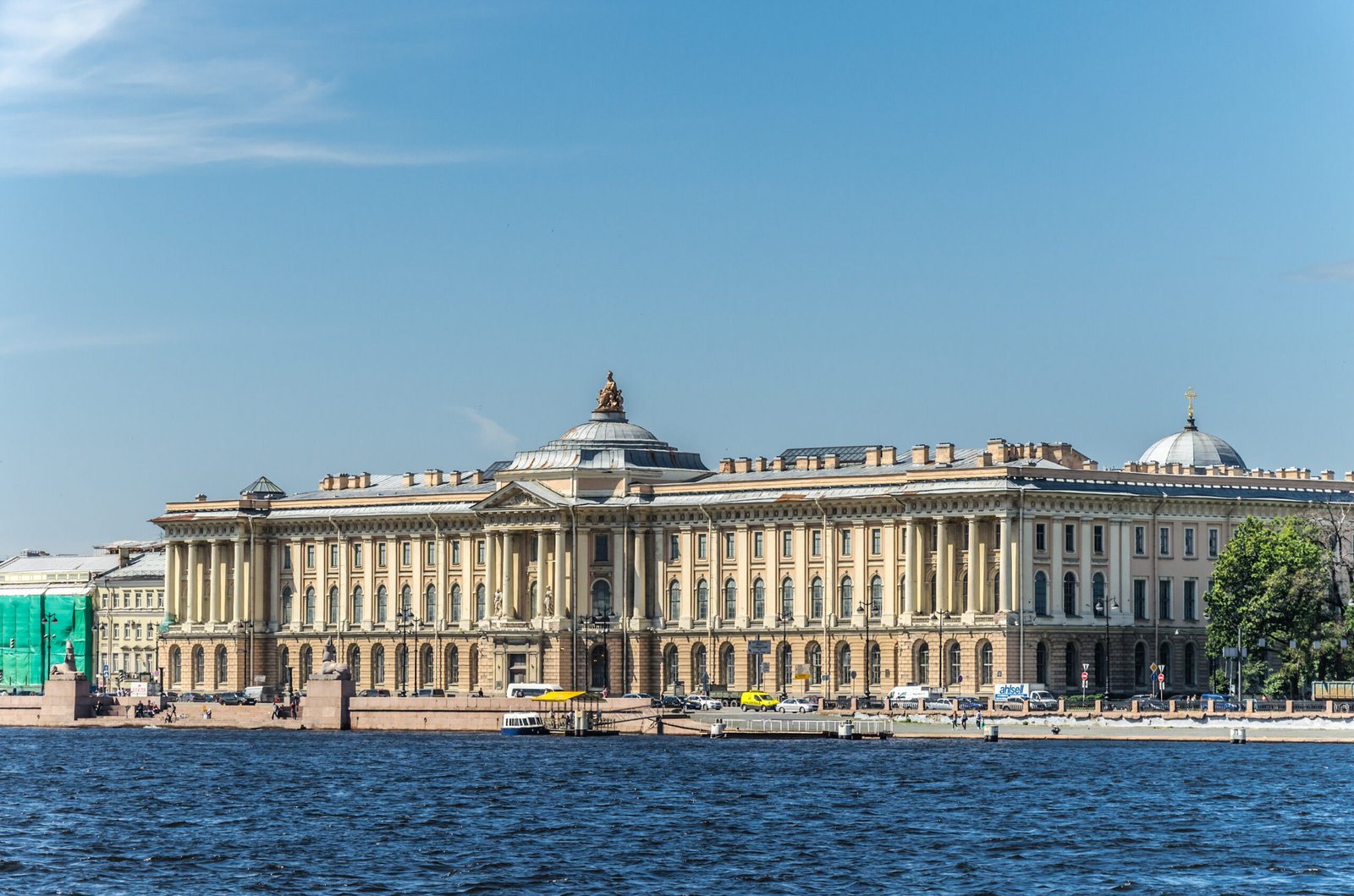
A generation-spanning current of Soviet realist painting, forged inside the reformed Academy of Arts and bound together for six decades by the Leningrad Union of Soviet Artists.
At a glance
The Leningrad School of Painting names not a building but a body of artists, roughly 1,200 by one historian’s count, who trained and worked in Leningrad from the early 1930s onward. It grew out of the reorganised Academy of Arts, later the Repin Institute of Painting, Sculpture and Architecture, and was held together institutionally by the Leningrad Union of Soviet Artists, active from 1932 to 1991.
History
The school’s origins lie in political decree, not artistic manifesto. In April 1932 the Politburo ordered the dissolution of independent literary and art groups in favour of a single creative union. That October the Council of People’s Commissars decreed the creation of the Academy of Arts, absorbing the Institute of Proletarian Art. From 1934 Isaak Brodsky headed the reconstituted Academy and Institute; Kuzma Petrov-Vodkin became the first chairman of the new Leningrad Union of Soviet Artists. Teachers carried forward older lineages. Some had studied under Ilya Repin, Pavel Chistyakov and Arkhip Kuindzhi. Others, among them Dmitry Kardovsky, Alexander Matveyev and Boris Ioganson, brought their own academic training into the Soviet curriculum. The result was fifteen years of institutional upheaval before a recognisable school settled into place. Its name entered Western art history later still, popularised through the exhibition and auction series “L’École de Leningrad,” held in France between 1989 and 1992, and confirmed by St. Petersburg exhibitions of private collections through the mid-1990s.
What you see
There is no single facade to photograph here. What survives is a shared visual language. Critics point to monumental scale, dense multi-figure composition, and a “mother-colour” tonal unity across canvases. Painters worked directly from life, favouring narrative subjects rendered with what one historian called nobility rather than timidity. The city itself left its mark. Nadezhda Leonova argued in 1979 that Leningrad’s classical architecture, literature and theatre shaped the school’s poetic, urban-landscape sensibility, alongside the pull of revolutionary tradition.
Cultural significance
For decades Leningrad and Moscow ran parallel, competing schools of Soviet art, the Repin Institute carrying particular prestige. Scholars still debate whether a strict formula defines “Leningrad art,” yet curators at the Russian Museum, among them Vladimir Lenyashin and Vladimir Gusev, insist the school exists as something distinct within Soviet culture. Today its output anchors serious study of twentieth-century Russian painting. Works by its leading masters now sit on the entrance-exam syllabus for art history graduates at St. Petersburg State University, and the first dedicated monographs on the school appeared only in 2007 and 2008.
Key facts
- Institutional base: Academy of Arts / Repin Institute of Painting, Sculpture and Architecture, Leningrad
- Governing body: Leningrad Union of Soviet Artists, 1932–1991
- First chairman: Kuzma Petrov-Vodkin
- Academy leadership from 1934: Isaak Brodsky
- Estimated membership: around 1,200 artists (S. Ivanov)
- Term popularised abroad: “L’École de Leningrad,” exhibitions and auctions, France, 1989–1992
Practical information & getting there
You cannot visit “the Leningrad School” as a single site, but you can trace it through Saint Petersburg. The Repin Institute, successor to the Academy of Arts, still stands on Vasilyevsky Island near the coordinates associated with the school. The Russian Museum holds major works by its painters and has staged exhibitions examining the movement directly. Plan a visit around both institutions rather than a single address, and expect gallery hours rather than open access to teaching spaces.
Sources & resources
Find it on the map
See this place and what’s around it →📷 Become a Cultural Heritage Online photographer
Share your photos of places: they stay published under your name as the author. The more they're seen, the more you get noticed — and soon a contest will reward the most appreciated photos.
Log in or sign up free to add a photoIs this page about you?
This page is read by travellers and heritage enthusiasts who find it on Google. Tell us how you are connected to this place and we will take it from there.