
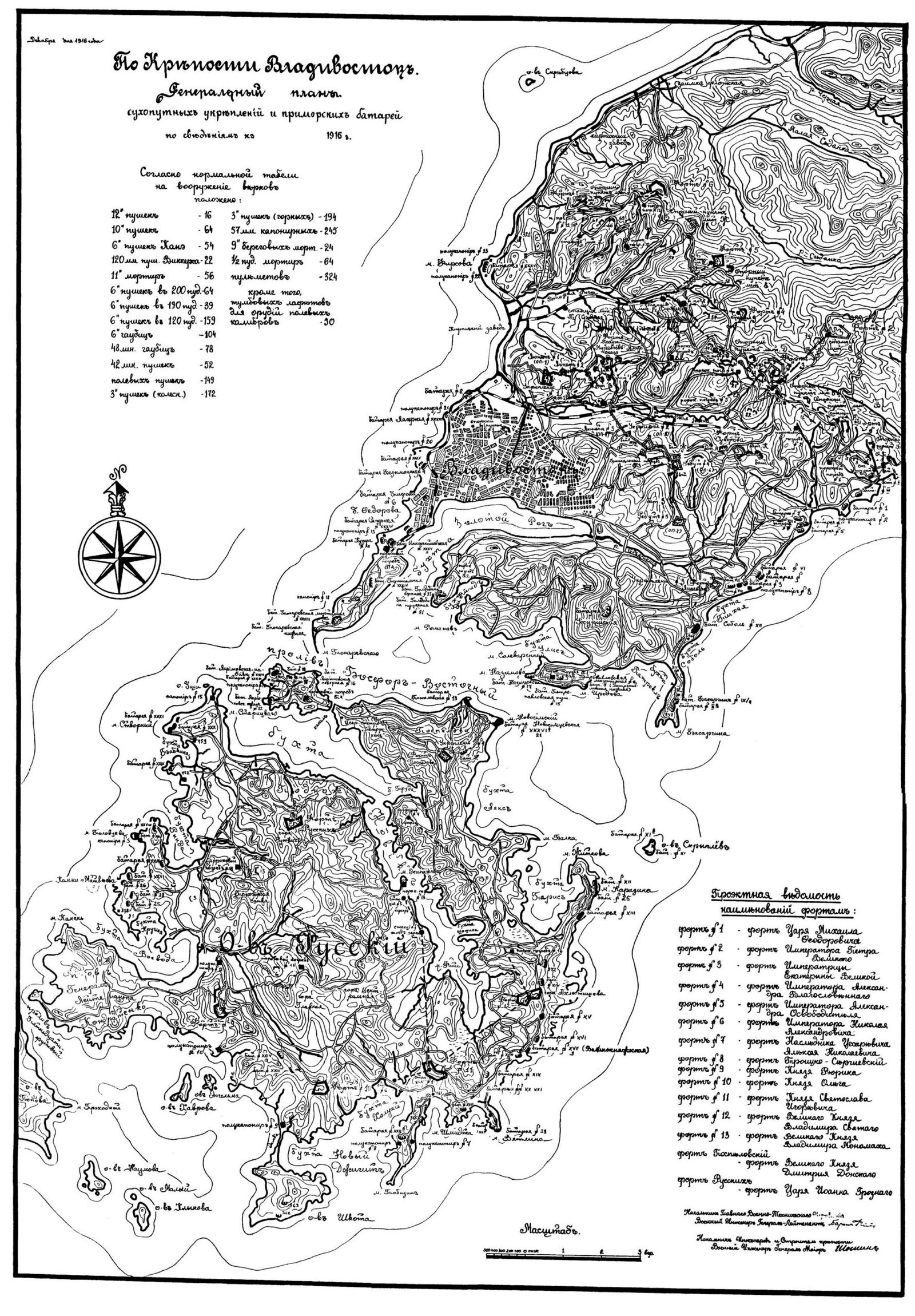
A vast belt of forts, batteries and tunnels wraps the hills around Vladivostok, built by Russian military engineers to guard the empire’s only Pacific naval base.
At a glance
Vladivostok Fortress is not a single building but a fortified landscape: sixteen forts, dozens of coastal caponiers, and around fifty shore batteries strung across the city and its surrounding islands. Construction ran from 1889 until 1918, when war and revolution stopped the work with the system roughly two-thirds finished. It remains, by the account of military historians, the most heavily fortified stronghold built anywhere in that era.
History
Work began in 1889 as a modest defensive line. The project unfolded in three stages, each responding to changing threats. A second line of defense followed between 1899 and 1905. Then came the reckoning of the Russo-Japanese War. The fall of Port Arthur in 1904 exposed weaknesses in Russian coastal defense doctrine, and after the 1905 Treaty of Portsmouth stripped Russia of that base, Vladivostok became the empire’s sole Pacific naval port. Its fortification suddenly mattered enormously. In April 1907, Nicholas II ordered the fortress upgraded to first-class status. Engineers spent the following decade designing and building a much stronger main defensive line, informed directly by the lessons of 1904. Construction continued into the First World War, but the upheavals of that conflict and the October Revolution of 1917 halted the project before completion.
What you see
The forts sit deliberately scattered across rough mountainous terrain rather than arranged along textbook lines. Engineers avoided copying standard fortification models. Instead they placed gun emplacements to exploit the folds of the landscape, spreading them out to frustrate enemy targeting. Roads run along reverse slopes, hidden from an attacking force, and duplicate routes let troops maneuver even under bombardment. Underground telegraph and telephone cables link forts, batteries and barracks to a central switchboard. Casemated barracks on the major forts are backed by more than three kilometers of galleries and six kilometers of tunnels. Concrete walls up to five meters thick, tested for durability in 1913, were built to withstand fire from 280-millimeter guns. Later structures, dating from 1910 onward, shed the decorative cornices and window dressings of earlier concrete casemates in favor of plain, heavy-set facades — function over ornament, in step with fortification design across Europe at the time.
Cultural significance
The fortress embodies a pivotal shift in Russian military engineering, forged directly from the trauma of defeat at Port Arthur. Its scale is staggering: over 1,600 guns and machine guns across land and coastal fronts, a garrison plan calling for tens of thousands of troops, and over 200 kilometers of connecting roads. It stands today as physical evidence of imperial Russia’s final major fortification effort in the Far East, frozen mid-construction by revolution. For military historians it offers a rare, largely intact record of early twentieth-century concrete fortification technique.
Key facts
- Location: Vladivostok, Russia
- Construction period: 1889–1918
- Scale: 16 forts, roughly 50 shore batteries, dozens of caponiers
- Underground works: over 3 km of galleries, 6 km of tunnels
- Declared 1st-class fortress: April 1907, by order of Nicholas II
- Heritage status: officially protected heritage site
Practical information & getting there
You can reach several forts and museum sections within and around Vladivostok, a city served by rail on the Trans-Siberian line and by air. Terrain is steep in places, so sturdy footwear helps. Check current opening arrangements and guided-tour options before visiting, since access varies by site and season.
Sources & resources
Find it on the map
See this place and what’s around it →📷 Become a Cultural Heritage Online photographer
Share your photos of places: they stay published under your name as the author. The more they're seen, the more you get noticed — and soon a contest will reward the most appreciated photos.
Log in or sign up free to add a photoIs this page about you?
This page is read by travellers and heritage enthusiasts who find it on Google. Tell us how you are connected to this place and we will take it from there.