
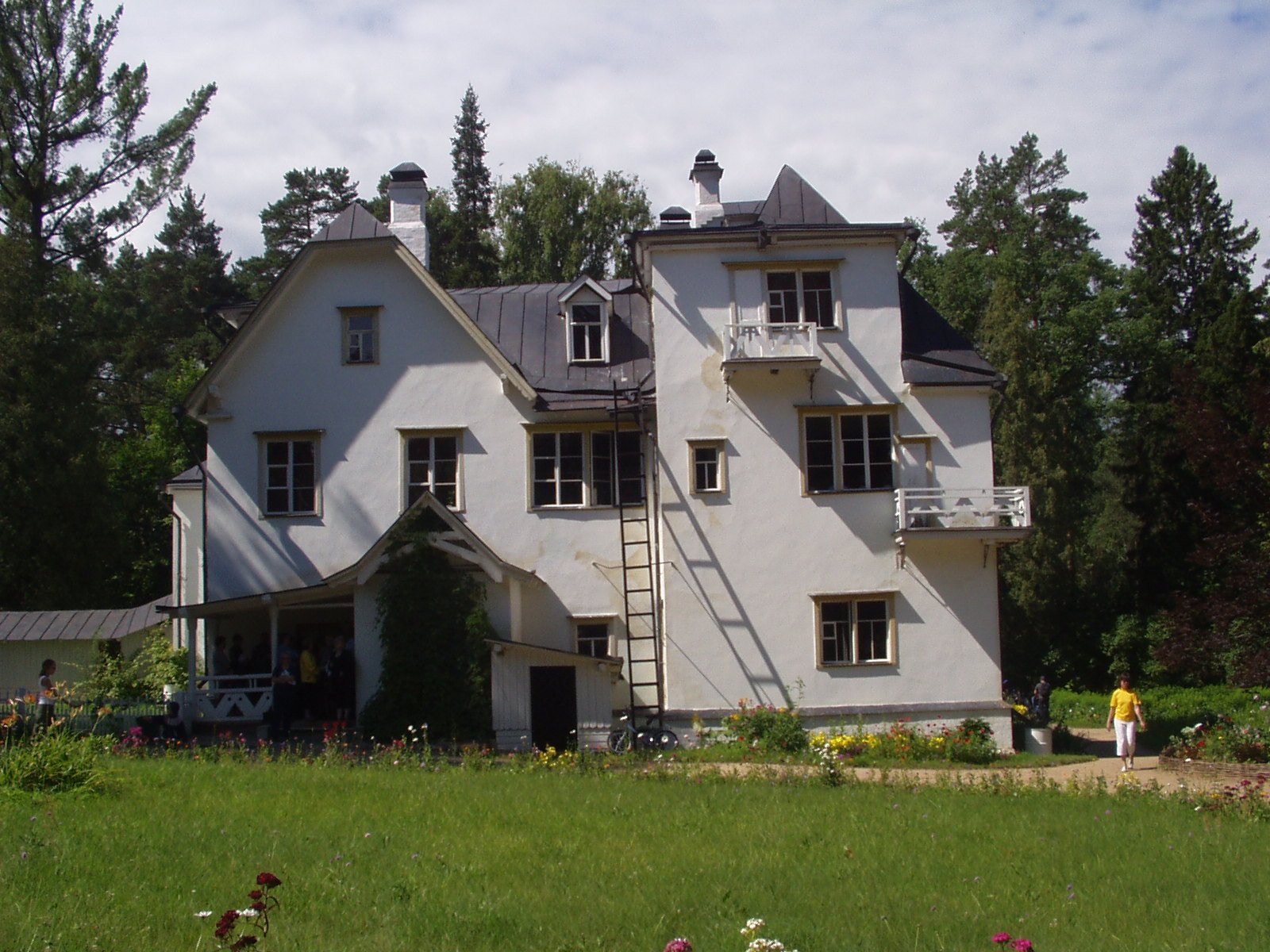
On a bluff above the Oka river stands the house Vasily Polenov built for himself, and around it the estate he turned into a working artists’ colony and, later, a museum.
At a glance
Polenovo is the museum estate of the painter Vasily Polenov, set on the high right bank of the Oka in the Tula Region. The white, three-storey house was designed by Polenov himself and completed in 1892. Today the estate functions as a state memorial reserve combining history, art and the surrounding riverside landscape.
History
Polenov bought the land, then known as Borok, in 1891. He designed the main house rather than commissioning an architect, and building work finished the following year. It became both home and studio, and a gathering place for fellow painters. Polenov died in 1927. His family then handed his collections and property to the state, a decision that preserved the interiors largely intact. A house museum opened in 1939, though the estate’s formal inception as an institution is sometimes dated earlier, to 1931, in official records. The site was renamed the Museum Estate of V. D. Polenov in the 1950s. In 1983 it was reorganised as the State Memorial History, Art and Natural Museum Reserve, broadening its remit to the landscape as well as the buildings.
What you see
The main house is modest in scale but confident in massing: three white storeys set against dark pine and river light. Polenov shaped the rooms around his own working life, with studio space integrated into the domestic plan rather than added as an afterthought. Outbuildings and the wider grounds extend the estate down toward the Oka, giving the whole complex a lived-in, self-designed character rather than a formal architectural program.
Cultural significance
Polenovo matters less for grandeur than for continuity. It preserves the working environment of a major Russian realist painter almost as he left it, thanks to his family’s early transfer of the estate to state care. The site’s evolution from private house to house museum to full memorial reserve tracks how Soviet and post-Soviet Russia has handled the legacies of its 19th-century artists. That the director since 2011 has been Polenov’s own great-granddaughter, Natalia Polenova, gives the institution a rare direct thread back to its founder.
Key facts
- Location: right bank of the Oka river, Zaoksky District, Tula Region, Russia
- Estate acquired by Vasily Polenov: 1891, then known as Borok
- Main house designed by Polenov himself; built 1892
- House museum opened: 1939 (institutional inception recorded as 1931)
- Renamed Museum Estate of V. D. Polenov: 1950s
- Reorganised as State Memorial History, Art and Natural Museum Reserve: 1983
- Director since 2011: Natalia Polenova, Polenov’s great-granddaughter
- Heritage-listed site
Practical information & getting there
Polenovo sits in rural Tula Region, on the Oka’s high bank, so plan for a countryside approach rather than a city visit. Check the museum’s official website before travelling, since opening days and access can vary by season. Bring time for the grounds as well as the house; the reserve’s natural setting is part of what it protects.
Sources & resources
Find it on the map
See this place and what’s around it →📷 Become a Cultural Heritage Online photographer
Share your photos of places: they stay published under your name as the author. The more they're seen, the more you get noticed — and soon a contest will reward the most appreciated photos.
Log in or sign up free to add a photoIs this page about you?
This page is read by travellers and heritage enthusiasts who find it on Google. Tell us how you are connected to this place and we will take it from there.