
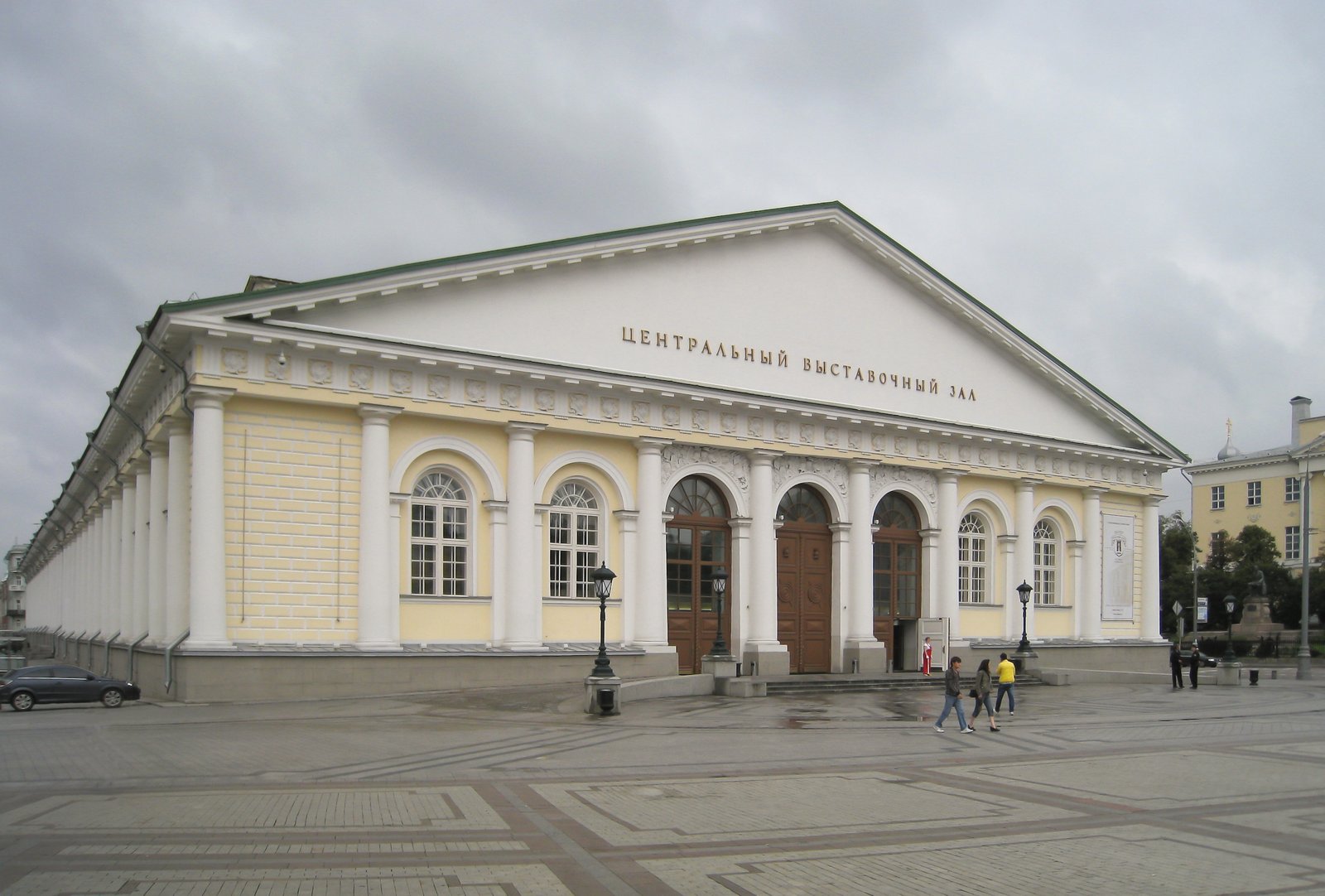
An oblong Neoclassical hall beside the Kremlin, built to drill an entire regiment under one unsupported roof, later a stage for orchestras, art, and political theatre.
At a glance
The Manege stretches along the western edge of Manege Square, a rectangular block raised for military exercise and reborn many times since. Its most striking feat is structural: a timber roof spanning 45 metres with no interior columns to interrupt the floor. That engineering trick, credited to the Spanish engineer Agustín de Betancourt, let two thousand soldiers drill indoors, watched by an audience.
History
Construction ran from 1817 to 1825. Joseph Bové, the Russian architect who reshaped much of post-1812 Moscow, gave the engineering shell its Neoclassical dress. The building first served as a manège, an indoor riding and drill academy for imperial officers. By 1831 it had shifted to exhibitions. In 1867 Hector Berlioz and Nikolai Rubinstein conducted here before 12,000 listeners, an audience size few concert halls could match. Soviet authorities later used the space as an art gallery. It was here, at a 1962 exhibition, that Nikita Khrushchev publicly denounced avant-garde artists in the episode now known as the Manege Affair. Fire struck on 14 March 2004, the night of Vladimir Putin’s re-election. Wooden beams and rafters collapsed; two firefighters died. Officials blamed a short circuit, though the timing fed speculation in the press. The rebuilt Manege reopened on 18 February 2005, resuming the very exhibition that fire had interrupted.
What you see
The one-storey building runs 166 metres long and 44 metres wide, rising about 15 metres. Roman Doric and Tuscan semi-columns march along the facades, framing arch-headed windows within a blind arcade. Walls are painted white and cream yellow. Gables sit plain above each front, without ornament. Wooden gates pierce the middle of the side walls and beneath the gables. Windows once accounted for roughly a third of the wall surface, flooding the drill floor with daylight. The southern facade was meant to face the Kutafya Tower, one of the Kremlin’s gated approaches. Inside, the restored roof again exposes its rafters and beams, resting on the external colonnade rather than internal supports, so the hall opens as one uninterrupted volume.
Cultural significance
Few buildings sit closer to the seat of Russian power. The Manege’s location, a stone’s throw from the Kremlin, has made it witness to military ceremony, concert life, and ideological confrontation alike. The 1962 clash between Khrushchev and nonconformist artists remains a touchstone in histories of Soviet culture and censorship. The 2004 fire, and its politically charged timing, added another layer to the building’s public meaning. Since 2012 it has housed the Moscow Design Museum, extending its long function as a venue where the city displays itself.
Key facts
- Location: Manege Square, Moscow, Russia
- Built: 1817–1825
- Engineer: Agustín de Betancourt (roof design)
- Architect: Joseph Bové (facades); Pavel Andreyev also credited
- Style: Neoclassical architecture
- Dimensions: 166 m long, 44 m wide, about 15 m high
- Roof span: 45 m, without internal supports
- Original floor area: 7,424.67 m²
- Fire: 14 March 2004; reopened 18 February 2005
- Current use: exhibition hall, Moscow Design Museum since 2012
- Heritage status: listed
Practical information & getting there
The Manege stands beside Red Square, within easy walking distance of the Kremlin and Alexander Garden. You can reach it on foot from several central metro stations. Exhibition hours and tickets follow the schedule of whatever show currently occupies the hall, so check the official site before visiting.
Sources & resources
Find it on the map
See this place and what’s around it →📷 Become a Cultural Heritage Online photographer
Share your photos of places: they stay published under your name as the author. The more they're seen, the more you get noticed — and soon a contest will reward the most appreciated photos.
Log in or sign up free to add a photoIs this page about you?
This page is read by travellers and heritage enthusiasts who find it on Google. Tell us how you are connected to this place and we will take it from there.