
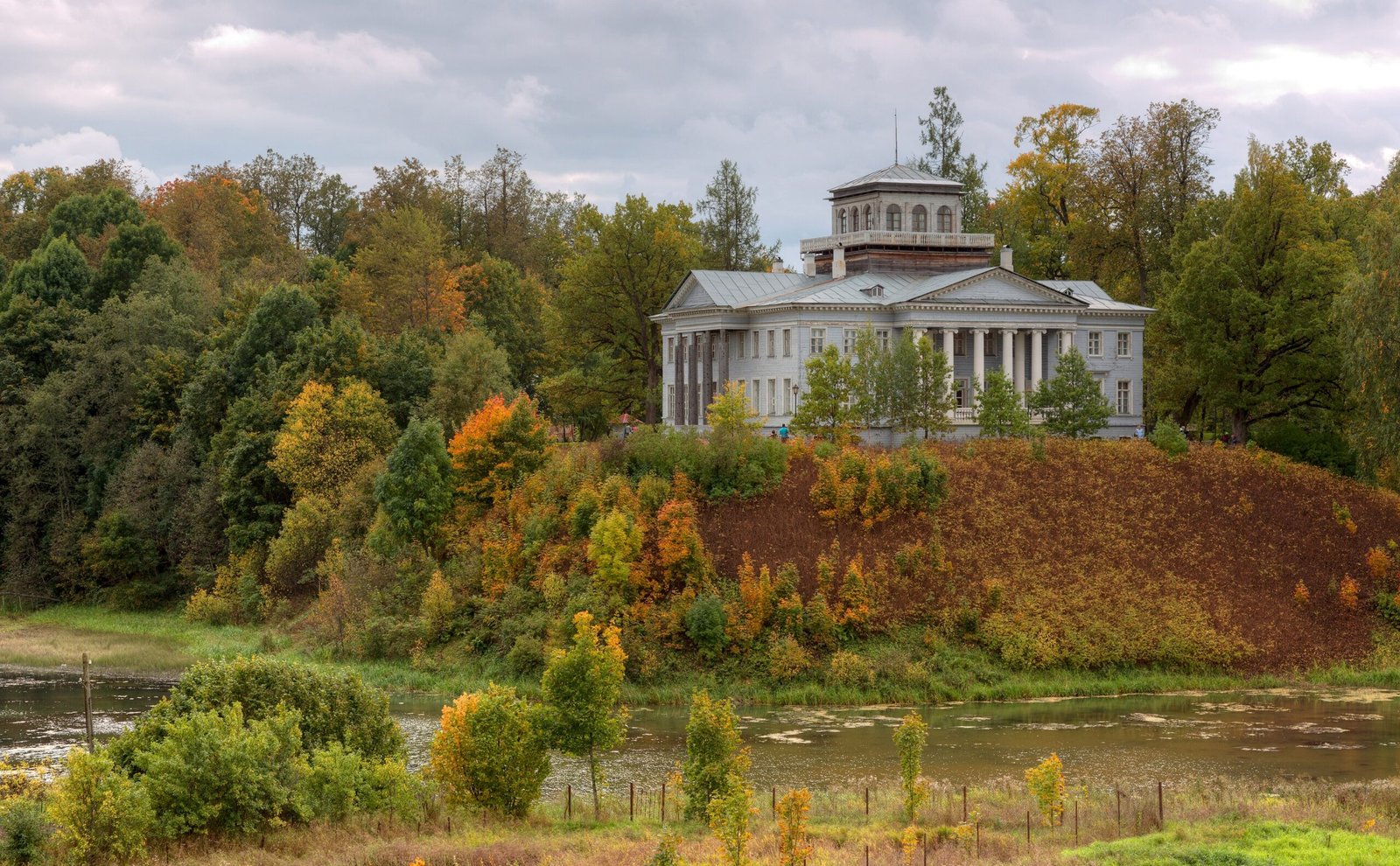
A columned manor above the Oredezh River, the last of three Nabokov family properties still standing, now a house museum devoted to the writer’s Russian years.
At a glance
Rozhdestveno stands near Siverskaya in Gatchinsky District, Leningrad Oblast, not far from the sites of Batovo and Vyra, the two neighbouring estates also tied to Vladimir Nabokov’s childhood. Both those houses are gone. Rozhdestveno alone survived. The estate takes its name from the nearby Church of the Nativity of Our Lady, and the manor itself is heritage-listed today.
History
Nabokov’s grandfather, Ivan Rukavishnikov, acquired the estate during the nineteenth century. It passed in 1901 to his son Vasiliy Ivanovich Rukavishnikov, known in the family as “Uncle Ruka.” When Uncle Ruka died in 1916, he left Rozhdestveno, along with a fortune worth millions in today’s terms, to his young nephew Vladimir. The inheritance did not last. Nabokov fled the Leningrad area in 1917 as revolution swept the country, and he never returned to see the house again. Batovo burned in 1925. Vyra was destroyed in 1944. Only Rozhdestveno remained of the triad.
What you see
The mansion is built in an Italian style, its main facade carried on six Ionic columns. A rectangular belvedere crowns the roof, catching light above the treeline. Inside, a large central hall once hosted balls and formal receptions. The ground floor held official rooms; the family’s actual living quarters were upstairs on the second floor. Kitchens and household services were tucked into the basement, out of sight of guests. Stables and other outbuildings still stand nearby, sketching the working life of a country estate.
Cultural significance
The museum’s Nabokov identity was not immediate. It opened in 1957 as a plain local-history exhibit, later folded into a display for a collective farm named after Lenin. Photographs supplied by Nabokov’s former cook brought the estate’s real owners back into view. The Museum of Local History and Tradition moved into the manor in 1974, and by 1984 it had been reorganised as the Rozhdestveno Historic Literary and Memorial Museum of Vladimir Nabokov. Public Nabokov readings began in 1988. A dedicated Nabokov Room opened in 1992. A fire in 1995 caused serious damage, a reminder of how fragile these wooden and stone survivals remain. In 2013 vandals attacked the estate over accusations of promoting pedophilia, part of a wider spate of hostility toward Nabokov-related sites in Saint Petersburg that year. Despite this, the museum continues to hold two stories at once: the private world of the Nabokov and Rukavishnikov families, and the broader life of Russian nobility and ordinary rural people in the last years before the revolution.
Key facts
- Location: near Siverskaya, Gatchinsky District, Leningrad Oblast, Russia
- Style: Italianate manor with Ionic-columned facade and rectangular belvedere
- Family link: owned by Ivan Rukavishnikov, then Vasiliy “Uncle Ruka” Rukavishnikov, bequeathed to Vladimir Nabokov in 1916
- Museum reorganised at this site: 1974
- Nabokov Room opened: 1992
- Fire damage: 1995
- Heritage-listed status: confirmed
Practical information & getting there
Rozhdestveno sits close to Siverskaya, within reach of the wider Gatchina area southwest of Saint Petersburg. Visiting typically pairs well with the sites once occupied by Batovo and Vyra, since all three are grouped along the Oredezh valley and were part of Nabokov’s early landscape. Check the museum’s own site before travelling, as hours and access can change, especially after periods of damage or restoration.
Sources & resources
Find it on the map
See this place and what’s around it →📷 Become a Cultural Heritage Online photographer
Share your photos of places: they stay published under your name as the author. The more they're seen, the more you get noticed — and soon a contest will reward the most appreciated photos.
Log in or sign up free to add a photoIs this page about you?
This page is read by travellers and heritage enthusiasts who find it on Google. Tell us how you are connected to this place and we will take it from there.