
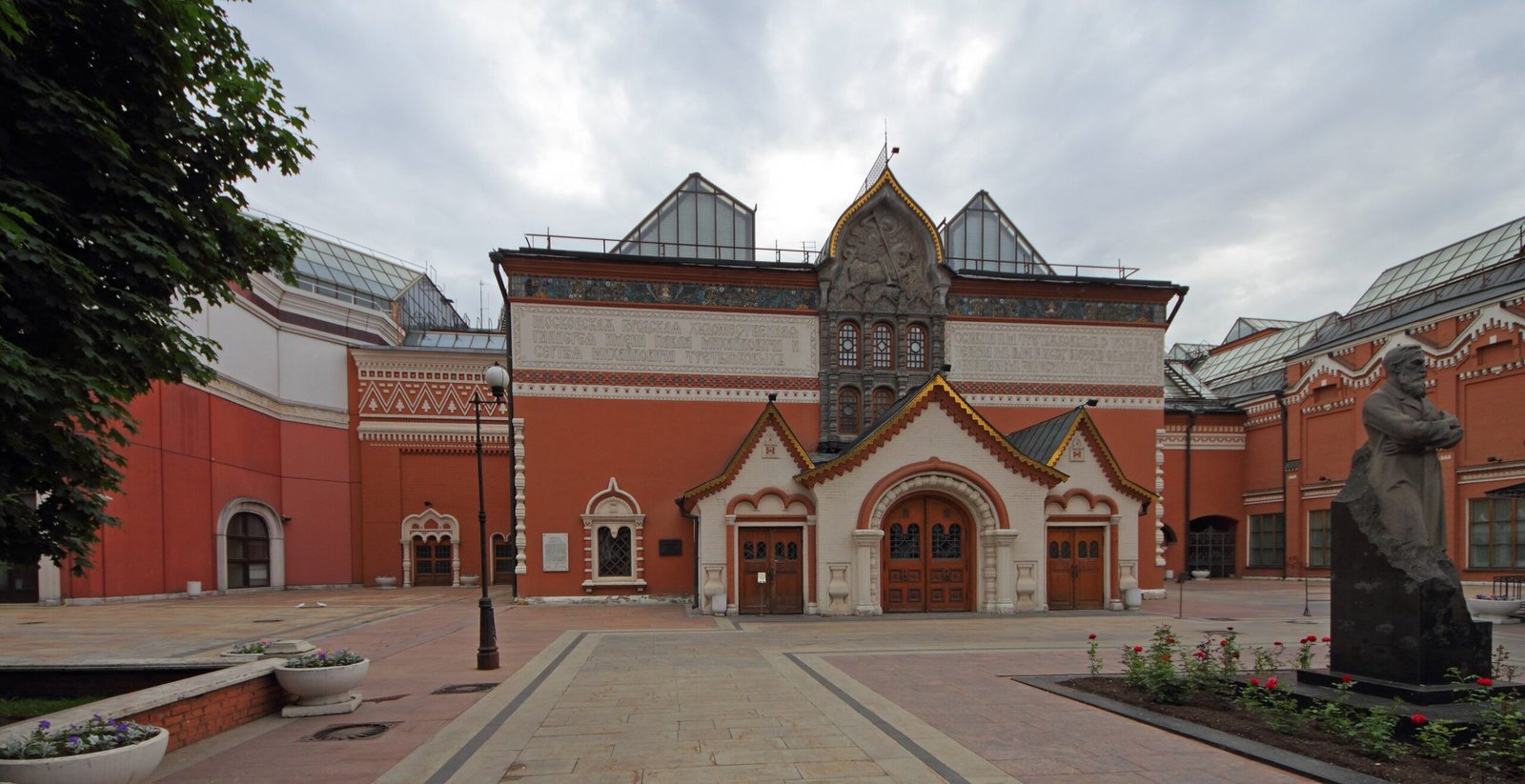
A merchant’s private passion became Russia’s national picture gallery, its fairy-tale façade guarding more than 130,000 works of icons, portraits and revolutionary abstraction.
At a glance
The State Tretyakov Gallery sits just south of the Kremlin on Lavrushinsky Lane. It grew from the private collection of Pavel Mikhailovich Tretyakov, a Moscow textile merchant who began buying paintings in the 1850s. Today its holdings span the Theotokos of Vladimir to Kandinsky and Malevich, making it the principal repository of Russian fine art anywhere in the world.
History
Tretyakov’s first purchases, in 1856, were two contemporary Russian canvases. He kept buying for decades, filling the family mansion until rooms meant for living became rooms for art. Additions followed in 1873, 1882, 1885 and 1892. In 1892 Tretyakov gave his entire collection, by then roughly 2,000 works, to the city of Moscow. The museum opened officially in 1893. Nationalized in 1918, it became the State Tretyakov Gallery under director Igor Grabar. War came in 1941. Staff rolled paintings onto wooden shafts, wrapped them, and shipped seventeen wagons of art to Novosibirsk. The gallery reopened in Moscow in May 1945. Later directors, notably Alexey Shchusev and Y. K. Korolev, kept expanding the site through the twentieth century, adding storage, restoration workshops and exhibition wings.
What you see
The building’s famous red-and-cream façade dates to 1902–1904. Painter Viktor Vasnetsov designed it in a deliberately folkloric, almost storybook Russian style, with architect V. Bashkirov translating the drawings into stone and A. M. Kalmykov managing construction. Inside, the route winds through the absorbed 17th-century Church of St. Nicholas in Tolmachi, closed in 1929 and folded into the museum by 1932. A purpose-built top floor there displays Alexander Ivanov’s vast Appearance of Christ Before the People. Later Soviet-era halls, including the 1936 Shchusevsky building, extend the exposition without disrupting its continuous flow.
Cultural significance
The gallery functions as a visual chronicle of Russian identity, from medieval icon painting through the avant-garde. It held part of the George Costakis collection from 1977. In 2012 its halls hosted the FIDE World Chess Championship. In 2023 the museum publicly resisted, then lost, custody of Andrei Rublev’s Trinity, transferred to the Russian Orthodox Church by presidential order. The episode underlined how deeply the collection is tied to questions of national memory and control.
Key facts
- Founded: 1856, by Pavel Tretyakov
- Façade architect/designer: Viktor Vasnetsov (built 1902–1904)
- Collection size: over 130,000 works
- 2020 visitors: 894,374
- Heritage-listed site
Practical information & getting there
The main building stands at Lavrushinsky Lane, close to the Tretyakovskaya and Novokuznetskaya metro stations. You can also reach the affiliated modern-art branch near Krymsky Val, south of the Krymsky Bridge, where a sculpture garden of relocated Soviet monuments sits alongside the museum. Check the official website before visiting, since parts of the complex have periodically closed for renovation.
Sources & resources
Find it on the map
See this place and what’s around it →📷 Become a Cultural Heritage Online photographer
Share your photos of places: they stay published under your name as the author. The more they're seen, the more you get noticed — and soon a contest will reward the most appreciated photos.
Log in or sign up free to add a photoIs this page about you?
This page is read by travellers and heritage enthusiasts who find it on Google. Tell us how you are connected to this place and we will take it from there.