
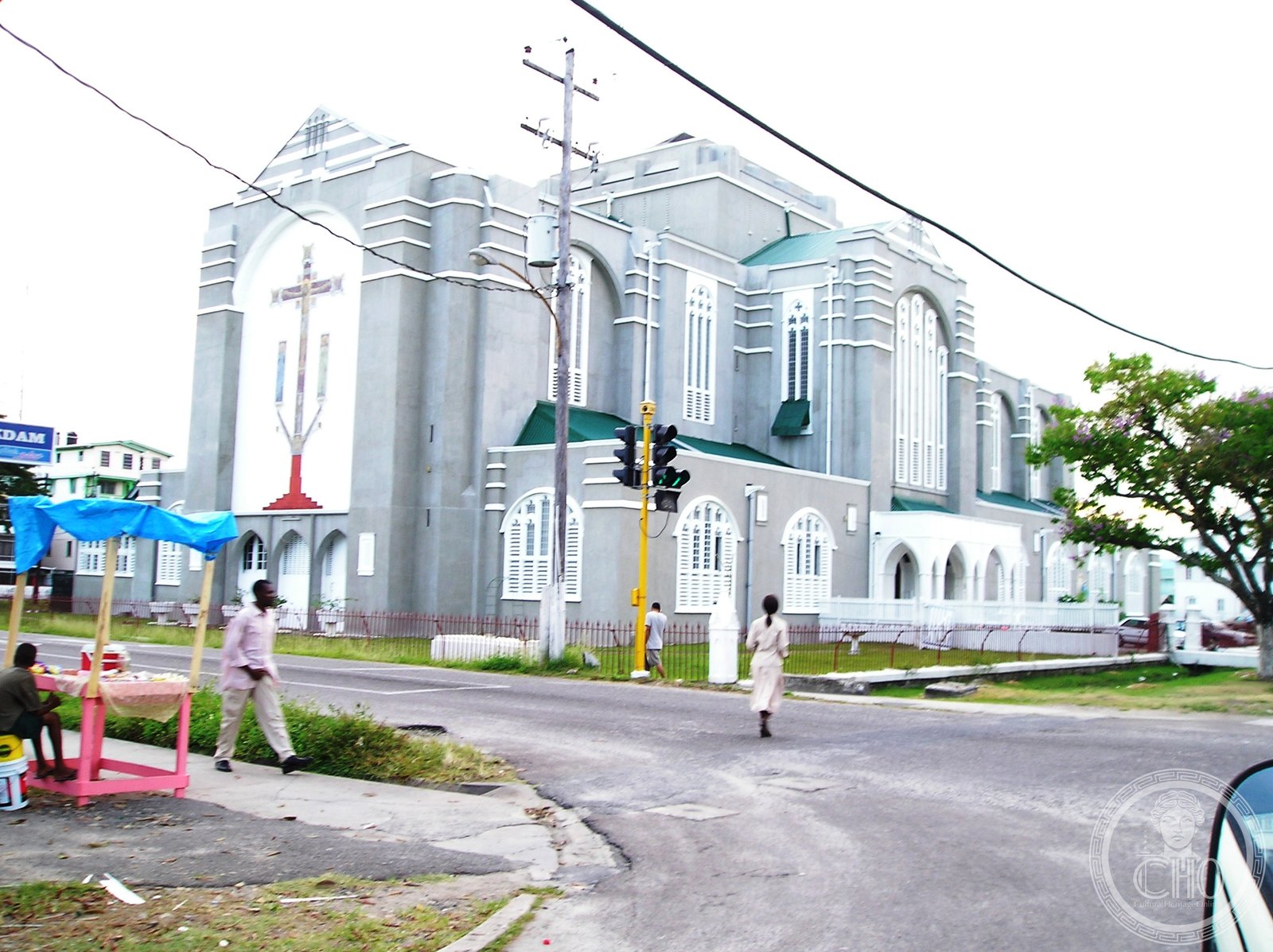
In Georgetown, the capital of Guyana, the Catholic cathedral of Our Lady of the Immaculate Conception, commonly called «Brickdam Cathedral» after the street it stands on, replaced St. Mary’s Cathedral, destroyed by fire on 7 March 1913. Fundraising for the new building began as early as 9 March, convened by the mayor of Georgetown, Francis Dias. The design of the English architect Leonard Stokes was chosen by competition, and Bishop C.T. Galton laid the foundation stone on 15 August 1915. Built in Romanesque style, of granite from the Dalli and Wolga quarries on the Essequibo river and sand from the island of Leguan, with steel and cement imported, the cathedral was among the first reinforced-concrete buildings in what was then the colony of British Guiana. The outer walls reached 80 feet by 1921, the building was blessed while still unfinished on 13 March of that same year, the eastern section opened for public worship on 13 December 1925 and construction was completed on 30 April 1927, although the bell tower and spire that had been planned were never built. The formal consecration came only on 10 October 1960, at the hands of Bishop Richard Lester Guilly. The exact dimensions of the building remain uncertain, with sources disagreeing and a figure of «1,000 feet wide» almost certainly the result of a transcription error, not to be relied on. Inside there are a high altar of marble, a gift of Pope Pius XI to Bishop Galton in 1930, and a metal shrine dedicated to the Virgin, salvaged from the earlier St. Mary’s Cathedral and survivor of the fire of 1913. The organised Catholic mission in the future British Guiana goes back to 1825, when Father William Clancy obtained the Brickdam site from the colonial governor. The apostolic vicariate of British Guiana was erected on 12 April 1837, with Clancy himself as first bishop, and raised to the diocese of Georgetown on 29 February 1956, a suffragan of the archdiocese of Port of Spain, Trinidad. The first native Guyanese bishop, of Indo-Guyanese descent, was Benedict Ganesh Singh, ordained in 1971 or 1972 depending on the source. The present bishop is Monsignor Francis Dean Alleyne, a Benedictine, in office since 2004. Contrary to what might be assumed, the Guyanese Catholic community has its roots not so much in the Indian indentured workers, evangelised mainly by Anglicans and Presbyterians, as in the Portuguese immigrants from Madeira, who arrived as indentured workers from 3 May 1835 onwards. On 14 July 1979 the Jesuit priest Bernard Darke was stabbed to death by members of the «House of Israel» sect, tied to the government of President Forbes Burnham, while photographing an opposition demonstration. The intended target was in fact Father Andrew Morrison, editor of the Catholic newspaper Catholic Standard, then in open conflict with the government over press freedom, an episode connected to the Guyanese Catholic institution in general and not specifically to this cathedral. It should also be made clear that the Peoples Temple of Jim Jones, later the setting of the mass killing at Jonestown in 1978, held a single service, in February 1975, in a different Catholic church in Georgetown, the Sacred Heart Church, before being turned away by the church authorities, an episode entirely unrelated to this cathedral. No papal visit is documented either to this cathedral or to Guyana in general.
About the Cathedral of the Immaculate Conception
In Georgetown, Guyana, the Catholic Cathedral of Our Lady of the Immaculate Conception, commonly called “Brickdam Cathedral” after the street it stands on, replaced St. Mary’s Cathedral, destroyed by fire on 7 March 1913; fundraising for the new building began just two days later, convened by Georgetown’s mayor Francis Dias. English architect Leonard Stokes’s design was chosen through a competition, and Bishop C.T. Galton laid the foundation stone on 15 August 1915. Built in Romanesque style, of granite from the Dalli and Wolga quarries on the Essequibo River and sand from Leguan Island, with steel and cement imported, it was among the first reinforced-concrete buildings in what was then British Guiana.
Key facts
- 7 March 1913: the predecessor St. Mary’s Cathedral destroyed by fire.
- 15 August 1915 – 30 April 1927: the current reinforced-concrete cathedral built.
- 10 October 1960: formally consecrated by Bishop Richard Lester Guilly.
- 29 February 1956: elevated to the seat of the Diocese of Georgetown.
- 14 July 1979: Jesuit priest Bernard Darke is murdered, likely mistaken for the editor of the Catholic Church’s newspaper amid conflict with the Burnham government.
- Distinct from both the Anglican wooden St. George’s Cathedral and Sacred Heart Church, briefly used by Jim Jones’s Peoples Temple in 1975.
History
Rebuilt in reinforced concrete after fire destroyed its wooden predecessor in 1913, this cathedral rose gradually over more than a decade, not fully consecrated until 1960. Its institutional history intersects with one of Guyana’s darkest political episodes: the 1979 murder of Jesuit priest Bernard Darke by a government-linked cult, in an attack believed to have actually targeted the editor of the Catholic Church’s own newspaper amid its open conflict with the Burnham government over press freedom.
What you see
A grey reinforced-concrete Romanesque facade, built from Essequibo River granite, rises without the bell tower and spire originally planned for it. Inside, a 1930 marble altar donated by Pope Pius XI and a metal Marian shrine salvaged from the fire-destroyed predecessor church stand among the cathedral’s oldest surviving furnishings.
Practical information
- Opening hours: generally open daily outside services; check current hours before visiting.
- Address: Brickdam, Georgetown, Guyana.
Getting there
The cathedral stands on Brickdam in central Georgetown, in the Stabroek area. GPS: 6°48′27″N, 58°09′43″W.
Nearby
- St. George’s Cathedral — Georgetown’s separate Anglican cathedral, a famous wooden Gothic Revival building, not to be confused with this Catholic cathedral.
Sources
- Kaieteur News — “Brickdam Cathedral marks 100 years old with a Festival of Trees,” November 2025.
- Wikipedia — “Immaculate Conception Cathedral, Georgetown” and “Catholic Church in Guyana”
- Wikipedia — “Murder of Bernard Darke”
- Diocese of Georgetown — official “About Us” history page (rcdiocesegy.org).
- Catholic-Hierarchy.org — Diocese of Georgetown listing.
Find it on the map
See this place and what’s around it →📷 Become a Cultural Heritage Online photographer
Share your photos of places: they stay published under your name as the author. The more they're seen, the more you get noticed — and soon a contest will reward the most appreciated photos.
Log in or sign up free to add a photo