
At Parikia, on the island of Paros, tradition holds that the church of the Dormition of the Virgin was founded in 326 by Saint Helena. She was the mother of the emperor Constantine, and is said to have stopped at Paros on her way to Jerusalem and to have vowed to build a church if she found the True Cross. That account comes from tourist and devotional sources, not from primary historical documents, and is to be taken as legend. More solid, though also based on tradition, is a significant rebuilding under the emperor Justinian I in the 6th century. By the legend he sent the architect Isidore of Miletus, one of the two designers of Hagia Sophia in Constantinople, to entrust the work to his own pupil Ignatius. A local tradition tells that Isidore, envious of the superior work of his pupil, pushed him off the roof, but that Ignatius, as he fell, dragged his master down with him, and both died. It is a story like other «jealous master» legends found elsewhere, such as that of the Apprentice Pillar at Rosslyn, and not documented history. Two carved figures by the Chapel of Agia Theodosia, popularly identified with Isidore and Ignatius, are in fact held by archaeologists to depict satyrs from an earlier temple to Dionysus on the same site. The name «Ekatontapyliani», the «Hundred Doors», is also tied to a widespread legend by which the building has ninety-nine visible doors, the hundredth destined to reveal itself only when Hagia Sophia returns to Greek hands. Historians, however, debate the very origin of the name, which may come from the older «Katapoliani», «near the lower town», with a later addition, perhaps as early as the 17th century, echoing the Egyptian toponym «Hekatompylos» to lend the complex greater solemnity. The complex today takes in the main cruciform church, the Chapel of Agios Nikolaos, whose oldest core, north of the sanctuary, is thought to go back to the 4th century, before the main church of the Justinian era, and an early Christian baptistery of the 4th century with a cross-shaped font, described as one of the best preserved in the whole Orthodox East. Counted among the most important surviving early Byzantine monuments of Greece, the church is today the second most important Marian sanctuary of the country after Tinos, and the destination every 15 August, the feast of the Dormition, of a pilgrimage with vespers, liturgy and a candlelit procession through the streets of Parikia. A restoration led by the architect Anastasios Orlandos between 1959 and 1964 stabilised the structure and brought earlier building phases to light, largely restoring the appearance of the Justinian era.
About Panagia Ekatontapyliani
In Parikia, on the Greek island of Paros, tradition holds that the church dedicated to the Dormition of the Virgin was founded in 326 CE by Saint Helena, mother of Emperor Constantine, who is said to have stopped at Paros on her way to Jerusalem and vowed to build a church if she found the True Cross — a story passed down through tourism and devotional sources, not primary historical documents, and best treated as legend. More solidly grounded, though still based on tradition, is a significant rebuilding under Emperor Justinian I in the 6th century, who is said to have sent the architect Isidore of Miletus, one of the two designers of Hagia Sophia in Constantinople, to entrust the work to his pupil Ignatius; a local tradition tells how Isidore, jealous of his pupil’s superior work, pushed him off the roof, only for Ignatius to pull his master down with him as he fell, both dying together — a story paralleling other “jealous master” legends found elsewhere, such as the Apprentice Pillar at Rosslyn, and not documented history. Two carved figures at the Chapel of Agia Theodosia, popularly identified as Isidore and Ignatius, are actually believed by archaeologists to depict satyrs from an earlier temple to Dionysus on the same site. Even the name “Ekatontapyliani,” the “Hundred Doors,” is tied to a widespread legend holding that the building contains ninety-nine visible doors, with the hundredth destined to reveal itself only when Hagia Sophia returns to Greek hands; historians, however, debate the name’s very origin, which may derive from the older “Katapoliani” (“near the lower town”), with a later addition, perhaps as early as the 17th century, evoking the ancient Egyptian toponym “Hekatompylos” to lend the complex greater grandeur. The complex today comprises the main cruciform church, the Chapel of Agios Nikolaos, whose oldest core, north of the sanctuary, is thought to date to the 4th century, predating the Justinian-era main church, and a 4th-century early Christian baptistery with a cross-shaped font, described as one of the best preserved anywhere in the Orthodox East. Considered among the most important surviving early Byzantine monuments in Greece, the church is today the country’s second most important Marian pilgrimage site after Tinos, drawing crowds every 15 August, the feast of the Dormition, for vespers, liturgy and a candlelit procession through the streets of Parikia. A restoration led by architect Anastasios Orlandos between 1959 and 1964 stabilized the structure and revealed earlier building phases, largely restoring its Justinian-era appearance.
Key facts
- 326 CE (tradition): founding legend attributes the church to Saint Helena, mother of Constantine.
- 6th century: significant rebuilding under Emperor Justinian I.
- 4th-century baptistery, among the best preserved in the Orthodox East, with a cross-shaped font.
- The “Hundred Doors” name is tied to legend; its historical origin remains debated.
- Second most important Marian pilgrimage site in Greece, after Tinos.
- 1959-1964: major restoration under architect Anastasios Orlandos.
History
Panagia Ekatontapyliani’s layered history — a legendary 4th-century founding, a firmer 6th-century Justinian rebuilding, and a 20th-century restoration that peeled back later additions to reveal that earlier fabric — makes it a rare case where centuries of Byzantine construction remain physically legible in a single complex. The jealous-master-mason legend attached to its construction, and the discovery that its supposed “portraits” of that legend’s protagonists are actually recycled pagan satyr statues, illustrates how local storytelling has repeatedly reinterpreted the same physical fragments across the centuries.
What you see
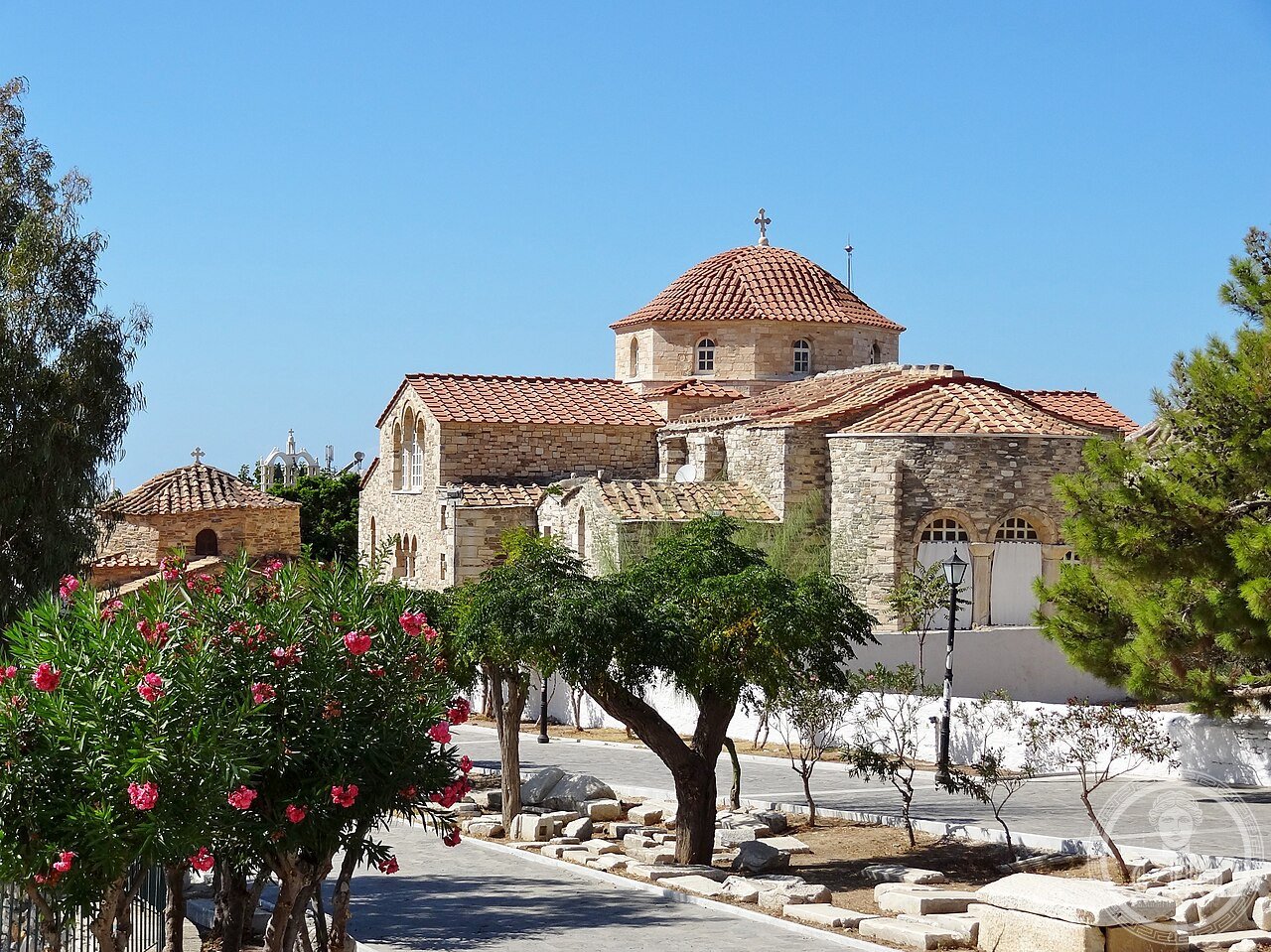
A cruciform main church anchors a wider complex including the Chapel of Agios Nikolaos, possibly the oldest surviving structure on site, and a 4th-century baptistery with a cruciform font among the best preserved of its era anywhere in Orthodox Christendom. The 1959-1964 restoration uncovered Justinian-era stonework beneath later accretions, giving the complex today a closer resemblance to its 6th-century form than it had for centuries.
Practical information
- Opening hours: generally open daily with seasonal variation; check current hours before visiting, especially around the 15 August festival.
- Address: Parikia, Paros, Greece.
Getting there
Panagia Ekatontapyliani stands in the centre of Parikia, Paros’s main town, easily reached on foot from the port. GPS: 37°05′06″N, 25°09′06″E.
Nearby
- Parikia — the main town and port of Paros.
- Archaeological Museum of Paros — a short walk from the church.
Sources
- Wikipedia — “Panagia Ekatontapiliani” (en.wikipedia.org).
- Greeka.com — Paros sightseeing, Panagia Ekatontapiliani.
- Monastiria.gr — “Pilgrimage of Panagia Ekatontapyliani, Paros Island”
Find it on the map
See this place and what’s around it →📷 Become a Cultural Heritage Online photographer
Share your photos of places: they stay published under your name as the author. The more they're seen, the more you get noticed — and soon a contest will reward the most appreciated photos.
Log in or sign up free to add a photo