
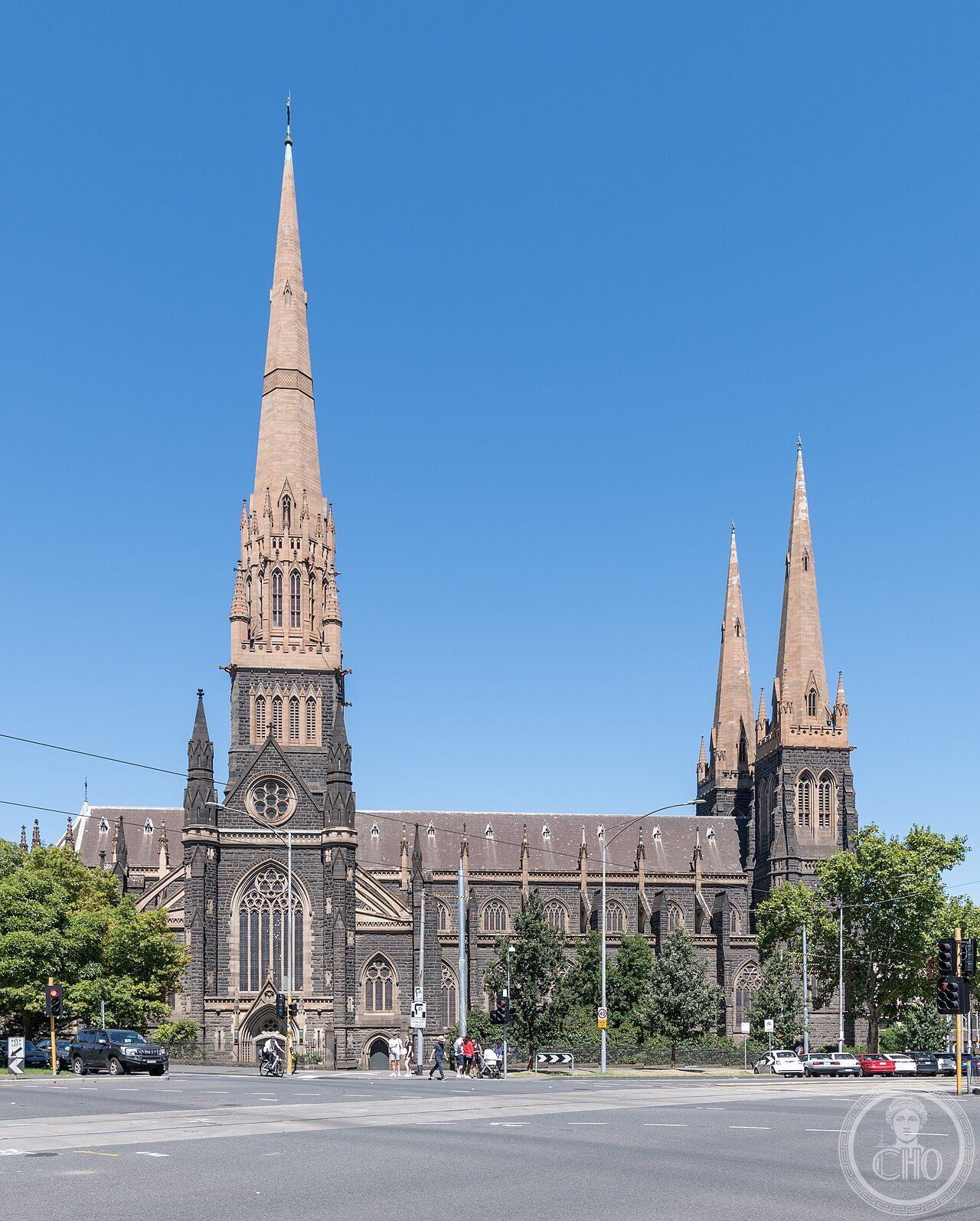
In Melbourne, Bishop Goold blessed a foundation stone for a smaller church on the site on 9 April 1850, a design later abandoned. The present Gothic Revival cathedral was designed by the architect William Wardell, the same man who would later design the cathedral of St Mary in Sydney, in a similar but even larger style. Its own foundation stone was laid on 25 March 1860, after Wardell had arrived in Melbourne and work on the new foundations had already begun in December 1858. The nave and the transepts were blessed and opened for worship on 29 November 1868, but the cathedral, still without its spires, was fully consecrated only on 1 November 1897. The three spires, built to a taller design than the original one by Wardell, commissioned by Archbishop Mannix from the firm Conolly & Vanheems and built from the middle of the Thirties, were completed in 1939, after some 81 years of work in all. Built of bluestone, the dark basalt quarried at Footscray, with sandstone dressings, the cathedral has a central spire 105 metres high and two flanking spires of about 62 metres, which make it, according to numerous sources, the tallest church and the largest ecclesiastical building in Australia, although no single official ranking confirms it. Inside there are stained-glass windows mostly by the Hardman firm of Birmingham, with two windows in the Blessed Sacrament Chapel by Franz Mayer of Munich, a high altar and Stations of the Cross bought in Rome in 1887, an altar of Carrara marble inlaid with rosso antico and lapis lazuli, Venetian glass mosaics on the reredos, and a pipe organ largely rebuilt by George Fincham & Sons between 1962 and 1964, with 81 speaking stops, restored again in 1996-97 for the centenary of the consecration. Raised to minor basilica in 1974, the cathedral is the seat of the Catholic archbishop of Melbourne and hosts major Catholic and civic ceremonial occasions.
About St Patrick’s Cathedral
In Melbourne, Bishop Goold blessed a foundation stone for a smaller church on the site on 9 April 1850, a design later abandoned; the present Gothic Revival cathedral, designed by architect William Wardell — who would later design St Mary’s Cathedral in Sydney, in a similar but even larger style — had its own foundation stone laid on 25 March 1860, after Wardell arrived in Melbourne and work on new foundations had already begun in December 1858. The nave and transepts were blessed and opened for worship on 29 November 1868, but the cathedral, still lacking its spires, was fully consecrated only on 1 November 1897; the three spires, built to a taller design than Wardell’s original, commissioned by Archbishop Mannix from the firm Conolly & Vanheems and constructed from the mid-1930s, were completed in 1939, after roughly 81 years of construction overall. Built of bluestone, the dark basalt quarried at Footscray, with sandstone dressings, the cathedral has a central spire 105 metres tall and two flanking spires around 62 metres, making it, according to numerous sources, the tallest church and largest ecclesiastical building in Australia, though no single official ranking body confirms this. Inside are stained glass windows mostly by the Hardman firm of Birmingham, with two windows in the Blessed Sacrament Chapel by Franz Mayer of Munich, a high altar and Stations of the Cross purchased in Rome in 1887, a Carrara marble altar inlaid with rosso antico and lapis lazuli, Venetian glass mosaics on the reredos, and a pipe organ substantially rebuilt by George Fincham & Sons between 1962 and 1964, with 81 speaking stops, refurbished again in 1996-97 for the consecration centenary. Elevated to minor basilica status in 1974, the cathedral is the seat of the Catholic Archbishop of Melbourne and hosts major Catholic and civic ceremonial occasions.
Key facts
- 1860: foundation stone laid for William Wardell’s Gothic Revival design.
- 1868: nave and transepts opened for worship; full consecration follows only in 1897.
- 1939: the three spires finally completed, after roughly 81 years of construction.
- 105-metre central spire, widely reported as Australia’s tallest church.
- Built of Footscray bluestone, with English and German stained glass.
- 1974: elevated to minor basilica status, seat of the Archbishop of Melbourne.
History
St Patrick’s construction, spanning three distinct completion milestones across nearly eight decades — nave opening in 1868, full consecration in 1897, spires finished in 1939 — mirrors the same funding-constrained, multi-generational pattern seen at Wardell’s other cathedral in Sydney, suggesting a shared architectural fate for Australia’s grandest colonial-era Catholic churches. The taller-than-originally-planned spires, added under a different architectural firm nearly forty years after Wardell’s death, gave the cathedral its final silhouette only in the 20th century.
What you see
Dark Footscray bluestone rises in Gothic Revival form to a 105-metre central spire, flanked by two smaller towers completed decades after the cathedral itself was first consecrated. Inside, English Hardman and German Mayer stained glass, a Roman-purchased high altar, and a Carrara marble sanctuary inlaid with rosso antico and lapis lazuli reflect nearly a century of accumulated furnishing across the building’s long construction.
Practical information
- Opening hours: generally open daily outside services; check current hours before visiting.
- Address: Cathedral Place, East Melbourne, Victoria, Australia.
Getting there
St Patrick’s Cathedral stands on Eastern Hill in East Melbourne, a short walk from the CBD, easily reached by tram or on foot. GPS: 37°48′36″S, 144°58′34″E.
Nearby
- Fitzroy Gardens — the historic Victorian-era park adjoining the cathedral.
- Melbourne CBD — the city centre, a short walk away.
Sources
- Wikipedia — “St Patrick’s Cathedral, Melbourne” (en.wikipedia.org).
- Melbourne Catholic — official archdiocesan history and architecture pages (melbournecatholic.org).
- eMelbourne: The Encyclopedia of Melbourne Online (emelbourne.net.au).
Find it on the map
See this place and what’s around it →📷 Become a Cultural Heritage Online photographer
Share your photos of places: they stay published under your name as the author. The more they're seen, the more you get noticed — and soon a contest will reward the most appreciated photos.
Log in or sign up free to add a photo