
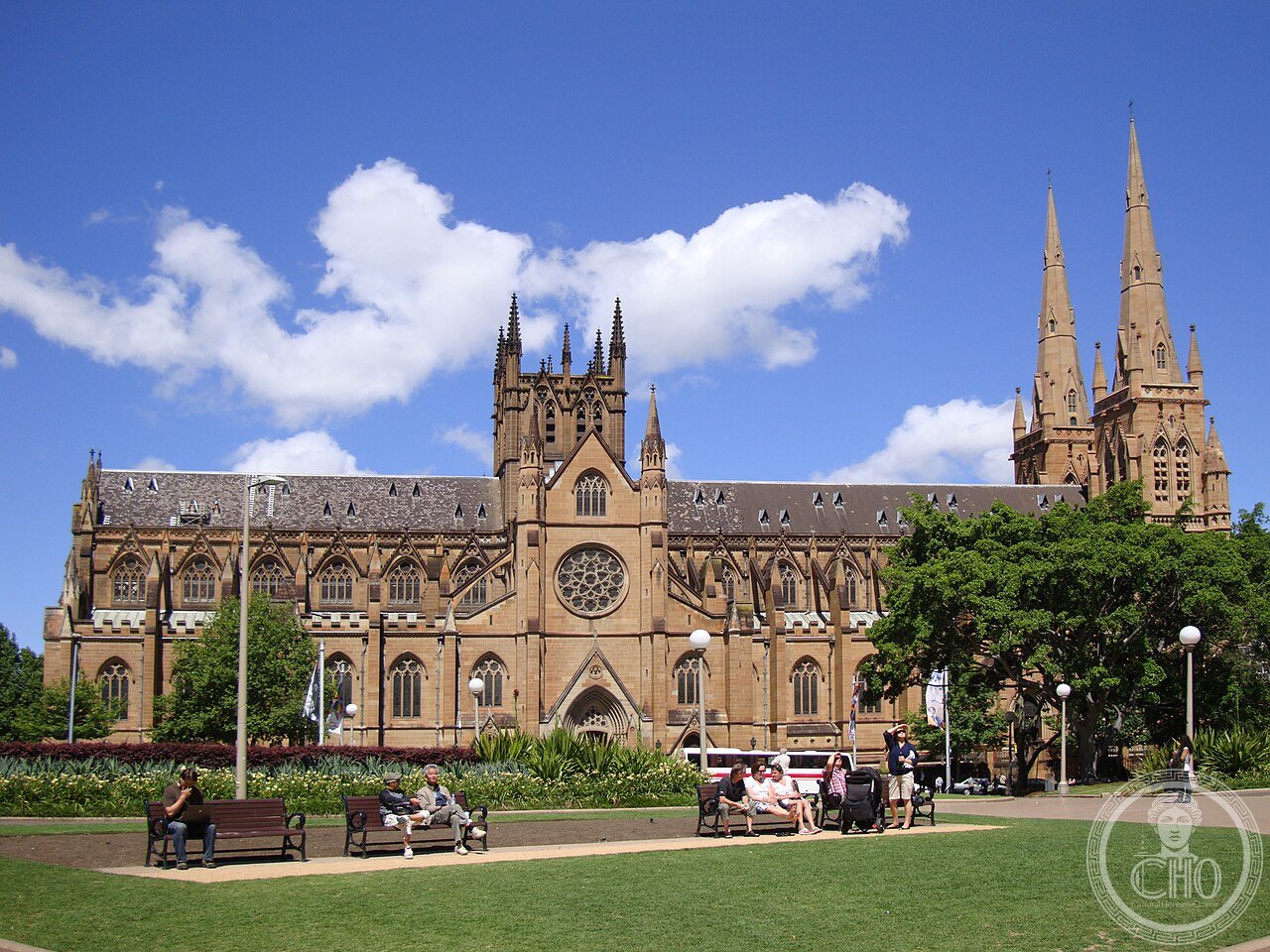
In Sydney, Governor Lachlan Macquarie laid the foundation stone of a first Catholic chapel on 29 October 1821, after Father John Joseph Therry had obtained the land the year before. The building remained without a roof until 1831, however, and the first mass was celebrated there only in December 1833. That first church was destroyed by fire on 29 June 1865, for which the sources record no established cause. In October 1865 Archbishop Polding commissioned the architect William Wardell, a pupil of Pugin, to design its replacement. The first stone of the present cathedral was laid on 8 December 1868, in the Gothic Revival style, the «geometric decorated Gothic» modelled on English work, with the tracery of the chancel window closely reproducing that of Lincoln cathedral. The building was dedicated, though still far from complete, on 8 September 1882. Archbishop Kelly laid the foundation stone of the nave in 1913, and the nave was completed and dedicated in 1928, to coincide with the 29th International Eucharistic Congress, after sixty years of work. Built mainly of Sydney sandstone, with Oamaru stone, marble and alabaster also used, the cathedral holds in its crypt a mosaic and terrazzo floor by the firm of Peter Melocco, with a large Celtic cross design of about 42 by 21 metres and medallions showing the days of Creation and the titles of Mary, described as one of the largest floors of its kind in existence. The two front spires foreseen in the original design of Wardell were never built in his lifetime, nor for decades afterwards, and were finally completed only in 2000, as a millennium project, with modern building methods that used steel frames lifted by helicopter. The actual 150th anniversary of the laying of the first stone was marked separately in 2018. The cathedral, seat of the archbishop of Sydney, was visited by Pope Benedict XVI on 19 July 2008 during World Youth Day in Sydney, although the event as a whole took place across several sites in the city.
About St Mary’s Cathedral
In Sydney, Governor Lachlan Macquarie laid the foundation stone of a first Catholic chapel on 29 October 1821, after Father John Joseph Therry had secured the land the previous year; the building remained roofless until 1831, however, and its first Mass was not celebrated until December 1833. That first church was destroyed by fire on 29 June 1865, for which no confirmed cause survives in the sources. Archbishop Polding commissioned architect William Wardell, a former student of Pugin, in October 1865 to design its replacement: the foundation stone of the present cathedral, in Gothic Revival style, specifically “Geometric Decorated Gothic” modeled on English precedent — with the chancel window tracery closely replicating that of Lincoln Cathedral — was laid on 8 December 1868, and the building was dedicated, though still far from complete, on 8 September 1882; Archbishop Kelly laid the nave’s foundation stone in 1913, and the nave was completed and dedicated in 1928 to coincide with the 29th International Eucharistic Congress, after sixty years of construction. Built mainly of Sydney sandstone, with Oamaru stone, marble and alabaster also used, the cathedral’s crypt holds a mosaic and terrazzo floor by Peter Melocco’s firm, featuring a large Celtic cross design roughly 42 by 21 metres with medallions depicting the days of Creation and Mary’s titles, described as one of the largest floors of its kind. The two front spires envisioned in Wardell’s original design were never built in his lifetime or for decades afterward, and were finally completed only in 2000, as a millennium project using modern construction methods including steel frames lifted by helicopter; the actual 150th anniversary of the foundation stone was marked separately in 2018. The cathedral, seat of the Archbishop of Sydney, was visited by Pope Benedict XVI on 19 July 2008 during World Youth Day Sydney, though the event as a whole took place across multiple sites in the city.
Key facts
- 1821: foundation stone of a first Catholic chapel laid by Governor Lachlan Macquarie.
- 1865: the original chapel destroyed by fire, cause unrecorded.
- 1868-1928: the present cathedral built in stages over sixty years, designed by William Wardell.
- Crypt mosaic floor, roughly 42 by 21 metres, among the largest of its kind.
- 2000: the twin front spires finally completed, 132 years after the foundation stone.
- 19 July 2008: visited by Pope Benedict XVI during World Youth Day Sydney.
History
St Mary’s construction history, spanning the loss of an entire earlier building to fire and then over 130 years to finally add the spires envisioned in the original design, illustrates how colonial-era cathedrals were often built in fragments across generations rather than as single sustained projects. The 2000 completion of its spires, framed as a millennium undertaking rather than tied to any anniversary of the building itself, closed a design gap that had defined the cathedral’s silhouette for well over a century.
What you see
Sandstone Gothic Revival towers, in a Geometric Decorated style modeled closely on English cathedrals like Lincoln, now carry the twin spires added only in 2000 using modern steel-frame construction lifted into place by helicopter. Below, the crypt’s vast mosaic and terrazzo floor, arranged as a Celtic cross with medallions of the days of Creation, ranks among the largest floors of its type anywhere.
Practical information
- Opening hours: generally open daily outside services; crypt access may be separately ticketed; check current hours before visiting.
- Address: St Mary’s Road, Sydney, New South Wales, Australia.
Getting there
St Mary’s Cathedral stands beside Hyde Park in central Sydney, easily reached on foot or by public transport. GPS: 33°52′16″S, 151°12′48″E.
Nearby
- Hyde Park — the central Sydney park facing the cathedral.
- Sydney Opera House — the harbourside landmark a short distance away.
- Royal Botanic Garden Sydney — the historic garden near the harbour.
Sources
- Wikipedia — “St Mary’s Cathedral, Sydney” (en.wikipedia.org).
- Dictionary of Sydney — “St Mary’s Cathedral” entry.
- St Mary’s Cathedral official site — History & Art, Crypt pages (stmaryscathedral.org.au).
Find it on the map
See this place and what’s around it →📷 Become a Cultural Heritage Online photographer
Share your photos of places: they stay published under your name as the author. The more they're seen, the more you get noticed — and soon a contest will reward the most appreciated photos.
Log in or sign up free to add a photo