
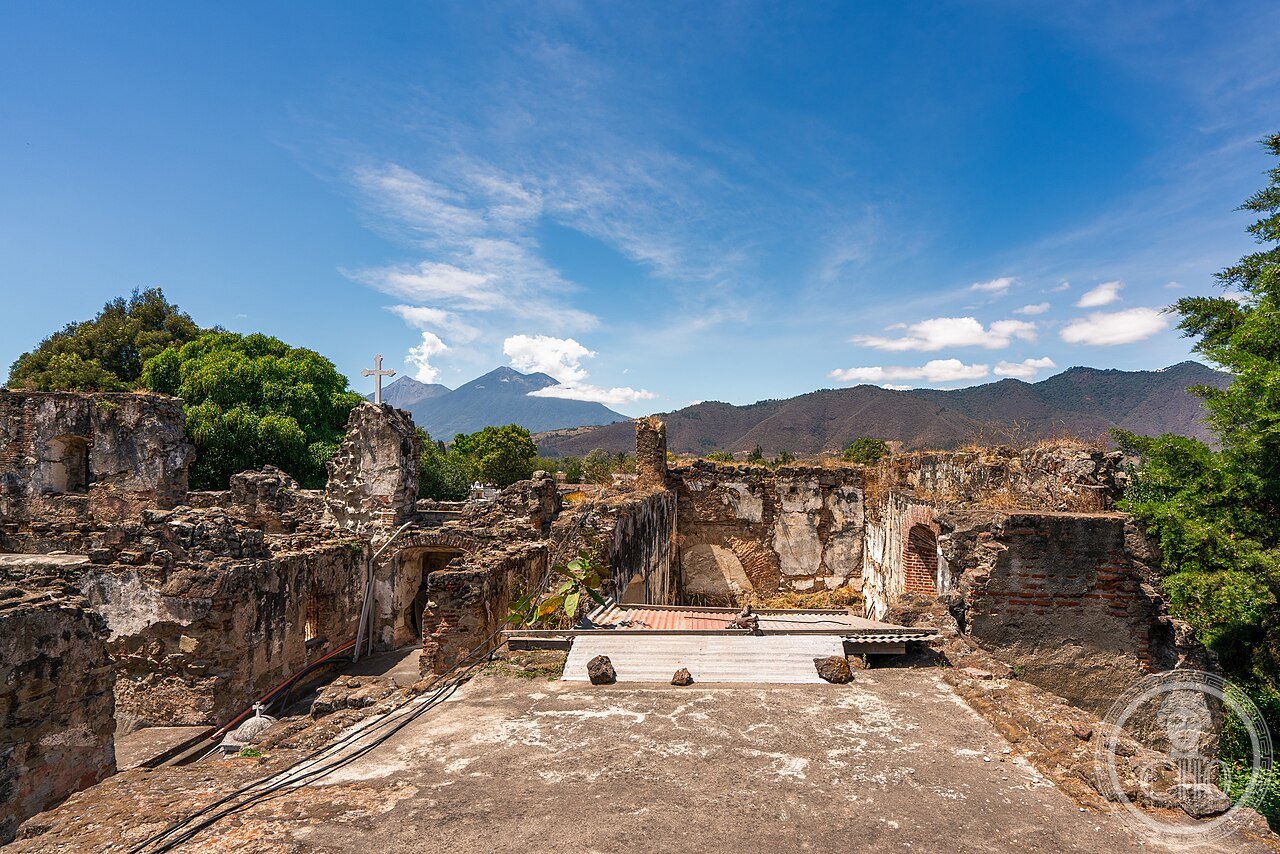
At Antigua Guatemala the Franciscans, who reached Guatemala in 1530, moved to the Panchoy valley in 1541. A first chapel was damaged in 1565, a new sanctuary rose in 1579, and the great church seen today, designed by Diego de Porres, was inaugurated in 1702. The building was struck by the earthquakes of 1717 and 1751, and largely destroyed by the catastrophic one of 1773, the event that led to the abandonment of Antigua as colonial capital. A further earthquake, in 1976, caused more damage. The complex, left in ruins for almost two centuries, returned to the Franciscans in 1960 and the church was rebuilt between 1961 and 1967: the building of today is therefore largely a reconstruction of the 20th century, while part of the convent remains unrestored. The church holds the tomb of Pedro de San José Betancur, born in Tenerife, in the Canaries, in 1626 and dead at Antigua in 1667. Too poor to complete his studies for the priesthood, he became a Franciscan tertiary, founded the Bethlehemite order and set up what is described as the first hospital in the Americas dedicated to the poor and the convalescent, the Hospital de Belén. Beatified in 1980, he was canonised by Pope John Paul II in Guatemala City on 30 July 2002, becoming the first saint of Central America. His tomb, inside the church, remains a place of pilgrimage for thousands of the faithful every year. The complex also holds the Museum of Brother Pedro, opened in 1982, which keeps his personal relics: cloak, burial tunic, staff, rosary and the little bell he rang every night through the streets of Antigua. The church forms part of the historic centre of Antigua Guatemala, inscribed on the UNESCO World Heritage List in 1979.
About San Francisco el Grande
In Antigua Guatemala, the Franciscans, who arrived in Guatemala in 1530, moved to the Panchoy Valley in 1541; an early chapel was damaged in 1565, a new sanctuary went up in 1579, and the grand church seen today, designed by Diego de Porres, was inaugurated in 1702. The building was struck by earthquakes in 1717 and 1751, and largely destroyed by the catastrophic 1773 earthquake that led to Antigua’s abandonment as colonial capital; a further earthquake in 1976 caused additional damage. Left in ruins for nearly two centuries, the complex was returned to the Franciscans in 1960 and the church was reconstructed between 1961 and 1967 — the building standing today is thus largely a 20th-century reconstruction, while part of the convent remains unrestored. The church holds the tomb of Pedro de San José Betancur, born in Tenerife, in the Canary Islands, in 1626 and died in Antigua in 1667: too poor to complete priestly studies, he became a Franciscan tertiary, founded the Bethlehemite Order, and established what is described as the first hospital in the Americas dedicated to the poor and convalescent, the Hospital de Belén. Beatified in 1980, he was canonized by Pope John Paul II in Guatemala City on 30 July 2002, becoming the first saint of Central America; his tomb, inside the church, remains a pilgrimage site for thousands of faithful each year. The complex also houses the Museum of Hermano Pedro, opened in 1982, which preserves his personal relics — cape, burial tunic, walking stick, rosary, and the bell he rang nightly through Antigua’s streets. The church forms part of Antigua Guatemala’s historic centre, inscribed on the UNESCO World Heritage List in 1979.
Key facts
- 1702: the present church, designed by Diego de Porres, is inaugurated.
- 1773: largely destroyed by the earthquake that ended Antigua’s time as colonial capital.
- 1961-1967: the church is reconstructed after nearly two centuries in ruins.
- 1626-1667: the life of Hermano Pedro de Betancur, buried here, founder of the Bethlehemite Order.
- 30 July 2002: Pedro de Betancur canonized by Pope John Paul II, the first saint of Central America.
- 1979: becomes part of the UNESCO World Heritage Site of Antigua Guatemala.
History
The church’s near-two-century interval as ruins, from the 1773 earthquake until reconstruction began in 1961, mirrors the broader fate of Antigua’s colonial religious architecture after the city’s abandonment as capital — a landscape of standing ruins only selectively rebuilt in the 20th century. Its ongoing role as a pilgrimage site rests entirely on the tomb it holds: Hermano Pedro’s 2002 canonization gave this specific, twice-destroyed and twice-rebuilt church a living devotional significance far beyond its architectural history alone.
What you see
A colonial-style facade, substantially rebuilt in the 1960s after two centuries of ruin, fronts a church whose main draw is not its architecture but the tomb of Hermano Pedro inside, alongside the adjoining museum holding his personal relics — cape, tunic, walking stick and nightly bell — set within grounds that still include unrestored sections of the original 1702 convent.
Practical information
- Opening hours: the church is generally open daily; the museum keeps separate visiting hours with a small admission fee; check current hours before visiting.
- Address: 7a Calle Oriente, Antigua Guatemala, Guatemala.
Getting there
The church stands a few blocks southeast of Antigua Guatemala’s central plaza, easily reached on foot within the historic centre. GPS: approximately 14°33′14″N, 90°43′46″W.
Nearby
- Church of La Merced — the yellow Baroque church and its cloister fountain.
- Antigua Guatemala — the UNESCO-listed colonial historic centre.
- Santa Catalina Arch — the iconic yellow arch spanning 5a Avenida Norte.
Sources
- Wikipedia — “Iglesia de San Francisco, Antigua Guatemala” (es.wikipedia.org).
- Vatican — John Paul II canonization homily, 30 July 2002 (vatican.va).
- Prensa Libre / vidaantigua.com — Museo del Hermano Pedro.
Find it on the map
See this place and what’s around it →📷 Become a Cultural Heritage Online photographer
Share your photos of places: they stay published under your name as the author. The more they're seen, the more you get noticed — and soon a contest will reward the most appreciated photos.
Log in or sign up free to add a photo