
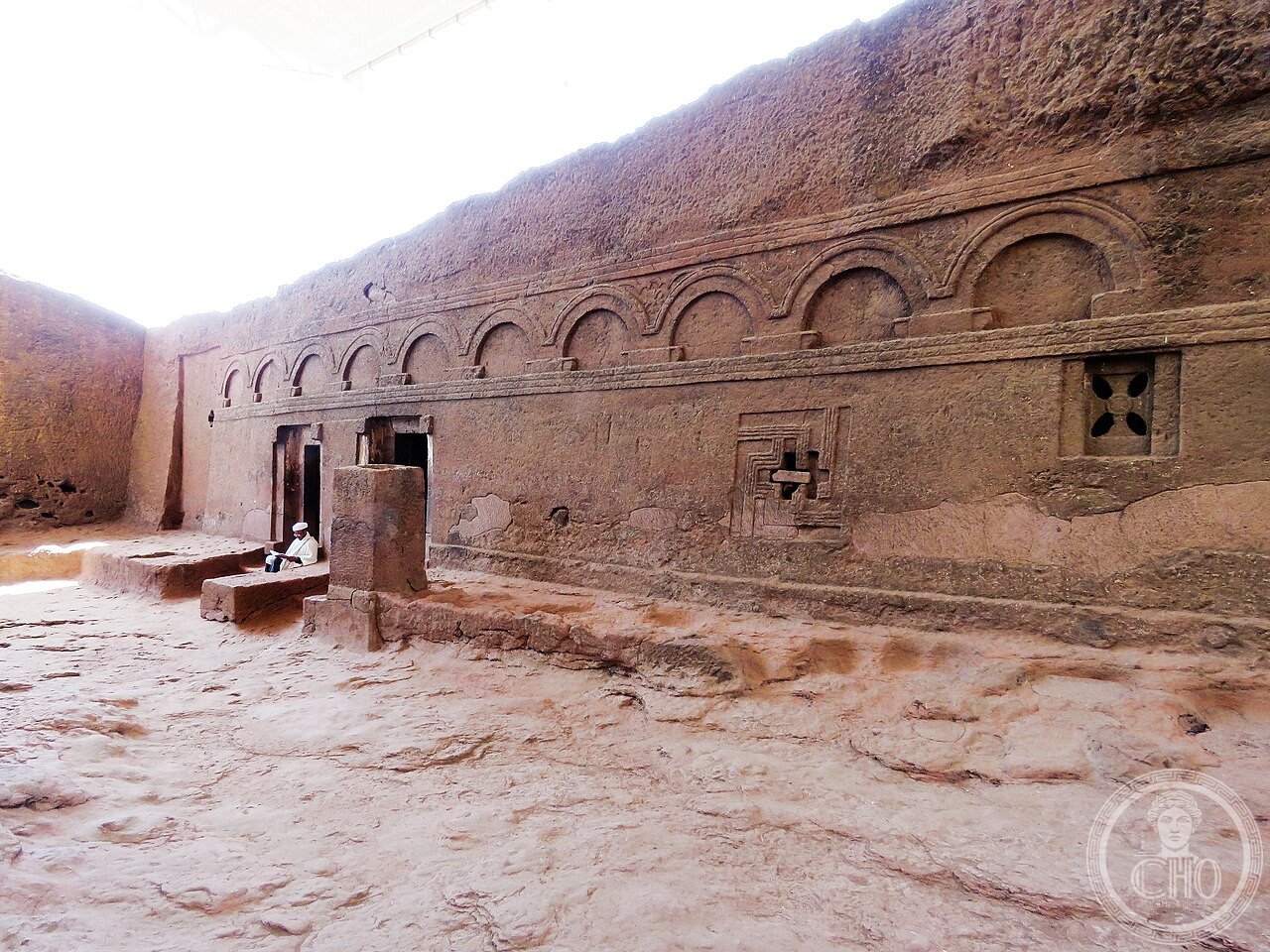
In Lalibela, Ethiopia, the church of Bete Meskel belongs to the northwestern group of rock-hewn churches, together with Bete Medhane Alem, Bete Maryam, Bete Golgotha and Bete Denagel, with which it shares a courtyard. Like the other ten churches, it is attributed to the reign of king Lalibela, of the Zagwe dynasty, part of his project to recreate a “New Jerusalem” in the Ethiopian highlands, datable between the late XII and the early XIII century. It is considered one of the smallest structures in the whole complex, with an estimated area of only about 35 square metres, so much so that several guides describe it more as a chapel than as a proper church. The name “Meskel” means “cross” in Amharic and in Ge’ez, and the church is dedicated to the True Cross. There are, however, no documented sources linking this building specifically to the Ethiopian Meskel festival, which celebrates the finding of the True Cross by Saint Elena, nor to the alleged relic of the True Cross kept elsewhere, at Gishen Maryam: the link remains purely thematic, in the shared name. The church is carved directly into volcanic tuff, with a sober and austere facade on which the marks of the tools used for the excavation are still visible. Nearby are niches carved into the softer rock, once used as hermit cells, some of which contained the skeletal remains of hermits. Since 1978 the church has been part of the UNESCO World Heritage Site “Rock-Hewn Churches of Lalibela.”
About Bete Meskel
Bete Meskel, in Lalibela, Ethiopia, belongs to the northwestern cluster of the town’s rock-hewn churches, sharing a courtyard with Bete Medhane Alem, Bete Maryam, Bete Golgotha and Bete Denagel. Like the other ten churches, it is attributed to the reign of King Lalibela of the Zagwe dynasty, part of his project to recreate a “New Jerusalem” in the Ethiopian highlands, dated broadly to the late 12th or early 13th century. It is considered one of the smallest structures in the entire complex, with an estimated area of only around 35 square metres, small enough that several guides describe it more as a chapel than a full church. The name “Meskel” means “cross” in both Amharic and Ge’ez, and the church is dedicated to the True Cross; no documented sources, however, tie this specific building to Ethiopia’s annual Meskel festival, which commemorates Saint Helena’s discovery of the True Cross, nor to the reputed relic of the True Cross held elsewhere at Gishen Maryam — the connection here remains purely thematic, in the shared name. The church is carved directly into volcanic tuff bedrock, its plain, austere facade still bearing visible tool marks from its excavation; nearby, niches carved into softer surrounding rock once served as hermit cells, some historically containing the skeletal remains of hermits. Since 1978, the church has formed part of the UNESCO World Heritage Site “Rock-Hewn Churches, Lalibela.”
Key facts
- Late 12th-early 13th century: attributed to the reign of King Lalibela, Zagwe dynasty.
- ~35 square metres, among the smallest of the eleven churches.
- “Meskel” means “cross” in Amharic and Ge’ez; dedicated to the True Cross.
- Northwestern cluster, sharing a courtyard with Bete Golgotha, Bete Maryam and Bete Denagel.
- Nearby hermit-cell niches, some historically containing skeletal remains.
- 1978: becomes part of the UNESCO World Heritage Site “Rock-Hewn Churches, Lalibela”
History
Bete Meskel’s modest scale and unassuming construction, among the humblest of Lalibela’s eleven churches, complete the picture of a complex encompassing everything from the vast Bete Medhane Alem to this small, chapel-like structure sharing its courtyard. Its proximity to rock-cut hermit cells reflects the ascetic dimension of the wider Lalibela complex, a reminder that the town’s religious life extended well beyond the eleven principal churches into a broader landscape of individual monastic devotion.
What you see
The church’s plain, tool-marked facade rises directly from the volcanic tuff bedrock of its shared courtyard, its modest scale offering a stark contrast to the elaborate carving found at Lalibela’s larger churches. Nearby rock-cut niches, once used as hermit cells, add a further layer to the site’s dense concentration of religious architecture within a single confined courtyard space.
Practical information
- Opening hours: generally open daily with seasonal variation; admission fee applies; check current hours before visiting.
- Address: Lalibela, Amhara Region, Ethiopia.
Getting there
Bete Meskel stands within the northwestern cluster of Lalibela’s rock-hewn churches, reachable on foot within the town. GPS: 12.0339° N, 39.0434° E.
Nearby
- Bete Golgotha — sharing the same courtyard, nearby.
- Bete Denagel — another of the complex’s smallest churches, adjacent.
- Lalibela town — the surrounding highland town, source of the church complex’s name.
Sources
- Wikipedia — “Biete Meskel” and “Rock-Hewn Churches, Lalibela” (en.wikipedia.org).
- UNESCO World Heritage Centre — “Rock-Hewn Churches, Lalibela” (whc.unesco.org).
- Zamani Project, University of Cape Town — 3D documentation of Lalibela (zamaniproject.org).
Find it on the map
See this place and what’s around it →📷 Become a Cultural Heritage Online photographer
Share your photos of places: they stay published under your name as the author. The more they're seen, the more you get noticed — and soon a contest will reward the most appreciated photos.
Log in or sign up free to add a photo