
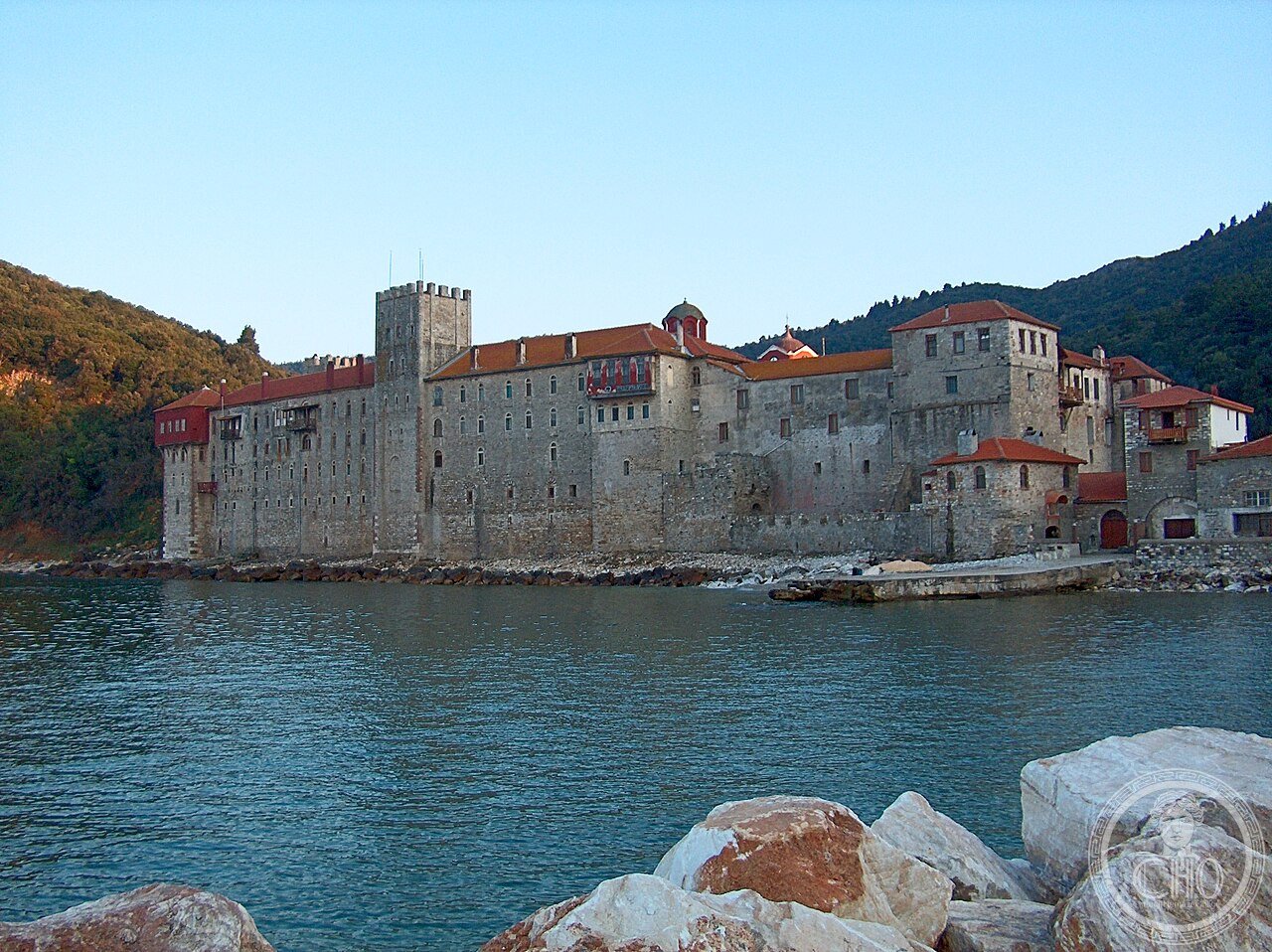
The monastery of Esphigmenou, the northernmost of those on Mount Athos, stands directly on the coast, literally “squeezed” between three hills and the sea: this is the origin of its name, which in Greek means “tightly girded.” Tradition attributes its founding to the V century, under the emperor Theodosius II and his sister Pulcheria, but this is a legend with no historical confirmation. Archival documents attest to its existence from the period 1016-1046. The monastery holds eighteenth place in the hierarchy of the twenty ruling monasteries of Mount Athos. Since 1972 the monastic community of Esphigmenou has lived in a state of schism with the Ecumenical Patriarchate of Constantinople and with the rest of Mount Athos. The break followed that year’s meeting between Patriarch Athenagoras and Pope Paul VI, who revoked the mutual excommunications of 1054, a gesture that the monks of Esphigmenou regarded as a betrayal of Orthodoxy tied to ecumenism. Since then the brotherhood has stopped liturgically commemorating the successive patriarchs, displaying the banner with the motto “Orthodoxy or Death” (Ẁρθοδοξία ὢ Θάνατος). In 2002 Patriarch Bartholomew formally declared the community schismatic, and the Greek courts ruled its occupation illegal. An alternative, canonically recognized brotherhood was installed between 2005 and 2006, giving rise to two rival communities. Clashes occurred in 2006 and in 2013, with criminal convictions for abbot Methodios and other monks, while in July 2024 the Greek police prepared a large-scale eviction operation, whose final outcome is not confirmed by the most recent sources available. The monastery nonetheless remains part of the UNESCO World Heritage of Mount Athos, inscribed in 1988 as a single site covering the entire monastic peninsula.
About Esphigmenou Monastery
Esphigmenou Monastery, the northernmost of the Mount Athos monasteries, stands directly on the coast, literally “squeezed” between three hills and the sea — the source of its Greek name, meaning “tightly girded.” Tradition attributes its founding to the 5th century, under the Byzantine Emperor Theodosius II and his sister Pulcheria, though this remains legend rather than documented history; archival evidence confirms the monastery’s existence from the period 1016-1046. Esphigmenou ranks eighteenth in the hierarchy of Mount Athos’s twenty ruling monasteries. Since 1972, the monastic brotherhood of Esphigmenou has remained in schism with the Ecumenical Patriarchate of Constantinople and the rest of Mount Athos; the break followed that year’s meeting between Patriarch Athenagoras and Pope Paul VI, which lifted the mutual excommunications of 1054, an act the monks of Esphigmenou regarded as a betrayal of Orthodoxy tied to ecumenism. Since then, the brotherhood has ceased liturgically commemorating successive patriarchs, and displays a banner bearing the motto “Orthodoxy or Death” (Ορθοδοξία ή Θάνατος). In 2002, Patriarch Bartholomew formally declared the community schismatic, and Greek courts ruled its occupation of the monastery illegal; a rival, canonically recognised brotherhood was installed between 2005 and 2006, producing two competing communities. Clashes occurred in 2006 and 2013, with criminal convictions against abbot Methodios and other monks, and in July 2024 Greek police prepared a large-scale eviction operation, the ultimate outcome of which is not confirmed in the most recent available reporting. Despite this ongoing dispute, the monastery remains part of the UNESCO World Heritage Site “Mount Athos,” inscribed in 1988 as a single designation covering the entire monastic peninsula.
Key facts
- 1016-1046: earliest documented evidence of the monastery’s existence.
- 18th in the hierarchy of Mount Athos’s twenty ruling monasteries.
- 1972: the brotherhood breaks communion with the Ecumenical Patriarchate over ecumenism.
- “Orthodoxy or Death” banner displayed at the monastery since the schism.
- 2002-2024: ongoing legal and physical disputes between the schismatic brotherhood and church/state authorities.
- 1988: part of the UNESCO World Heritage Site “Mount Athos,” unaffected by the community’s canonical status.
History
Esphigmenou’s 1972 break with the Ecumenical Patriarchate, sparked by opposition to that year’s rapprochement between Patriarch Athenagoras and Pope Paul VI, makes the monastery a rare and long-running case of internal schism within a UNESCO-inscribed religious community, its dispute with church and state authorities continuing largely unresolved for over five decades. The monastery’s isolated coastal position, hemmed in by the hills that give it its name, has done little to shield it from a controversy that has repeatedly drawn national and international attention to an otherwise remote corner of the Athonite peninsula.
What you see
The monastery’s fortified walls rise directly from the narrow coastal strip between its namesake hills, its “Orthodoxy or Death” banner a visible marker of the community’s decades-long schismatic stance. Visitors approaching by sea encounter a monastery whose modest architectural profile belies its outsized role in one of modern Orthodox Christianity’s most persistent internal controversies.
Practical information
- Access: Mount Athos requires a special entry permit (diamonitirion); open only to men, following traditional Athonite restrictions; access to Esphigmenou specifically may be affected by its ongoing disputed status — check current conditions before visiting.
- Address: Mount Athos peninsula, Chalkidiki, Greece.
Getting there
Esphigmenou Monastery lies on the northeastern coast of the Mount Athos peninsula, near Hilandar, reachable by boat along the coastline from Daphni, the peninsula’s port. GPS: 40.3528° N, 24.1381° E.
Nearby
- Hilandar Monastery — the Serbian monastery on Mount Athos, nearby.
- Vatopedi Monastery — major monastery further along the coast.
- Daphni — the port serving Mount Athos, reachable by boat.
Sources
- Wikipedia — “Esphigmenou” (en.wikipedia.org).
- UNESCO World Heritage Centre — “Mount Athos” (whc.unesco.org).
- Religion News Service / National Catholic Reporter — coverage of the 2024 eviction standoff.
Find it on the map
See this place and what’s around it →📷 Become a Cultural Heritage Online photographer
Share your photos of places: they stay published under your name as the author. The more they're seen, the more you get noticed — and soon a contest will reward the most appreciated photos.
Log in or sign up free to add a photo