
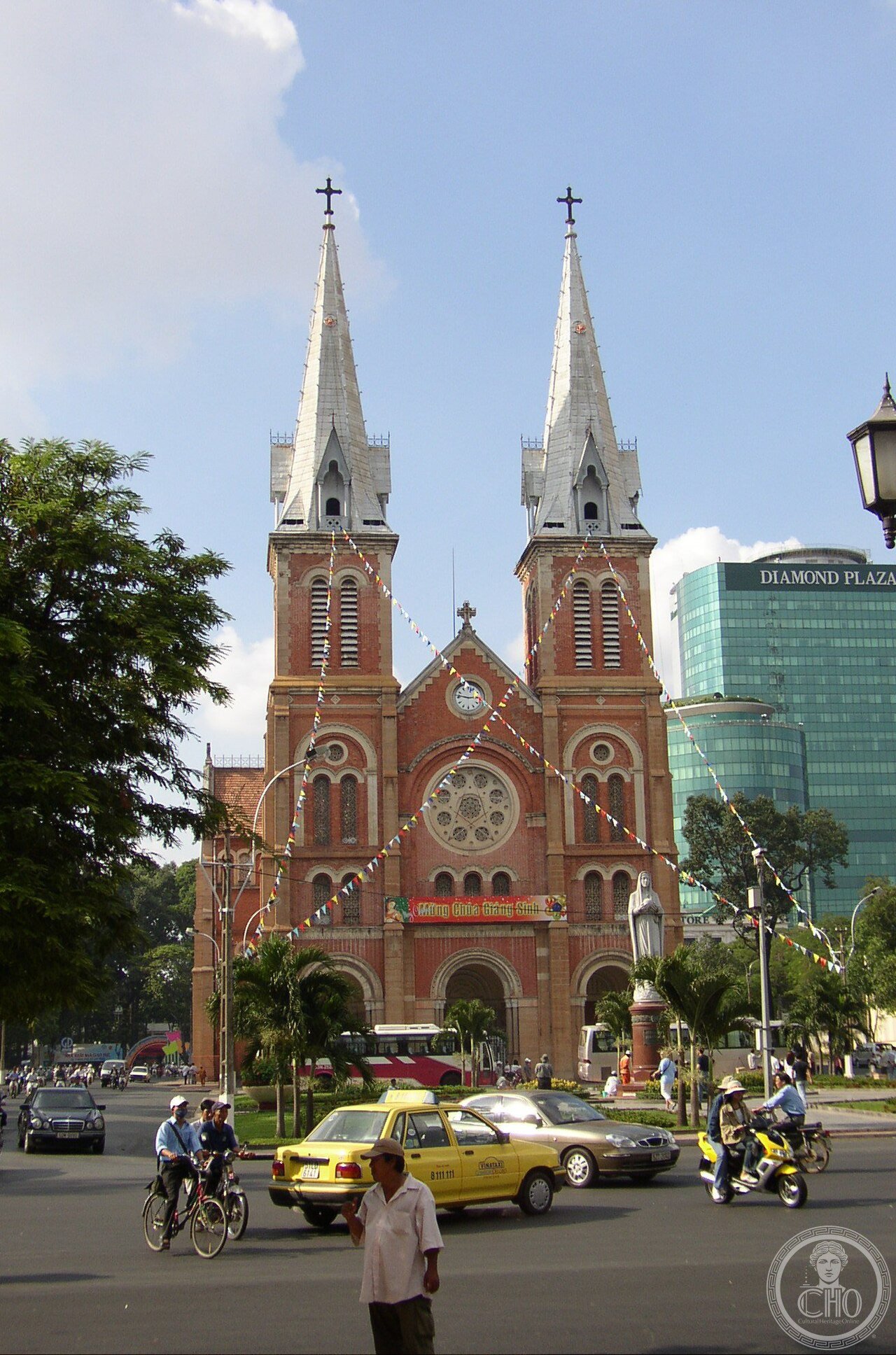
In the heart of Ho Chi Minh City, in Vietnam, the foundation stone of the cathedral of Notre-Dame was laid on 7 October 1877 by the French colonial authorities. The building was inaugurated on Easter Day, 11 April 1880. The design, chosen from seventeen proposals, was the work of the architect Jules Bourard, who drew loosely on Notre-Dame de Paris for its French Romanesque-Gothic style. Every single building material was shipped from France: the facade bricks came from Toulouse, the roof tiles from Marseille, the painted glass from the Lorin workshop of Chartres. The Toulouse bricks, according to tradition, have never been plastered or painted, and still keep their original rose colour more than a century later. In 1895 the two bell towers were added, each 57.6 metres high, housing six bronze bells cast in France with a combined weight of 28.85 tonnes. In front of the cathedral stands the granite statue of the «Queen of Peace», carved in Rome and installed on 16 February 1959. In October 2005 witnesses reported seeing a tear on the face of the statue, an episode that drew large crowds but was never officially confirmed by the Catholic Church in Vietnam. Since 29 June 2017 the cathedral has been undergoing a major restoration, which is still under way.
About Notre-Dame Cathedral Basilica of Saigon
Notre-Dame Cathedral Basilica of Saigon, in the heart of Ho Chi Minh City, Vietnam, had its foundation stone laid on 7 October 1877 under French colonial authorities, with the building inaugurated on Easter Day, 11 April 1880. The design, selected from seventeen submitted proposals, was the work of architect Jules Bourard, who drew loosely on Notre-Dame de Paris for the cathedral’s Romanesque-Gothic style. Every construction material was shipped from France: the facade bricks came from Toulouse, the roof tiles from Marseille, and the stained glass from the Lorin workshop of Chartres. The Toulouse bricks, according to tradition, have never required plastering or paint, retaining their original rose-red colour more than a century after construction — the source of the cathedral’s popular nickname, the “Pink Cathedral.” In 1895, two bell towers, each rising 57.6 metres, were added to the building, housing six bronze bells cast in France with a combined weight of 28.85 tonnes. In front of the cathedral stands the granite statue of “Our Lady of Peace,” carved in Rome and installed on 16 February 1959; in October 2005, witnesses reported seeing what appeared to be a tear on the statue’s face, an event that drew large crowds but was never officially confirmed by the Catholic Church in Vietnam. Since 29 June 2017, the cathedral has been undergoing a major renovation that remains ongoing, meaning visitors may encounter partial closures or scaffolding depending on when they visit. The cathedral remains the seat of the Archdiocese of Ho Chi Minh City and one of the city’s most recognisable landmarks.
Key facts
- 1877-1880: construction under French colonial authorities, architect Jules Bourard.
- All materials imported from France: Toulouse bricks, Marseille roof tiles, Chartres stained glass.
- 1895: two 57.6-metre bell towers added, housing six bronze bells weighing 28.85 tonnes combined.
- “Pink Cathedral”: nickname from the unpainted, still-vivid Toulouse brick facade.
- 1959: the granite “Our Lady of Peace” statue installed in front of the cathedral.
- 2017-ongoing: major renovation project, may affect visitor access.
History
Notre-Dame Cathedral Basilica of Saigon stands as one of the most complete surviving expressions of French colonial ambition in Indochina, its wholly imported construction materials reflecting both the technical limitations of building in colonial Saigon and the deliberate symbolic transplantation of metropolitan French architecture into the colony’s administrative heart. Its continued active use as the seat of the Archdiocese of Ho Chi Minh City, even through a modern Vietnam far removed from its colonial origins, reflects the cathedral’s enduring civic and religious significance well beyond the era that produced it.
What you see
The cathedral’s Romanesque-Gothic facade, built of unpainted rose-red Toulouse brick, rises between twin bell towers added in 1895, their combined bronze bells among the heaviest sets of church bells anywhere in Southeast Asia. In front of the building, the granite “Our Lady of Peace” statue, carved in Rome and installed in 1959, forms the focal point of Paris Commune Square, the public space facing the cathedral’s entrance.
Practical information
- Opening hours: currently affected by an ongoing renovation project begun in 2017; check current access before visiting.
- Address: Paris Commune Square, District 1, Ho Chi Minh City, Vietnam.
Getting there
Notre-Dame Cathedral Basilica of Saigon stands in District 1, the centre of Ho Chi Minh City, easily reached on foot from most central districts. GPS: 10.7797° N, 106.6992° E.
Nearby
- Saigon Central Post Office — another French colonial-era landmark, directly adjacent.
- Reunification Palace — historic government building, a short walk away.
- Ben Thanh Market — the city’s famous central market, nearby.
Sources
- Wikipedia — “Notre-Dame Cathedral Basilica of Saigon” (en.wikipedia.org).
- Atlas Obscura — “Notre-Dame Cathedral Basilica of Saigon in Ho Chi Minh City” (atlasobscura.com).
- AN Tours Vietnam — “Full history of Notre Dame Basilica Saigon” (antravelvietnam.com).
Find it on the map
See this place and what’s around it →📷 Become a Cultural Heritage Online photographer
Share your photos of places: they stay published under your name as the author. The more they're seen, the more you get noticed — and soon a contest will reward the most appreciated photos.
Log in or sign up free to add a photo