
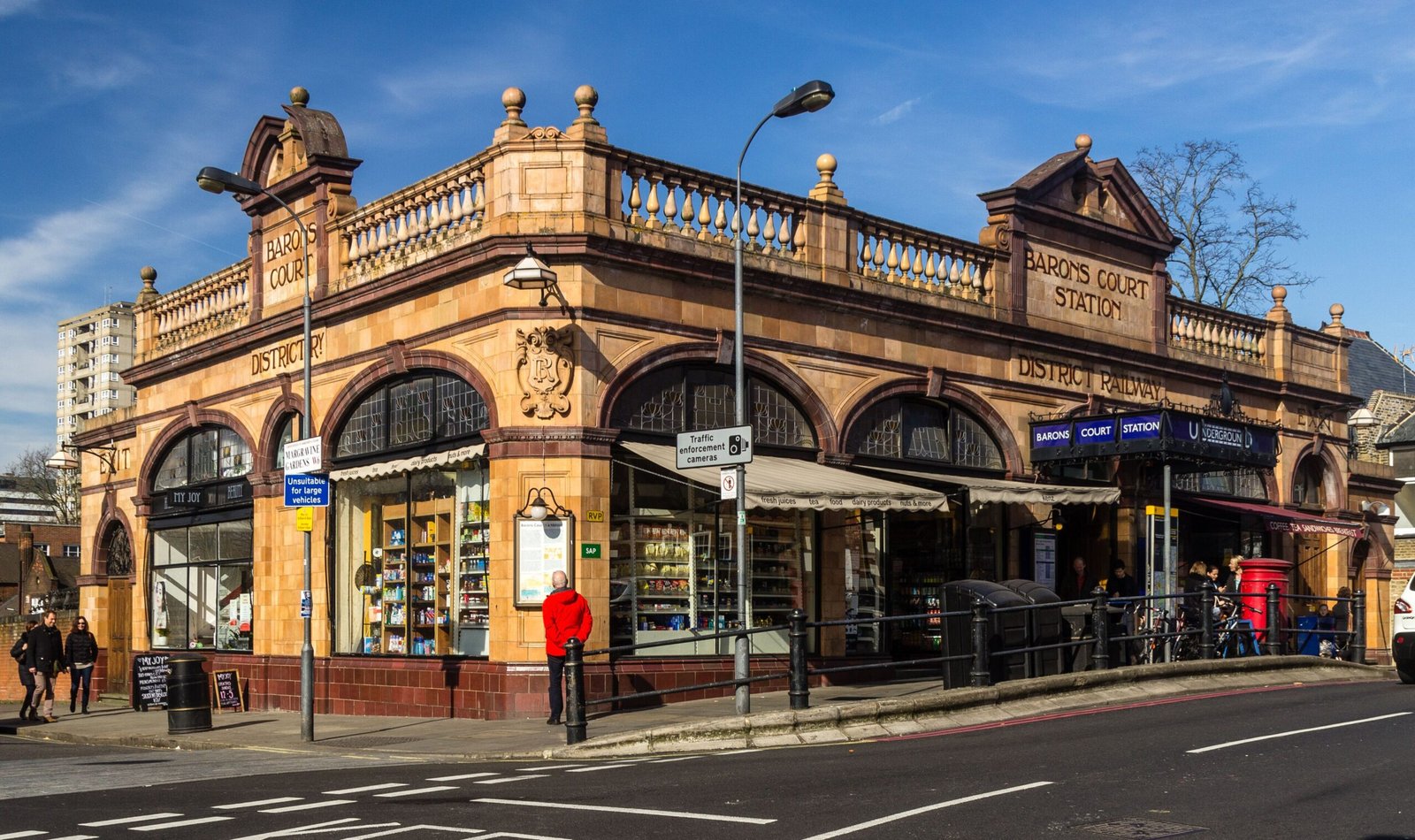
A West London transit hub where the District and Piccadilly lines converge, marking the threshold between open-air and underground travel on one of the world’s oldest rapid-transit networks.
At a glance
Barons Court station serves the neighbourhood of West Kensington in the London Borough of Hammersmith and Fulham, sitting in fare zone 2. Two of London’s most heavily used lines intersect here with convenient cross-platform interchange.
History
The station emerged as a junction point as London’s Underground network expanded westward. Its location on both the District and Piccadilly lines reflects the layered development of the system across the late 19th and 20th centuries.
What you see
The station occupies a transitional zone in the Underground’s geography. East of the platforms, the Piccadilly line descends into tunnel toward Earl’s Court, while the District line continues in an open cutting toward West Kensington. Barons Court represents the last open-air stop for eastbound Piccadilly line passengers until Arnos Grove, several miles north.
Cultural significance
As an interchange point, Barons Court carries symbolic weight in London’s transport infrastructure. The contrast between surface and subterranean travel at this single location illustrates the engineering pragmatism that characterised the Underground’s expansion into suburban west London.
Key facts
- Country: United Kingdom
- City: London Borough of Hammersmith and Fulham
- Lines served: District and Piccadilly
- Fare zone: 2
- Coordinates: 51.49°N, 0.21°W
Practical information & getting there
Barons Court is accessible via both the District line (between Hammersmith and West Kensington) and the Piccadilly line (between Hammersmith and Earl’s Court). Cross-platform interchange allows seamless transfers between lines.
Sources & resources
Find it on the map
See this place and what’s around it →📷 Become a Cultural Heritage Online photographer
Share your photos of places: they stay published under your name as the author. The more they're seen, the more you get noticed — and soon a contest will reward the most appreciated photos.
Log in or sign up free to add a photoIs this page about you?
This page is read by travellers and heritage enthusiasts who find it on Google. Tell us how you are connected to this place and we will take it from there.