
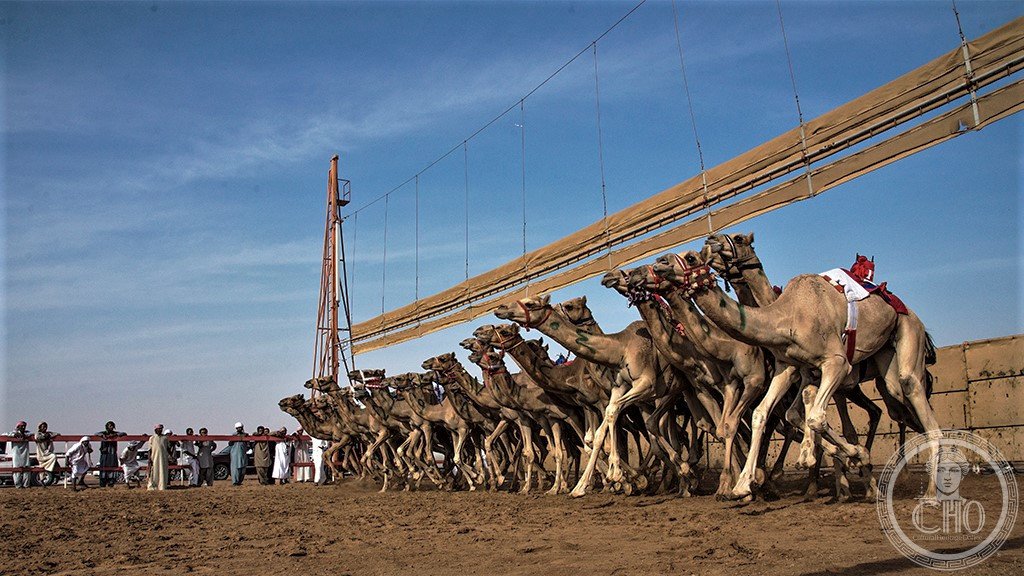
Jockeys compete on camels around circular tracks in a competitive sport that combines traditional horsemanship with modern regulation and technology.
At a glance
Camel racing is a competitive sport in which mounted jockeys guide camels around set laps of a circular racetrack, racing for speed and endurance. The practice thrives across the Middle East, Horn of Africa, Pakistan, Mongolia and Australia, where it serves both as professional sport and cultural expression tied to regional identity and heritage.
Origins & history
Camel racing emerges from centuries of camel herding and trade across desert regions. The sport formalized as a competitive, spectacle-driven practice in the Gulf states, where it became central to regional festive culture and social gatherings.
The practice
A camel racing event features riders astride camels, guiding them in rapid circuits around a track. Camels can reach speeds of 65 km/h in short sprints and sustain 40 km/h for extended periods, their long legs and powerful strides making them formidable racing animals.
Control of the racing camel traditionally fell to child jockeys, who used light whips and verbal commands to direct the animal. In recent decades, following international pressure over labor practices, camel racing has shifted toward remote-controlled robotic whips operated by handlers on the ground—a technological adaptation that preserves the sport while removing direct human jockey presence.
Cultural significance
Camel racing carries deep cultural resonance in Gulf societies, embodying heritage tied to nomadic and trading traditions. As both a professional betting sport and a festive social occasion, it draws spectators across communities and nations, functioning as a vehicle for cultural pride and regional identity.
Key facts
- Primary countries: United Arab Emirates, Oman
- Heartland: Al Ain, United Arab Emirates (24.20795, 55.7406)
- Top speed: 65 km/h in short sprints; sustained speed 40 km/h
- UNESCO ICH reference: 01576
- Modern adaptation: remote-controlled robotic whips have replaced child jockeys in many venues
Where to experience it
Al Ain, in the heart of the United Arab Emirates, remains the center of camel racing culture. The region hosts regular racing events where visitors can witness the speed and skill of both camels and handlers in competitive action.
Sources & resources
- Camel racing — Wikipedia
- Camel Racing: A Social Practice and a Festive Heritage Associated with Camels — UNESCO Intangible Cultural Heritage
- Cultural Heritage Online
Find it on the map
See this place and what’s around it →📷 Become a Cultural Heritage Online photographer
Share your photos of places: they stay published under your name as the author. The more they're seen, the more you get noticed — and soon a contest will reward the most appreciated photos.
Log in or sign up free to add a photo