
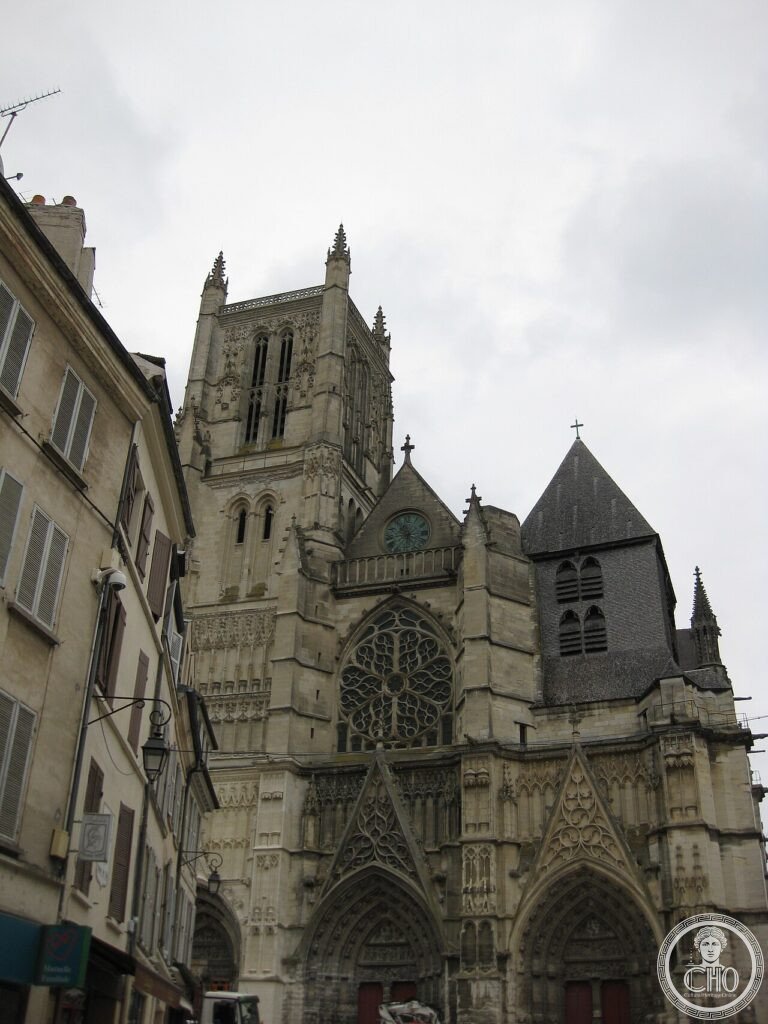
Three hundred and sixty-five years separate the start of the work, under Bishop Simon de Lizy, from the ringing of the bells in the north tower: long enough for the same cathedral to pass through High, Rayonnant and Flamboyant Gothic. In the choir rests Jacques-Bénigne Bossuet, the preacher Louis XIV chose as tutor to the Dauphin.
At a glance
Meaux Cathedral (Cathédrale Saint-Étienne) began construction around 1175 under Bishop Simon de Lizy, who set out to replace the city’s earlier Romanesque church with a new Gothic building — a project that would not reach completion until 1530-1540, when the bells of the north tower finally rang out, closing a construction span of well over three centuries. That extraordinary duration, punctuated by choir subsidence, successive rebuilding campaigns, and interruptions caused by war and religious conflict, means the cathedral physically documents the full evolution of French Gothic architecture within a single building: classical Soissons-style Gothic in parts of the central nave and north transept from the first quarter of the 13th century, giving way to Rayonnant and finally Flamboyant Gothic in the north tower and western nave. Behind wrought-iron grilles in the choir lies the black marble funerary slab of Jacques-Bénigne Bossuet, bishop of Meaux from 1682 to 1704 and one of the most significant figures in French religious and intellectual history, still popularly known by his nickname “l’Aigle de Meaux” (the Eagle of Meaux).
Key facts
- Construction: begun c. 1175 under Bishop Simon de Lizy; completed only 1530-1540, when the north tower’s bells first rang — a span of well over 350 years
- Stylistic range: classical Soissons-style Gothic (parts of the nave and north transept, early 13th century) through Rayonnant to Flamboyant Gothic (north tower and west nave) within a single building
- Construction difficulties: choir subsidence, successive reconstruction campaigns, and interruptions from war and religious conflict across the long building period
- Jacques-Bénigne Bossuet: Bishop of Meaux 1682-1704, celebrated preacher and tutor to the Dauphin (son of Louis XIV), buried in the cathedral choir behind wrought-iron grilles; nicknamed “l’Aigle de Meaux”
- Musée Bossuet: adjoining the cathedral in the former episcopal palace, dedicated to Bossuet’s life and the cathedral’s history
History
Meaux Cathedral’s more than three-and-a-half-century construction period, from Bishop Simon de Lizy’s initial commission around 1175 to the final completion of the north tower’s bells in 1530-1540, makes it one of the longer-running French cathedral building projects, and the specific difficulties recorded across that span — choir subsidence requiring structural remediation, successive changes of architectural plan reflecting evolving Gothic fashion across the centuries, and outright interruptions caused by the Hundred Years’ War and later religious conflict — give the building an unusually well-documented history of setbacks alongside its eventual completion. The resulting stylistic layering, from early 13th-century classical Gothic through to 16th-century Flamboyant work, offers a rare opportunity to trace French Gothic architecture’s full evolutionary arc within one coherent building rather than across separate structures from different periods.
Jacques-Bénigne Bossuet’s tenure as Bishop of Meaux from 1682 to 1704 represents the cathedral’s most historically significant later association: Bossuet, already established as one of the most celebrated preachers and religious writers of Louis XIV’s France, and specifically chosen by the king to tutor the Dauphin, brought national prominence to the Meaux bishopric during his twenty-two years there, and his burial in the cathedral choir — behind wrought-iron grilles that still enclose his black marble funerary slab today — anchors the building’s later identity as much as its medieval construction history does. The adjoining Musée Bossuet, in the former episcopal palace, extends this connection into a dedicated institutional presence, giving visitors a fuller account of Bossuet’s career and its intersection with the cathedral’s own long history.
What you see
The stylistic progression across the building’s more than three-century construction is best appreciated by comparing the early 13th-century classical Gothic sections of the nave and north transept against the visibly more elaborate Flamboyant Gothic work of the north tower and western nave, a direct architectural record of changing Gothic fashion within a single structure. Bossuet’s tomb, in the choir behind its wrought-iron enclosure, remains the building’s principal later-period focal point, connecting the medieval architecture to one of French religious history’s most significant post-medieval figures. The cathedral’s monumental organ and its distinctive black wooden tower structure add further points of interest for visitors moving through the building’s long and layered construction history.
Practical information
- Opening hours: daily, generally 9:00-12:00 and 14:00-17:00 (extended to 18:00 in summer)
- Musée Bossuet: adjoining the cathedral in the former episcopal palace; check current hours separately
- Address: Place Charles de Gaulle, 77100 Meaux
Getting there
Meaux is reachable from Paris via RER line P (SNCF, from Paris Gare de l’Est) in approximately 30-40 minutes, making it a practical half-day or day trip from the French capital. From Meaux station, the cathedral is approximately 5-6 minutes’ walk, and local bus lines 18E and 20E also stop nearby. GPS: 48.9603° N, 2.8789° E.
Nearby
- Musée Bossuet — directly adjoining the cathedral, in the former episcopal palace; Bossuet’s life and the cathedral’s history
- Meaux historic centre — surrounding the cathedral, on the Marne river; the town is also well known for Brie de Meaux cheese and Meaux mustard
- Disneyland Paris — approximately 20-30 minutes by car; unrelated to the historic centre but a well-known regional draw
Sources
- Ministère de la Culture — “La cathédrale Saint-Étienne de Meaux, 850 ans d’histoire, d’art et de lumière” (culture.gouv.fr)
- Musée Bossuet — “La cathédrale Saint-Étienne” (musee-bossuet.fr)
- Diocèse de Meaux — official visitor information (catho77.fr)
- Wikipedia — “Cathédrale Saint-Étienne de Meaux” (fr.wikipedia.org)
Find it on the map
See this place and what’s around it →📷 Become a Cultural Heritage Online photographer
Share your photos of places: they stay published under your name as the author. The more they're seen, the more you get noticed — and soon a contest will reward the most appreciated photos.
Log in or sign up free to add a photoIs this page about you?
This page is read by travellers and heritage enthusiasts who find it on Google. Tell us how you are connected to this place and we will take it from there.