
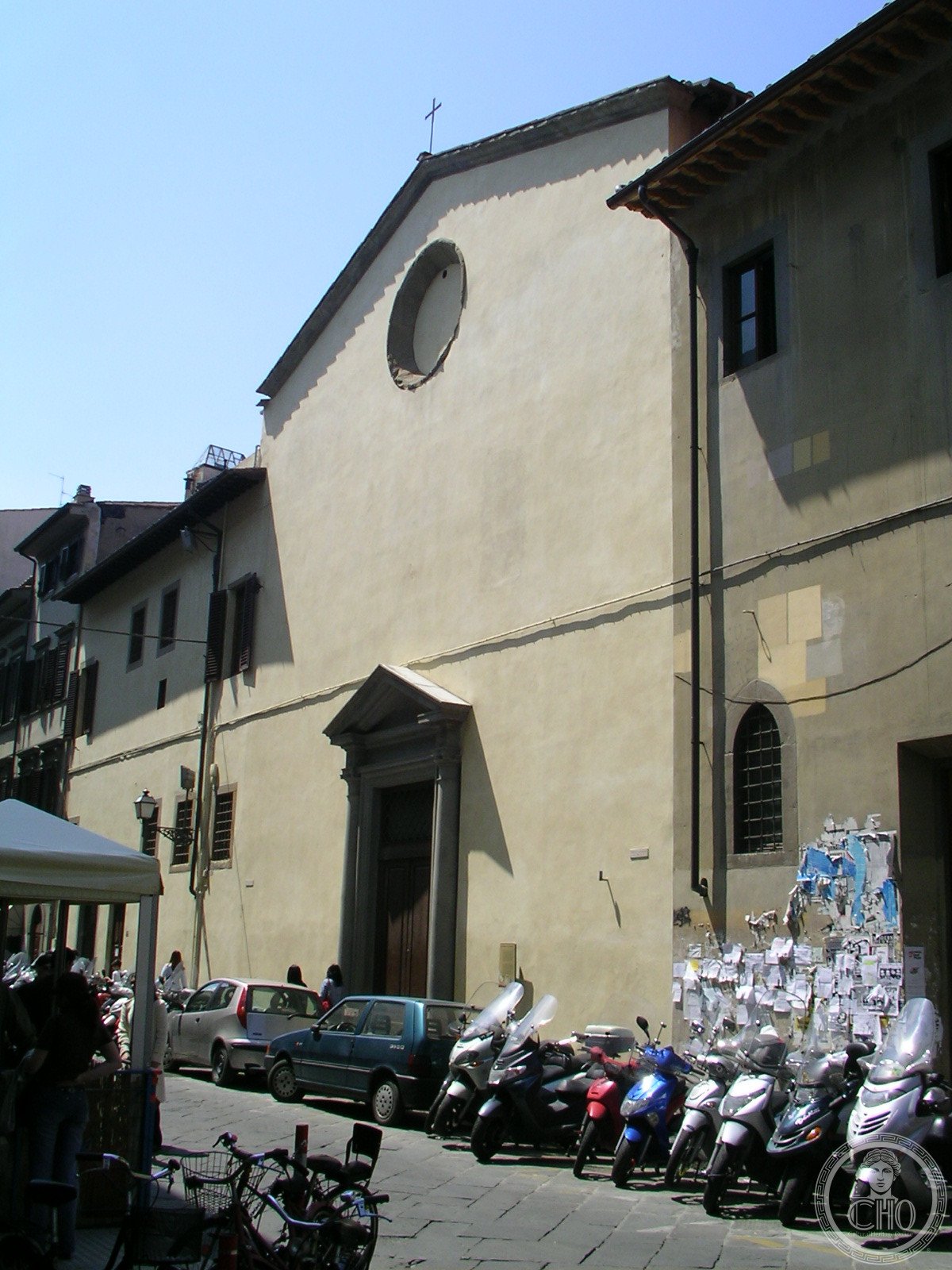
The Cenacolo di Sant’Apollonia is a former convent refectory in Florence housing one of the finest examples of early Renaissance fresco painting: Andrea del Castagno’s monumental Last Supper of c. 1447, which covers an entire wall with a trompe-l’oeil marble room and life-sized figures that anticipate the spatial experiments of later Renaissance masters. Once accessible only to the Benedictine nuns of Sant’Apollonia, the fresco became public after Italian unification (1866) and today forms part of a small state museum managed by the Polo Museale della Toscana.
At a glance
- Type
- State museum (former convent refectory)
- Period
- Fresco dated c. 1447; building mid-14th century onward
- Style
- Early Italian Renaissance
- Location
- Via XXVII Aprile 1, 50129 Florence FI, Italy
- Coordinates
- 43.7793° N, 11.2601° E
Overview
The Cenacolo di Sant’Apollonia preserves a rare and largely intact ensemble of frescoes by Andrea del Castagno (c. 1421-1457), one of the most technically innovative Florentine painters of the 15th century. The Last Supper on the end wall is accompanied by three scenes above it — the Crucifixion, the Deposition, and the Resurrection — creating a complete narrative cycle of the Passion. The museum also holds a collection of sinopie (preparatory drawings on the intonaco layer) detached from the frescoes, allowing visitors to study Castagno’s working method at close range.
History
The convent of Sant’Apollonia was founded in the 14th century and became home to a community of Benedictine nuns who commissioned Castagno to decorate their refectory around 1447. Because the convent was cloistered, the frescoes remained effectively hidden from the public for more than four centuries, known only through fragmentary descriptions. After the suppression of convents by the Italian state in 1866, the building was converted to public use and the refectory opened as a museum, revealing a landmark in the history of Renaissance painting. Subsequent conservation campaigns in the 20th century secured the frescoes’ long-term survival.
What you see
The refectory is a long rectangular hall whose end wall is entirely occupied by Castagno’s fresco. The Last Supper below depicts Christ and the twelve apostles at a marble-panelled table set in a painted room with polychrome marble revetment rendered with remarkable illusionistic precision. Judas is isolated on the near side of the table — a compositional choice that influenced later representations including Leonardo’s version in Milan. Above, three Passion scenes fill a second register, painted with bold expressiveness unusual in mid-15th-century Florence.
Cultural significance
Castagno’s Last Supper occupies a pivotal place in the history of Western painting: it is among the first Italian representations to use a fully illusionistic architectural setting to frame the sacred narrative, anticipating the spatial concerns of Leonardo da Vinci and the High Renaissance. The cenacolo painting tradition was distinctly Florentine, and Sant’Apollonia’s version predates the famous examples at San Marco and Ognissanti by several decades. Its long isolation behind convent walls paradoxically protected it from damage that compromised many comparable Florentine frescoes.
Practical information
- Address
- Via XXVII Aprile 1, 50129 Florence FI
- Opening hours
- Check the official Polo Museale della Toscana website for current hours; typically open mornings Tuesday-Sunday
- Admission
- Check official website for current tariffs; entry has historically been free or low-cost
Getting there
The cenacolo is in the San Marco neighbourhood of central Florence, a short walk from Piazza San Marco and the Galleria dell’Accademia. Bus lines serving Via XXVII Aprile stop nearby; the closest ATAF stops are on Via Cavour and Via La Pira. Florence Santa Maria Novella railway station is approximately 20 minutes on foot.
Sources & resources
See the place
Find it on the map
See this place and what’s around it →📷 Become a Cultural Heritage Online photographer
Share your photos of places: they stay published under your name as the author. The more they're seen, the more you get noticed — and soon a contest will reward the most appreciated photos.
Log in or sign up free to add a photo