
A Dominican music and dance born from the fusion of Spanish, Taíno, and African traditions, bachata emerged from the margins of society in the 20th century to become one of Latin music’s most celebrated global phenomena.
In UNESCO’s words
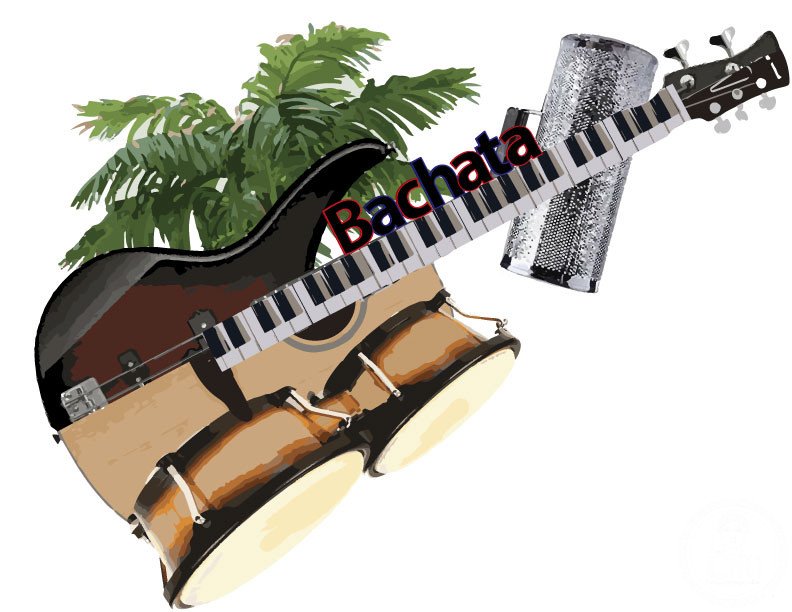
The music and dance of Dominican Bachata is a danceable musical expression, deriving from a fusion of rhythmic bolero with other Afro-Antillean genres such as Son, the Cha-cha-cha, Merengue, etc. The Dominican people consider the music and dance of Bachata as a vernacular cultural manifestation, omnipresent in community celebrations and social gatherings. In general, the lyrics of Bachata express deep, visceral feelings of love, passion and nostalgia. Etymologically, the term ‘bachata’, presumed to be of African origin, originally referred to a lively gathering or party, rather than a musical genre specifically. For its performance, Bachata traditionally requires a small group of musicians, who use one or two guitars as lead instruments (electric guitars are widely used nowadays), and a percussion composed of bongos, maracas and a guiro accompanied by a bass. The music has four tempos per beat and usually one of the musicians is the lead singer. The dance of Bachata is equally passionate, consisting of a couple’s dance characterized by a sensual hip movement and simple eight-step structure. Since the element is an integral part of all traditional celebrations in the Dominican Republic, the dance is learnt spontaneously from a young age, but there are also over a hundred academies, studios and schools dedicated to its transmission.
Official description, UNESCO Intangible Cultural Heritage List — Music and dance of Dominican Bachata
At a glance
Bachata is a danceable musical and dance form rooted in Dominican culture. It fuses rhythmic bolero with Afro-Antillean genres including Son, Cha-cha-cha, and Merengue. The lyrics typically express deep feelings of love, passion, and nostalgia. The term 'bachata', believed to derive from African origins, originally meant a lively gathering rather than a specific musical genre. Today, Dominican people regard it as a vernacular cultural expression present in community celebrations and social gatherings.
Origins & history
The exact historical origins are not detailed in available sources. The term 'bachata', presumed to be of African origin, originally referred to a lively gathering or party before becoming associated with the musical genre itself.
The practice
Bachata traditionally uses a small group of musicians with one or two guitars as lead instruments—electric guitars are now widely used. Percussion includes bongos, maracas, and a guiro, accompanied by bass. The music has four tempos per beat, and typically one musician serves as lead singer. The accompanying dance is a couple's form featuring sensual hip movement and a simple eight-step structure. The dance is learned spontaneously from a young age, though over a hundred academies, studios, and schools now formally teach it.
Cultural significance
Bachata is integral to all traditional celebrations in the Dominican Republic, making it central to community identity. Its transmission happens both organically through youth participation in celebrations and formally through numerous dedicated institutions, ensuring the tradition's continuance across generations.
Key facts
- Country: Dominican Republic
- Inscribed: 2019
- UNESCO list: Representative List of the Intangible Cultural Heritage of Humanity
- UNESCO reference: 01514
- UNESCO vocabulary: Dance; Social gathering; Vocal music
- Map: not shown — UNESCO’s official description of this element names no locality, and a living tradition is practised across a community, not at one address.
Where to experience it
Bachata thrives throughout the Dominican Republic as an integral part of traditional celebrations and social gatherings. Visitors can encounter the music and dance in community events, festivals, and social occasions where locals of all ages perform and learn spontaneously. Over a hundred academies, studios, and schools across the country are dedicated to teaching bachata, offering formal instruction alongside its organic transmission through family and community practice. The tradition also flourishes in Dominican diaspora communities worldwide, where bachata performances and lessons continue to sustain this passionate musical expression.
Sources & resources
- UNESCO — official element page: Music and dance of Dominican Bachata
- UNESCO — open data record: Intangible Heritage List, reference 01514
- UNESCO — official photograph: Nelly Soriano, bachatera — Benjamin de Menil — iASO Records, 2013
- Reference — Wikipedia (secondary): Bachata (music) — consulted as a secondary reference, not as confirmation
- Cultural Heritage Online: Our archive and city guides

Sources
- S1 — Pacini Hernandez, Deborah. Bachata: A Social History of a Dominican Popular Music. Temple University Press, 1995. ISBN 978-1-56639-300-3.
- S2 — Manuel, Peter, et al. Caribbean Currents: Caribbean Music from Rumba to Reggae. Temple University Press, 2006. ISBN 978-1-59213-463-2.
Spotted an error? Write to editorial@culturalheritageonline.com and we correct it the same day.