
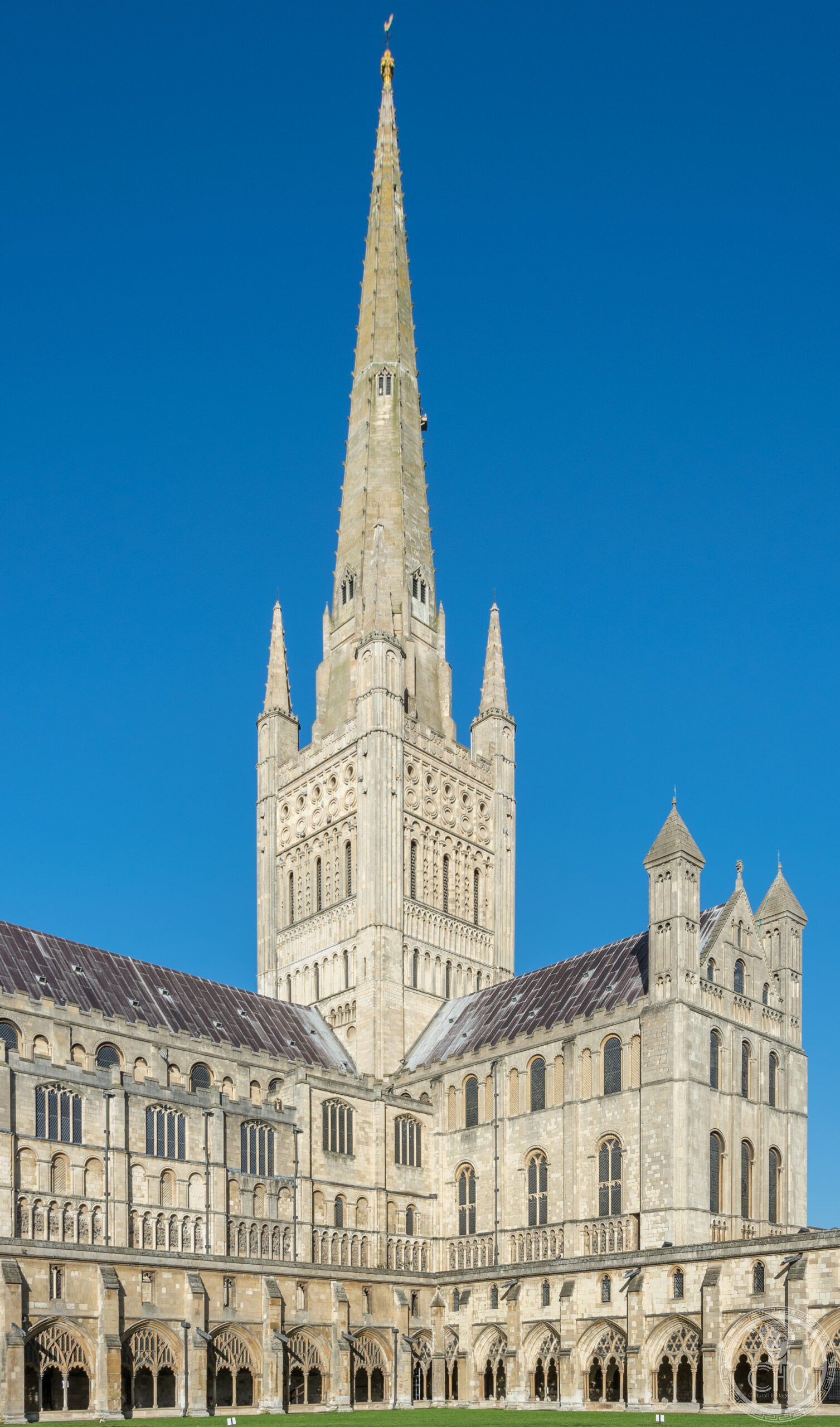
A Norman masterpiece of flint and Caen limestone, Norwich Cathedral dominates East Anglia’s skyline with the second-tallest spire in England and a treasury of medieval carved bosses that survived centuries of destruction.
At a glance
Norwich Cathedral is the seat of the bishop of Norwich and the mother church of the diocese. Its Norman structure, begun in 1096 at the command of Bishop Herbert de Losinga, makes it one of England’s supreme achievements in Romanesque architecture. When completed, its crossing tower made it the largest building in East Anglia.
History
Construction began in 1096 under Bishop Herbert de Losinga, the cathedral’s founder. The Norman building progressed over centuries, with the crossing tower marking the completion of the original design. In 1272, rioters damaged the cathedral; restoration took until 1278. The cloisters, started in 1297, evolved into the fourth largest in England. By 1480, the spire had been rebuilt in stone—a replacement for an earlier wooden version. Around 1830, architect Anthony Salvin remodelled the south transept. A modern hospitality and education facility by Hopkins Architects opened in 2010, formally inaugurated by Elizabeth II and the Duke of Edinburgh.
What you see
The cathedral is built of flint and mortar, faced with pale Caen limestone. The crossing tower measures 461 feet tall and 177 feet wide. Its stone spire, at 315 feet, ranks as the second tallest in England. The cloisters form a substantial quadrangle. The cathedral’s interior preserves an extraordinary ensemble of carved stone bosses—decorative roof panels of exceptional medieval craftsmanship that have endured from the Gothic period onward.
Cultural significance
Norwich Cathedral’s bosses represent one of the world’s greatest medieval sculptural treasures. Their survival through the iconoclasm of the Tudor era and the English Civil War makes them uniquely precious witnesses to English artistic continuity. The cathedral formerly housed one of England’s earliest astronomical clocks. The cathedral close itself occupied a tenth of the medieval city’s total area, reflecting its profound role in Norwich’s urban and spiritual life.
Key facts
- Location: Norwich, Norfolk, United Kingdom (52.631944°N, 1.301111°E)
- Founded: 1096
- Spire height: 315 feet (96 m)—second tallest in England
- Grade I listed building
- UNESCO status: Part of Norwich City Centre (inscribed 2004)
Practical information & getting there
Norwich Cathedral is located in the heart of Norwich, Norfolk. The cathedral is open daily with regular Church of England services. It serves as the administrative center of the diocese of Norwich, overseen by its dean and chapter. For opening hours, services, and current visitor information, consult the cathedral’s official website.
Sources & resources
Find it on the map
See this place and what’s around it →📷 Become a Cultural Heritage Online photographer
Share your photos of places: they stay published under your name as the author. The more they're seen, the more you get noticed — and soon a contest will reward the most appreciated photos.
Log in or sign up free to add a photoIs this page about you?
This page is read by travellers and heritage enthusiasts who find it on Google. Tell us how you are connected to this place and we will take it from there.