

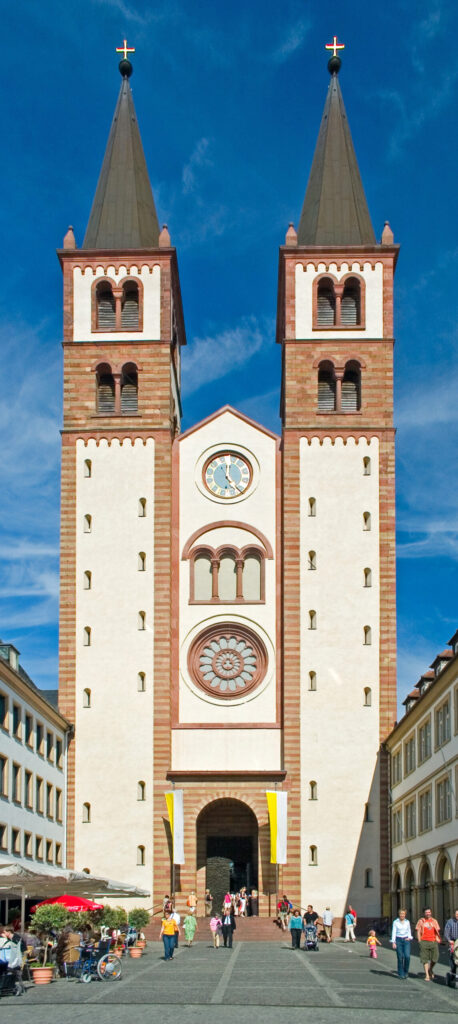
A monumental Romanesque cathedral dedicated to Saint Kilian, rebuilt after wartime destruction. German architecture at its most commanding: 103 metres of stone and devotion.
At a glance
Würzburg Cathedral stands as the seat of the Bishop of Würzburg and the fourth largest Romanesque church in Germany. Its austere grandeur reflects the ambitions of the Salian period, refined by Renaissance and Baroque masters across subsequent centuries.
History
The cathedral served as burial place for the Prince-Bishops of Würzburg for hundreds of years, anchoring the city’s ecclesiastical and political authority. During World War II, British bombardment in March 1945 devastated the structure. Post-war reconstruction restored the building to function and prominence, allowing continuous worship and commemoration.
What you see
At 103 metres long, the cathedral represents a masterpiece of German Romanesque architecture from the Salian period. Tilman Riemenschneider and Balthasar Neumann contributed significant later additions, introducing Renaissance and Baroque elements that enrich the original severe Romanesque vocabulary. The rebuilt interior and exterior blend medieval authority with 20th-century restoration sensibility.
Cultural significance
This cathedral embodies centuries of German ecclesiastical patronage and artistic ambition. The work of Riemenschneider and Neumann—two of the era’s finest artists—marks it as a touchstone of Central European sacred architecture. Its survival and reconstruction after total war testify to both cultural resilience and the costs of conflict.
Key facts
- Country: Germany
- City: Würzburg, Bavaria
- Dedicated to: Saint Kilian
- Length: 103 metres
- Rank: Fourth largest Romanesque church in Germany
- Coordinates: 49.79°N, 9.93°E
Practical information & getting there
The cathedral remains an active place of worship in Würzburg’s historic city centre. Access and visiting hours vary; check with local tourism authorities or the Diocese of Würzburg for current information.
Sources & resources
Find it on the map
See this place and what’s around it →📷 Become a Cultural Heritage Online photographer
Share your photos of places: they stay published under your name as the author. The more they're seen, the more you get noticed — and soon a contest will reward the most appreciated photos.
Log in or sign up free to add a photoIs this page about you?
This page is read by travellers and heritage enthusiasts who find it on Google. Tell us how you are connected to this place and we will take it from there.