
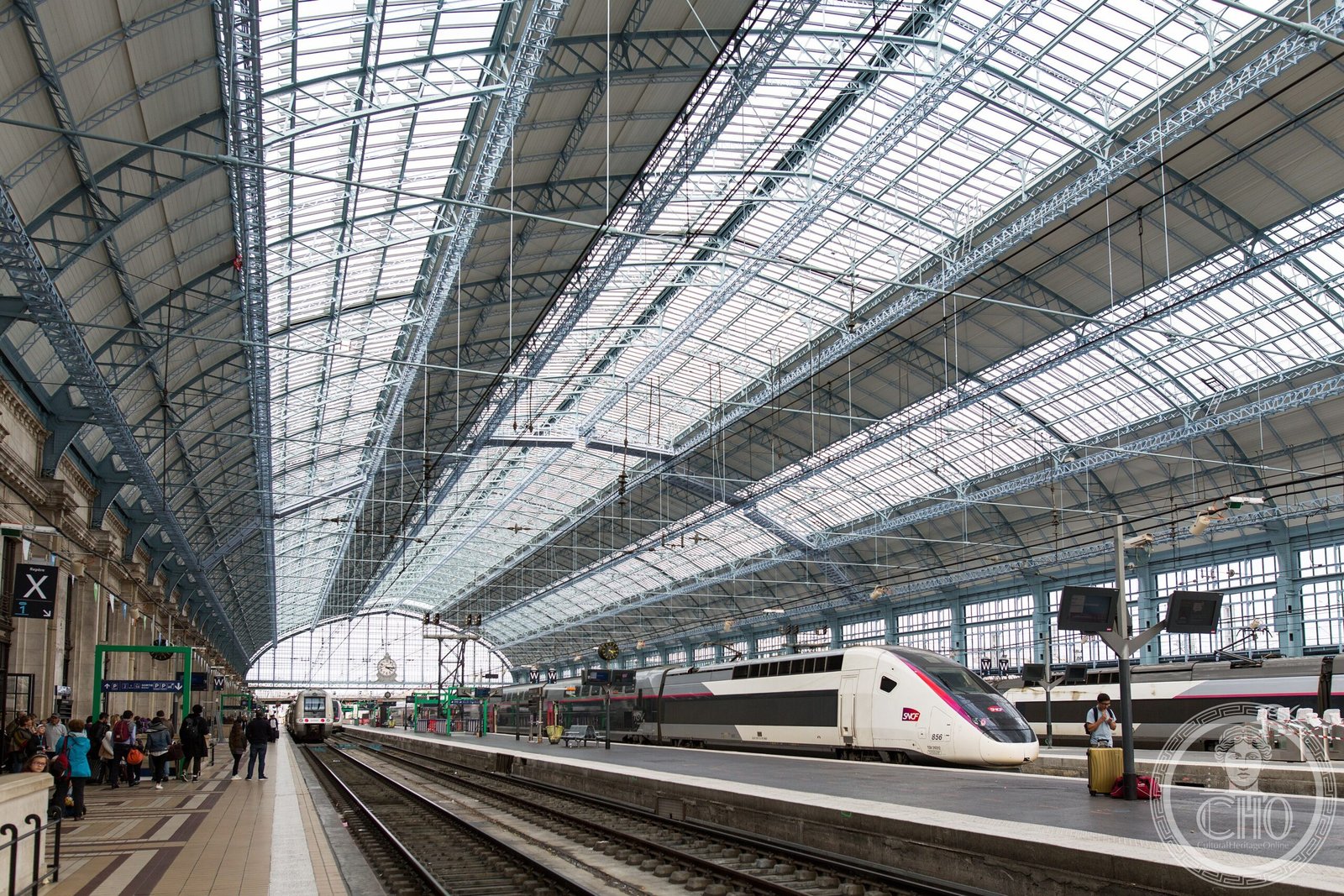
The principal railway gateway to southwestern France, this iron-and-glass terminus preserves Gustave Eiffel’s engineering legacy while serving as the vital hub connecting Bordeaux to Paris, the Pyrenees, and the Mediterranean.
At a glance
Bordeaux-Saint-Jean (formerly Bordeaux-Midi) anchors Aquitaine’s rail network. The station stands at the centre of the city, terminating the Paris–Bordeaux line from the north and the Chemins de fer du Midi line from Toulouse to the east. Modern TGV services now connect the city to France’s high-speed rail system.
History
Built as a major transportation hub in the nineteenth century, the station established Bordeaux as a crucial railway interchange. Its position as the southern terminus of the Paris–Bordeaux line and western terminus of the Midi main line cemented its role in linking the Atlantic coast with central France and Spain.
What you see
The station’s defining feature is its monumental trainshed, engineered by Gustave Eiffel. The metallic structure spans the platform area with characteristic iron lattice work. The building sits prominently at the end of Cours de la Marne in Bordeaux’s centre. Contemporary renovations have modernized facilities while preserving the original architectural character.
Cultural significance
As a landmark example of nineteenth-century railway architecture, Bordeaux-Saint-Jean represents the transformative role of industrial engineering in urban development. Eiffel’s trainshed demonstrates the aesthetic possibilities of iron construction during the Belle Époque.
Key facts
- Country: France
- City: Bordeaux
- Coordinates: 44.8256, −0.5556
- Trainshed designed by Gustave Eiffel
Practical information & getting there
Bordeaux-Saint-Jean is located at the end of Cours de la Marne in central Bordeaux. Regular TGV and regional services connect the city to Paris, Sète, Toulouse, and Spanish destinations. Ticket and journey information is available through SNCF (French National Railways).
Sources & resources
Find it on the map
See this place and what’s around it →📷 Become a Cultural Heritage Online photographer
Share your photos of places: they stay published under your name as the author. The more they're seen, the more you get noticed — and soon a contest will reward the most appreciated photos.
Log in or sign up free to add a photoIs this page about you?
This page is read by travellers and heritage enthusiasts who find it on Google. Tell us how you are connected to this place and we will take it from there.