
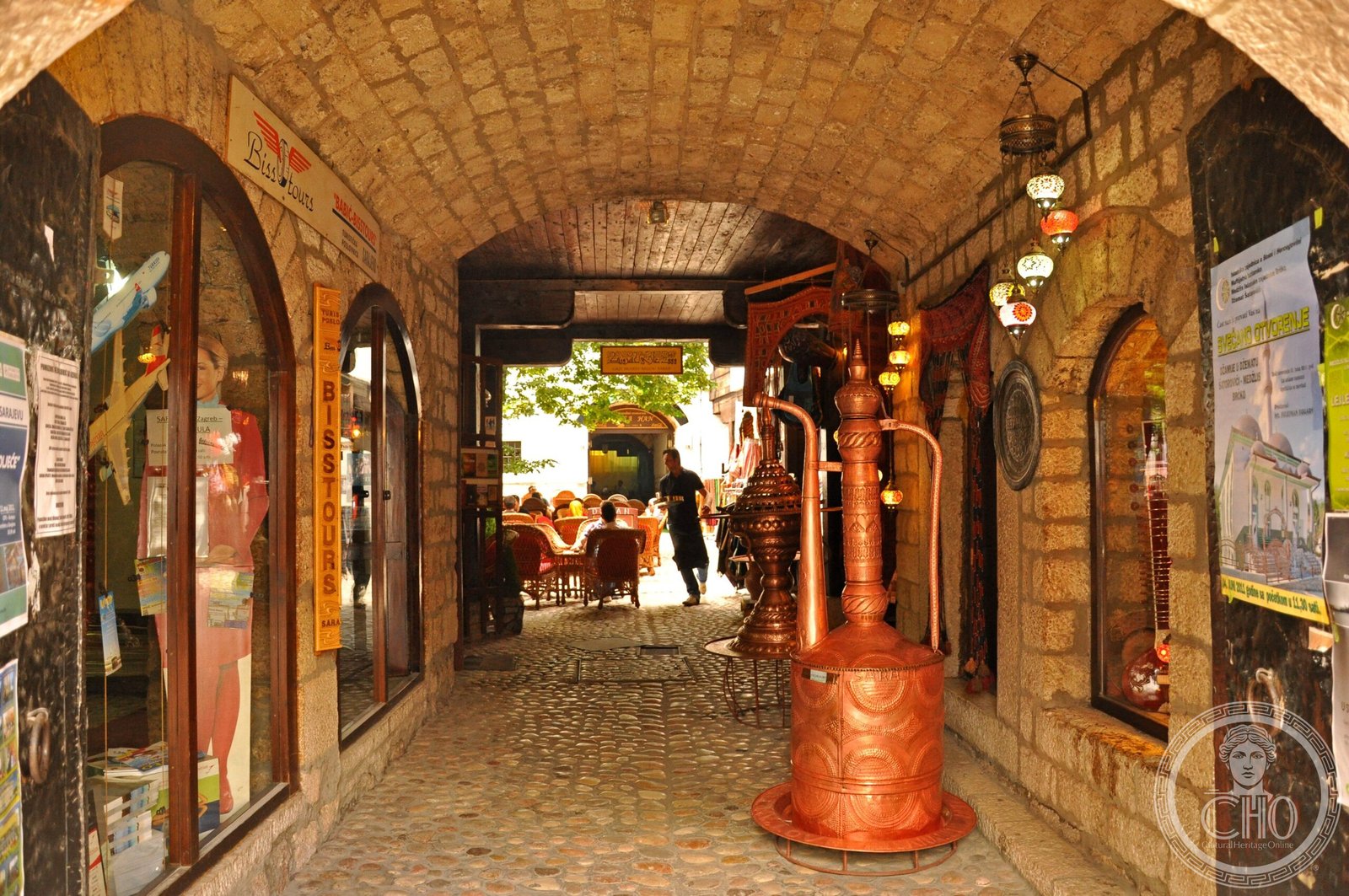
A 16th-century Ottoman caravanserai in Sarajevo’s old town, this han once sheltered 300 travellers and 70 horses. Today it stands as the city’s sole surviving roadside inn, rebuilt after fires and now restored to serve as a cultural space.
At a glance
Morića Han is a han—a fortified roadside inn designed to accommodate merchants and pilgrims along trade routes. Originally constructed in 1551 under the patronage of Gazi Husrev-Beg, it was rebuilt after a devastating fire in 1697 and again following destruction in 1957. Located on Sarači street in Baščaršija, Sarajevo’s historic quarter, it remains the city’s only surviving example of this Ottoman architectural type.
History
Built in 1551 as part of Gazi Husrev-Beg’s endowment (Vakuf), Morića Han served generations of merchants and travellers. Ottoman chronicler Evliya Çelebi visited Sarajevo in 1659 and documented the han under its then-landlord, Hadži-Bešir. The modern name probably derives from Mustafa-aga Morić and his son Ibrahim-aga Morić, who held the tenancy at the start of the 19th century, though some sources link it to the Morić brothers’ anti-Ottoman rebellions between 1747 and 1757.
A pivotal moment came on 29 July 1878, when citizens gathered here to establish the Narodni Odbor (People’s Council) and protest Austria-Hungary’s occupation. Following a catastrophic fire in December 1957, the han lay devastated until its reconstruction from 1971 to 1974, which incorporated Persian calligraphy verses by Omar Khayyám. In 1998, ownership returned to Gazi Husrev-Beg’s endowment.
What you see
As a true caravanserai, Morića Han exemplifies Ottoman mercantile architecture. Its original design permitted accommodation of approximately 300 passengers and 70 horses—a scale reflecting the intensity of Silk Road commerce. Post-1974 restoration introduced decorative Persian calligraphy inscriptions drawn from Omar Khayyám’s poetry, layering cultural references across its walls.
Cultural significance
Morića Han embodies multiple narratives of Sarajevo’s past: Ottoman trade and imperial authority, 19th-century resistance to foreign occupation, and 20th-century cultural revival. Its reference in the sevdalinka song “Vila kliče sa vrh Trebevića”—featured in Emir Kusturica’s film When Father Was Away on Business—anchors it within Bosnian artistic memory. Today, managed through Gazi Husrev-Beg’s endowment, it balances commerce with cultural stewardship, housing a national restaurant, a Persian carpet shop, and societies aligned with historical practice.
Key facts
- Country: Bosnia and Herzegovina
- City: Sarajevo
- Original construction: 1551
- Reconstructed: 1697 (after fire), 1971–1974 (after 1957 fire)
- Coordinates: 43.8597°N, 18.4301°E
- Location: Baščaršija, Sarači street, Stari Grad
- Capacity: approximately 300 passengers and 70 horses
Practical information & getting there
Morića Han stands in Baščaršija, the medieval heart of Sarajevo, within walking distance of Sarajevo’s main landmarks. It now operates as a commercial and cultural space, housing a restaurant, carpet shop, and community organisations. Visitors can enter freely to explore the courtyard and experience this living monument to Ottoman mercantile history.
Sources & resources
Find it on the map
See this place and what’s around it →📷 Become a Cultural Heritage Online photographer
Share your photos of places: they stay published under your name as the author. The more they're seen, the more you get noticed — and soon a contest will reward the most appreciated photos.
Log in or sign up free to add a photoIs this page about you?
This page is read by travellers and heritage enthusiasts who find it on Google. Tell us how you are connected to this place and we will take it from there.