
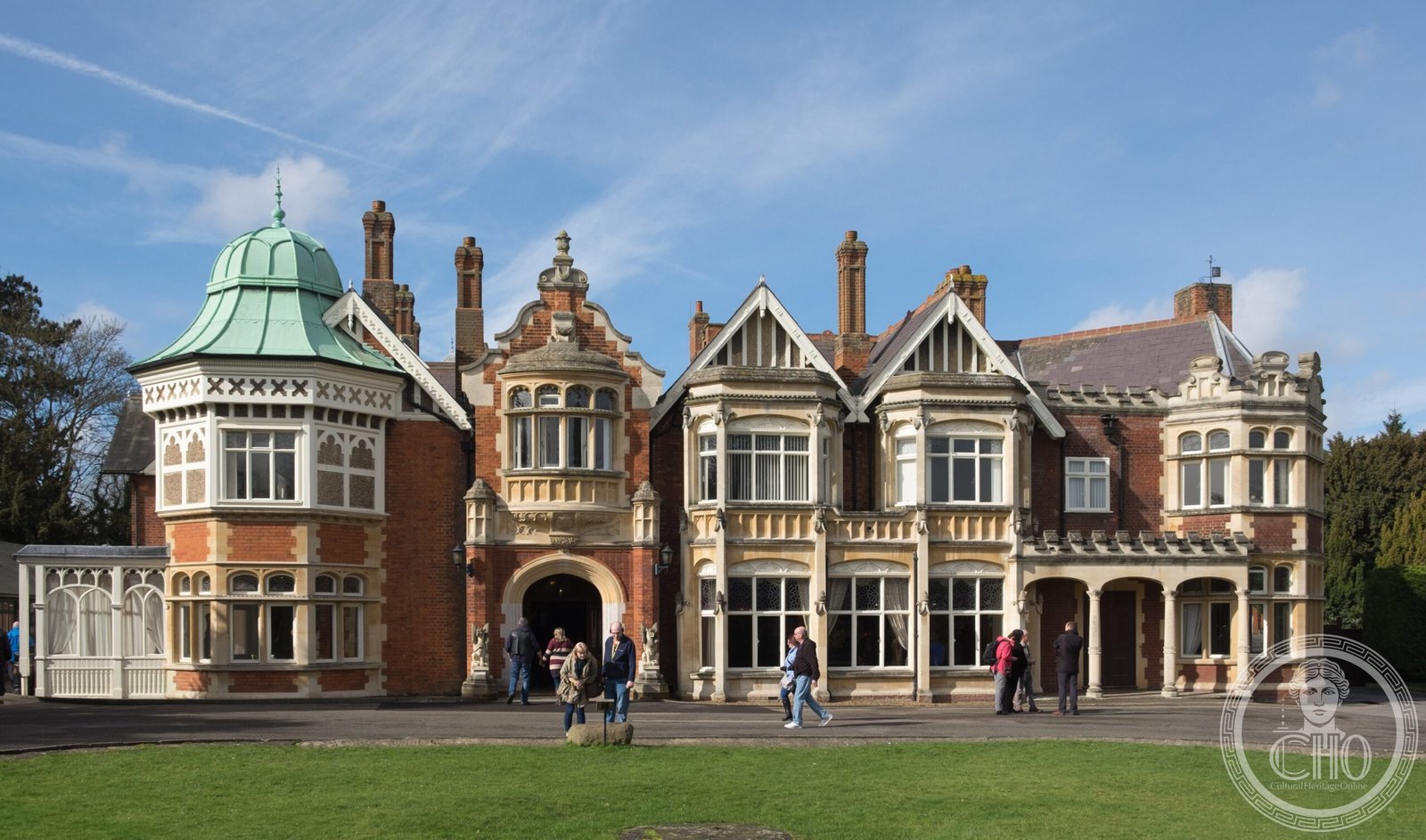
The English country house where Allied codebreakers cracked enemy communications during World War II, pioneering the first programmable digital electronic computer.
At a glance
Bletchley Park, an estate in Buckinghamshire, became the nerve centre of British wartime intelligence from 1939 onward. Home to the Government Code and Cypher School (GC&CS), it harboured one of history’s most consequential teams of mathematicians, linguists, and engineers—75% of them women—whose work shortened the war and transformed computing.
History
Requisitioned by the War Office at the outbreak of World War II, Bletchley Park housed the GC&CS and its mission to penetrate Axis communications. The estate became the focal point for decrypting the German Enigma and Lorenz ciphers—mechanical encipherment systems thought unbreakable. Codebreaking operations ended in 1946; wartime activities remained classified until the mid-1970s, when the scale of the achievement could finally be acknowledged.
What you see
The estate preserves the country house and its surrounding grounds, now interpreted as a museum. Visitors encounter period buildings, machinery, and artefacts that document both the daily working life of codebreakers and the technological innovations developed on site—including the Colossus computer, the world’s first programmable digital electronic machine.
Cultural significance
Bletchley Park stands as a monument to collective intellectual achievement under wartime pressure. Its team—including Alan Turing, Gordon Welchman, John Tiltman, Dilwyn Knox, Hugh Alexander, Bill Tutte, and others—solved mathematical and engineering problems that had seemed insurmountable. The work is credited with saving countless lives and accelerating the Allied victory. The site also marks a turning point in the history of computing and the formal recognition of women’s essential contributions to science and cryptanalysis.
Key facts
- Location: Milton Keynes, Buckinghamshire, United Kingdom
- Coordinates: 51.99805556, −0.74111111
- Notable personnel included Alan Turing, Gordon Welchly, John Tiltman, Dilwyn Knox, Margaret Rock, Mavis Lever, Harry Golombek, Hugh Alexander, Donald Michie, Bill Tutte, and Stuart Milner-Barry
- Workforce: approximately 75% women
- Key achievement: development of Colossus, the first programmable digital electronic computer
Practical information & getting there
Bletchley Park now operates as a museum open to visitors. Consult the official website for current opening hours, admission prices, and guided-tour options. The estate is accessible by road and rail from central London and other parts of the Midlands.
Sources & resources
Find it on the map
See this place and what’s around it →📷 Become a Cultural Heritage Online photographer
Share your photos of places: they stay published under your name as the author. The more they're seen, the more you get noticed — and soon a contest will reward the most appreciated photos.
Log in or sign up free to add a photoIs this page about you?
This page is read by travellers and heritage enthusiasts who find it on Google. Tell us how you are connected to this place and we will take it from there.