
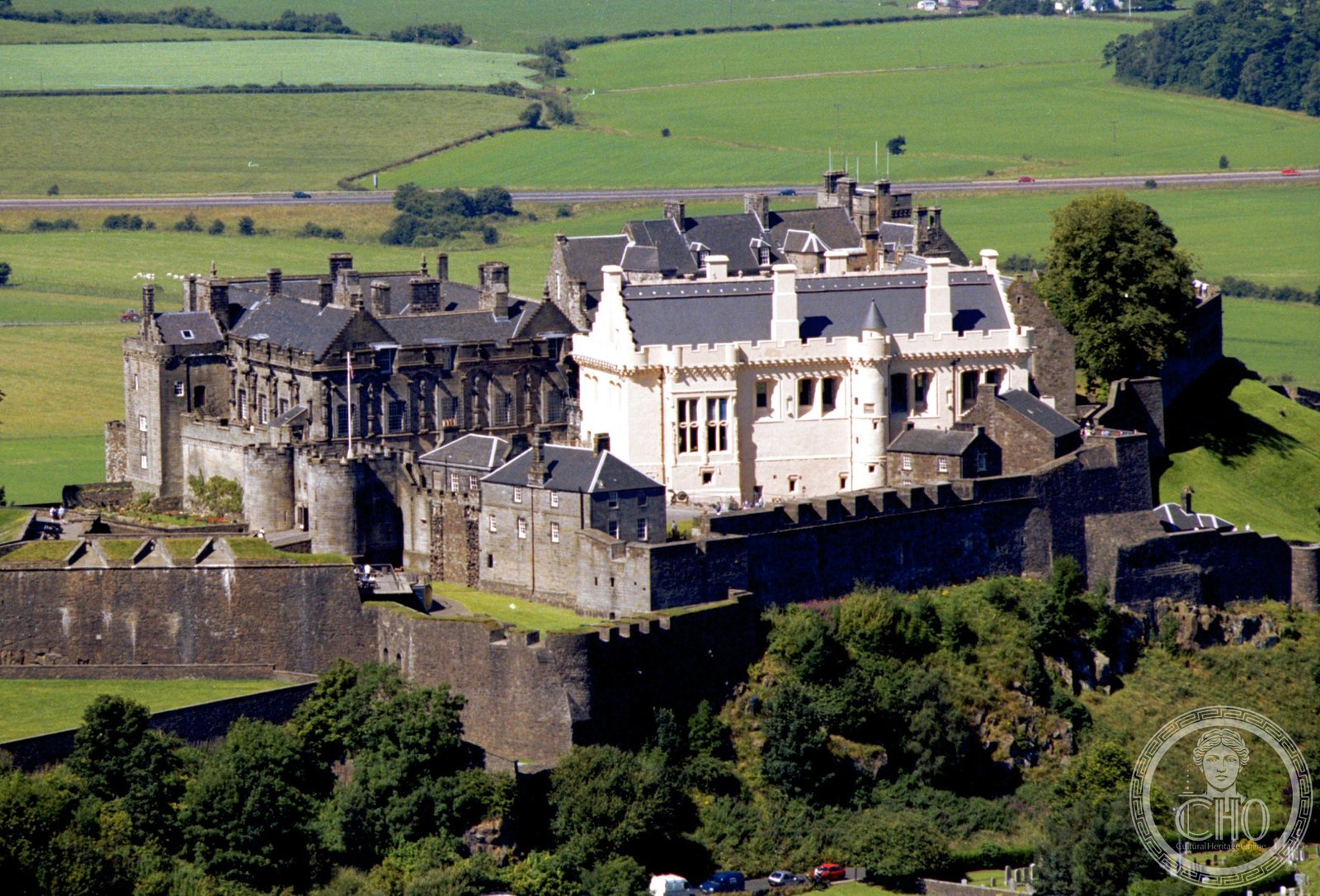
One of Scotland’s largest and most strategically vital castles, Stirling commanded the Forth crossing for centuries and served as both royal palace and fortress to the Scottish crown.
At a glance
Stirling Castle crowns a dramatic volcanic crag surrounded on three sides by sheer cliffs, creating a formidable defensive stronghold. Its commanding position over the River Forth made it essential to Scottish power from medieval times onwards. The castle evolved over four centuries into a complex of royal and military structures, testament to its dual role as seat of kingship and military fortress.
History
Stirling’s strategic importance stems from its control of the farthest downstream crossing of the River Forth until the 1890s. Before Scotland’s union with England, the castle ranked among the most frequently used royal residences in the kingdom. Mary, Queen of Scots was crowned here in 1542; other monarchs were born, died, or were crowned within its walls. The castle withstood at least eight major sieges, including crucial engagements during the Wars of Scottish Independence. The final siege came in 1746, when Bonnie Prince Charlie’s forces failed to breach its defences.
What you see
Most principal buildings date from the fifteenth and sixteenth centuries, reflecting Stirling’s peak as a Renaissance royal court. A handful of structures survive from the fourteenth century. Early eighteenth-century defensive works face the town, showing the castle’s military evolution. The volcanic crag itself—part of the Stirling Sill geological formation—provides dramatic natural fortification, its steep cliffs forming an almost impregnable barrier on three sides.
Cultural significance
Stirling Castle embodies Scotland’s medieval and Renaissance identity. As a venue for royal coronations and the birthplace of queens, it stands at the heart of Scottish dynastic history. The castle’s architecture and strategic mastery demonstrate how medieval rulers combined aesthetic ambition with military pragmatism. Its role in the Wars of Scottish Independence cemented its place in the nation’s consciousness as a symbol of sovereignty.
Key facts
- Location: Stirling, Scotland, United Kingdom
- Coordinates: 56.12388889, −3.94777778
- Principal construction periods: 14th–18th centuries
- Status: Scheduled Ancient Monument, managed by Historic Environment Scotland
Practical information & getting there
Stirling Castle is open to the public as a major tourist attraction. The site is managed by Historic Environment Scotland. Detailed opening hours, admission prices, and visitor facilities are available on the Historic Environment Scotland website. The castle sits prominently above Stirling town centre and is accessible on foot from the surrounding streets.
Sources & resources
Find it on the map
See this place and what’s around it →📷 Become a Cultural Heritage Online photographer
Share your photos of places: they stay published under your name as the author. The more they're seen, the more you get noticed — and soon a contest will reward the most appreciated photos.
Log in or sign up free to add a photoIs this page about you?
This page is read by travellers and heritage enthusiasts who find it on Google. Tell us how you are connected to this place and we will take it from there.