
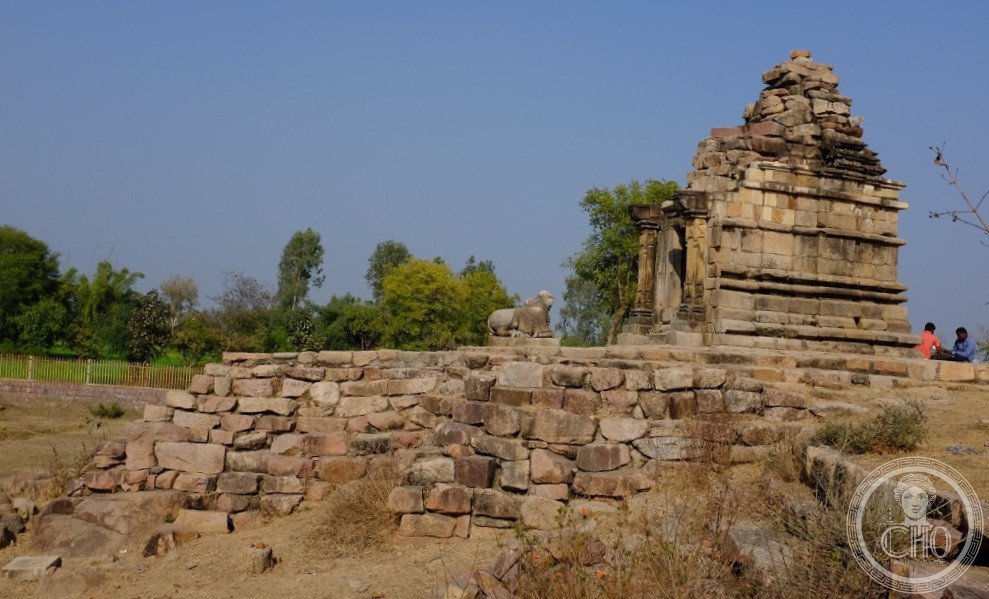
A granite Shiva temple built around 900 CE, the second oldest structure at Khajuraho and now a haunting ruin on the banks of Lalguan Sagar lake.
At a glance
Among Khajuraho’s surviving monuments, the Lalguan Mahadeva stands apart. Built when the site was transitioning from granite to sandstone construction, it represents an earlier, simpler phase of temple building at this remarkable site. Though reduced to ruins, it remains precious evidence of 10th-century architectural practice in central India.
History
The Lalguan Mahadeva temple dates to approximately 900 CE, making it the second oldest surviving temple at Khajuraho after the Chausath Yogini temple. Built when construction materials were in flux—granite still in use but sandstone being introduced—the temple reflects a transitional moment in regional building practices.
The temple was constructed on the bank of a lake, now named Lalguan Sagar. Like other Khajuraho temples, it was eventually designated a Monument of National Importance by the Archaeological Survey of India and inscribed as part of the Khajuraho Group of Monuments on the UNESCO World Heritage List in 1986.
What you see
Compared to later Khajuraho temples, the Lalguan Mahadeva is modest in scale and austere in decoration. Its design parallels that of the nearby Brahma temple. A pyramid-shaped roof once crowned the structure, and a single diamond motif adorned the doorway—restraint that speaks to its age.
Today the temple exists as a ruin. The curvilinear tower of the sanctum has collapsed, and the entrance porch has vanished entirely. Constructed entirely in granite, its weathered stone still conveys the discipline of early medieval temple design.
Cultural significance
The Lalguan Mahadeva temple documents the early development of the Khajuraho complex during the 10th century. Its materials and restrained ornamentation provide crucial context for understanding how architectural practice evolved across the site, before the elaborate sculptural traditions that define later Khajuraho monuments emerged.
Key facts
- Country: India
- City: Khajuraho, Madhya Pradesh
- Coordinates: 24.850802°N, 79.911269°E
- Date: c. 900 CE
- Material: Granite
- UNESCO World Heritage Site: Khajuraho Group of Monuments (inscribed 1986)
- Status: Monument of National Importance (Archaeological Survey of India)
Practical information & getting there
The Lalguan Mahadeva temple is part of the Khajuraho Group of Monuments, which is publicly accessible in Khajuraho town, Madhya Pradesh. For current opening hours, entrance fees, and guided tour availability, contact the local Archaeological Survey of India office or consult official Khajuraho tourism resources.
Sources & resources
Find it on the map
See this place and what’s around it →📷 Become a Cultural Heritage Online photographer
Share your photos of places: they stay published under your name as the author. The more they're seen, the more you get noticed — and soon a contest will reward the most appreciated photos.
Log in or sign up free to add a photoIs this page about you?
This page is read by travellers and heritage enthusiasts who find it on Google. Tell us how you are connected to this place and we will take it from there.