
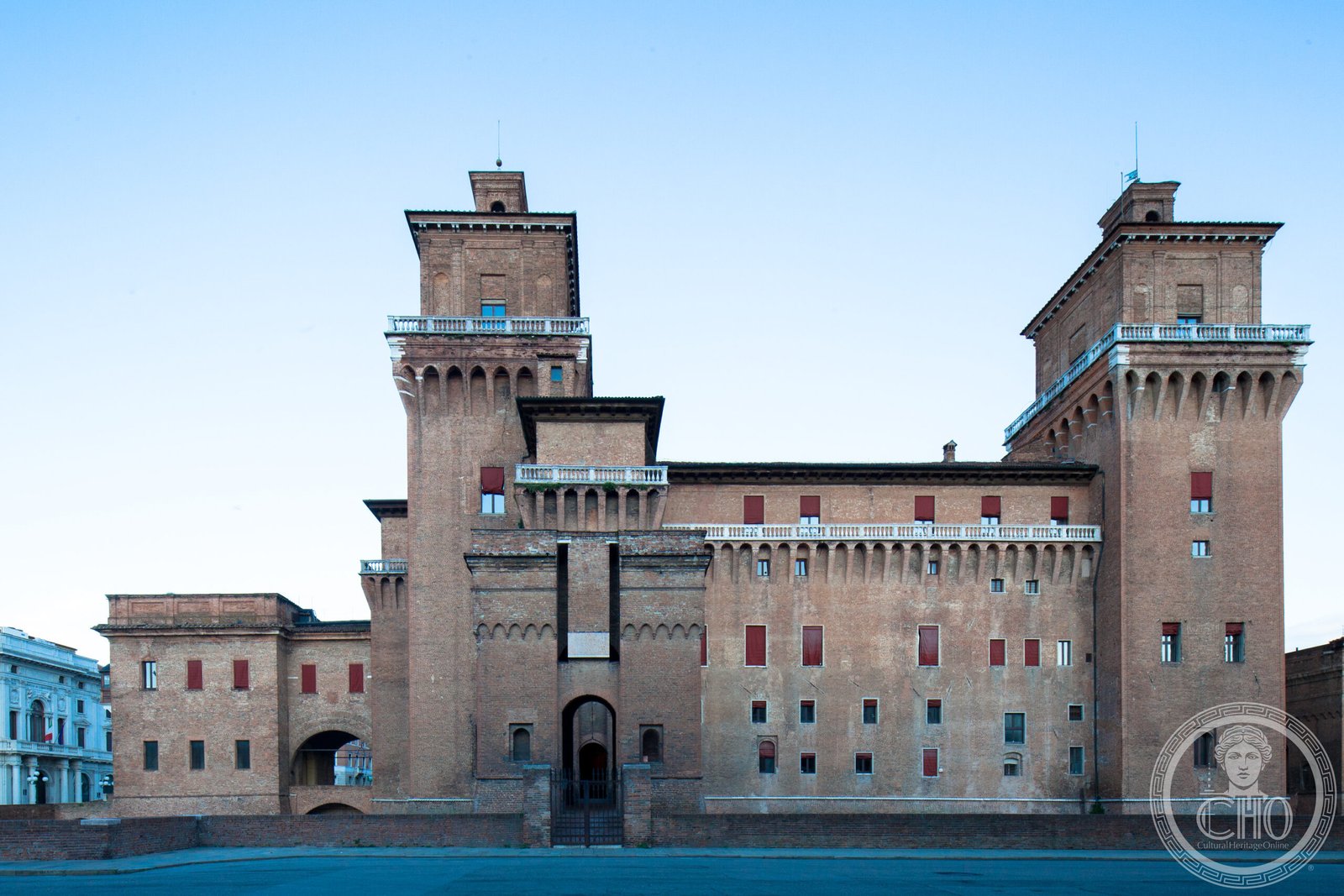
The Castello Estense, also known as the Castello di San Michele, is a moated medieval castle at the very centre of Ferrara, in the Emilia-Romagna region of northern Italy. Built from 1385 as the stronghold of the Este dynasty — the ruling family that made Ferrara one of the most brilliant courts of the Italian Renaissance — the castle rises from a water-filled moat and is defined by four massive corner towers connected by high curtain walls. Together with the city’s Renaissance urban plan it forms part of the UNESCO World Heritage Site of Ferrara, declared in 1995.
At a glance
- Type
- Moated medieval castle · museum
- Period
- Construction begun 1385; successive Este additions through the 16th century
- Style
- Late medieval · early Renaissance fortification
- Location
- Corso Martiri della Libertà, 44121 Ferrara FE, Italy
- Coordinates
- 44.8378° N, 11.6196° E
- UNESCO
- Part of the World Heritage Site “Ferrara, City of the Renaissance, and its Po Delta” (1995, extended 1999)
Overview
The Castello Estense is a large rectangular block with four corner towers — the Torre dei Leoni, Torre di San Paolo, Torre della Marchesana and Torre di Santa Caterina — each rising to commanding height above the city roofline. A broad moat filled with water still surrounds the entire structure, crossed by drawbridges that once controlled access to the Este court. Today the castle functions as a museum and cultural centre, housing administrative offices of the Province of Ferrara alongside exhibition spaces open to the public.
History
Construction was ordered in 1385 by Niccolò II d’Este following a popular uprising — the Tumulto di San Luca — that threatened the dynasty’s rule; the fortified castle was conceived as a refuge and symbol of Este power. Successive members of the dynasty, including Leonello, Borso and Ercole I d’Este, transformed the austere fortress into a courtly palace with frescoed reception halls, hanging gardens and a ducal chapel. The Este court at Ferrara became synonymous with Renaissance patronage, attracting Ariosto, Tasso, Mantegna and other leading figures of Italian culture. After the Papal annexation of Ferrara in 1598 the Este relocated to Modena and the castle passed to papal and later Italian state ownership.
What you see
Visitors cross the moat via a stone bridge to enter the castle, where interior highlights include the Sala dei Giochi frescoed with Este heraldic imagery, the intimate Cappella di Renée de France — daughter of Louis XII and patron of Protestant thought at the Ferrara court — and the grim prison cells in which Niccolò III had his wife Parisina Malatesta and son Ugo executed in 1425, an episode that later inspired poems by Byron and Browning. The walkway along the castle walls offers rooftop views over Ferrara’s distinctive flat Renaissance skyline.
Cultural significance
The Castello Estense is the defining monument of Ferrara and the visible symbol of Este dynastic culture, one of the most sophisticated princely courts of 15th–16th-century Europe. As a component of a UNESCO World Heritage Site, it anchors a city whose Renaissance urban fabric — planned by Biagio Rossetti for Ercole I — is among the best-preserved in Italy. The castle’s association with literary figures from Ariosto to Byron gives it a pan-European cultural resonance rarely matched by provincial Italian monuments.
Practical information
- Address
- Corso Martiri della Libertà 75, 44121 Ferrara FE, Italy
- Hours
- Typically Tuesday–Sunday 09:30–17:30; check official website for seasonal variations
- Admission
- Paid entry; reduced for EU citizens under 25 and over 65; check official website
- Website
- castelloestense.it
Getting there
Ferrara railway station is served by direct trains from Bologna (25–30 min), Venice (90 min) and Milan (via Bologna). The castle is a 15-minute walk from the station along Viale Cavour. No car is needed — the historic centre is largely pedestrianised and Ferrara is famously a cycling city with extensive bike-hire options.
Sources & resources
- Castello Estense — Wikipedia
- UNESCO World Heritage — Ferrara, City of the Renaissance
- Cultural Heritage Online — Italy travel and heritage guides
See the place
Find it on the map
See this place and what’s around it →Historical events at this place (2)
📷 Become a Cultural Heritage Online photographer
Share your photos of places: they stay published under your name as the author. The more they're seen, the more you get noticed — and soon a contest will reward the most appreciated photos.
Log in or sign up free to add a photoIs this page about you?
This page is read by travellers and heritage enthusiasts who find it on Google. Tell us how you are connected to this place and we will take it from there.