
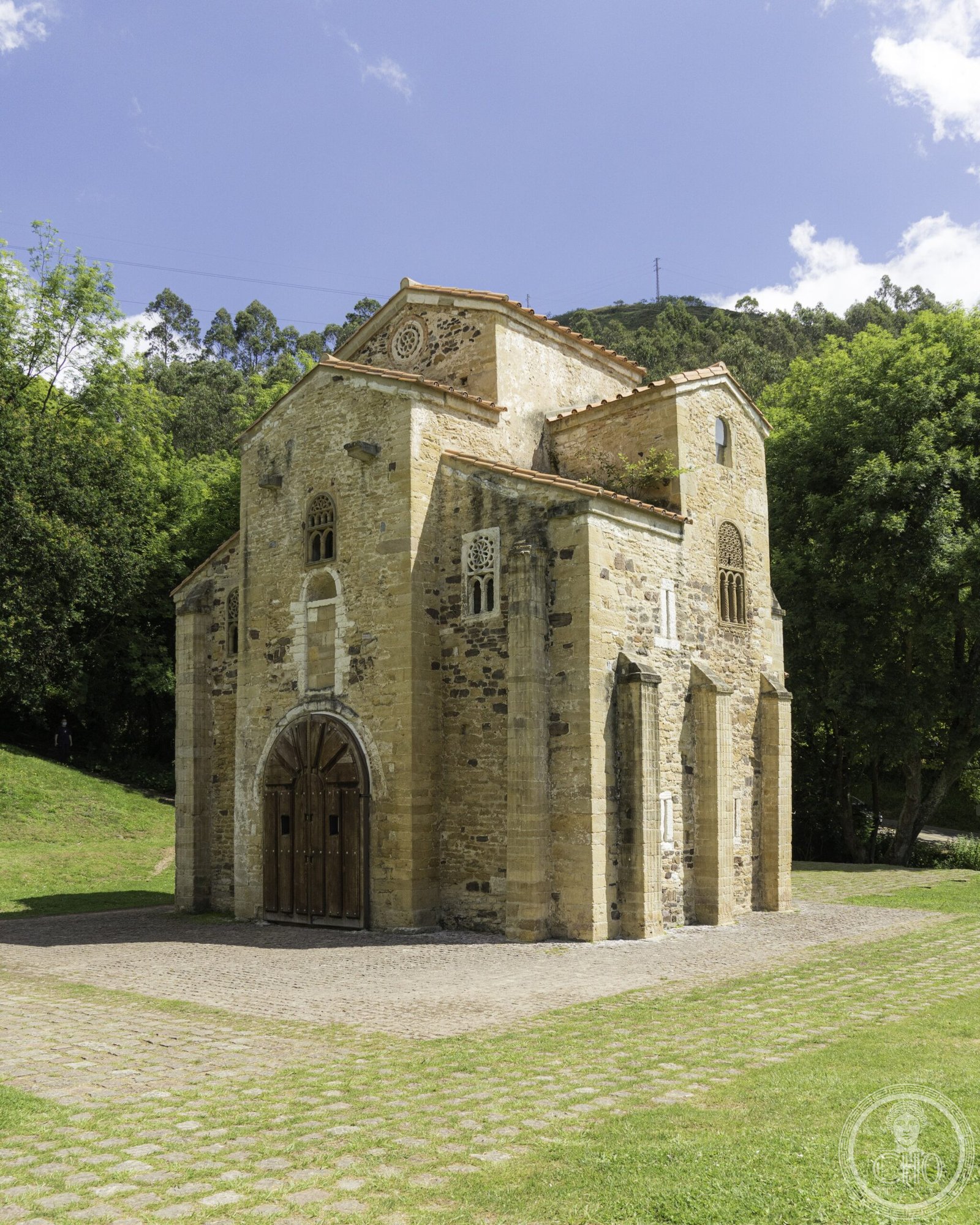
A Visigothic church of extraordinary stonework, San Miguel de Lillo crowns Mount Naranco with carved tracery that defies its austere mountain setting. Consecrated in 848, it preserves fragments of one of early medieval Europe’s most sophisticated decorative schemes.
At a glance
Built in 842 and consecrated in 848 by King Ramiro I and Queen Paterna, San Miguel de Lillo stands on Mount Naranco near its sister church, Santa María del Naranco. Originally dedicated to St. Mary, the church took its current dedication when worship transferred to a nearby palace in the 12th century. The structure has been part of the UNESCO World Heritage Site “Monuments of Oviedo and the Kingdom of Asturias” since 1985.
History
The church was completed in 842 as a three-aisled basilica with barrel vaults extending some five bays in length. Its original dedication to St. Mary changed in the 12th century when royal devotion shifted to a neighboring palace, leaving this mountain sanctuary under the protection of Saint Michael.
A catastrophic collapse during the 12th or 13th century destroyed much of the structure, leaving only the distinctive Frankish-style royal westwork—the western entrance block—standing today. The surviving section, though narrow, rises dramatically through the use of external buttressing that channeled weight downward through stone.
What you see
The most striking features are the carved stone windows. Each bifora and quadrifora on the west facade was sculpted from a single slab of stone, perforated with extraordinary precision to create intricate geometric tracery. Coupled columns support slender lintels topped by roundels or half-roundels, demonstrating sophisticated technical mastery.
The transept displays triforas with elaborate patterning. A vaulted vestibule protects the entrance, above which a gallery or upper choir is accessed by flanking staircases. The walls once blazed with murals similar to those at Santuyano; only fragments survive today, hints of the chromatic richness that once enveloped visitors.
Cultural significance
Sixteenth-century historian Ambrosio de Morales praised the church’s harmonious spatial composition and the quality of its materials—marbles, jasper, and porphyry—acknowledging its blend of Gothic detail with Romanesque restraint. The carved tracery represents a technical achievement rarely seen in contemporary European churches.
San Miguel de Lillo exemplifies Asturian ecclesiastical ambition during the reign of Ramiro I, a period of cultural flourishing before the Christian Reconquista accelerated. Its preservation on UNESCO’s World Heritage list reflects its importance to early medieval architectural history.
Key facts
- Country: Spain
- City: Oviedo, Asturias
- Coordinates: 43.38027778, −5.86838889
- Completed: 842; consecrated 848
- UNESCO World Heritage Site: Monuments of Oviedo and the Kingdom of Asturias (inscribed 1985)
Practical information & getting there
The church is located on Mount Naranco near the city of Oviedo. It stands adjacent to the Church of Santa María del Naranco, allowing both monuments to be visited together. Current visiting hours and accessibility details are available through local tourism information in Oviedo.
Sources & resources
Find it on the map
See this place and what’s around it →📷 Become a Cultural Heritage Online photographer
Share your photos of places: they stay published under your name as the author. The more they're seen, the more you get noticed — and soon a contest will reward the most appreciated photos.
Log in or sign up free to add a photoIs this page about you?
This page is read by travellers and heritage enthusiasts who find it on Google. Tell us how you are connected to this place and we will take it from there.