
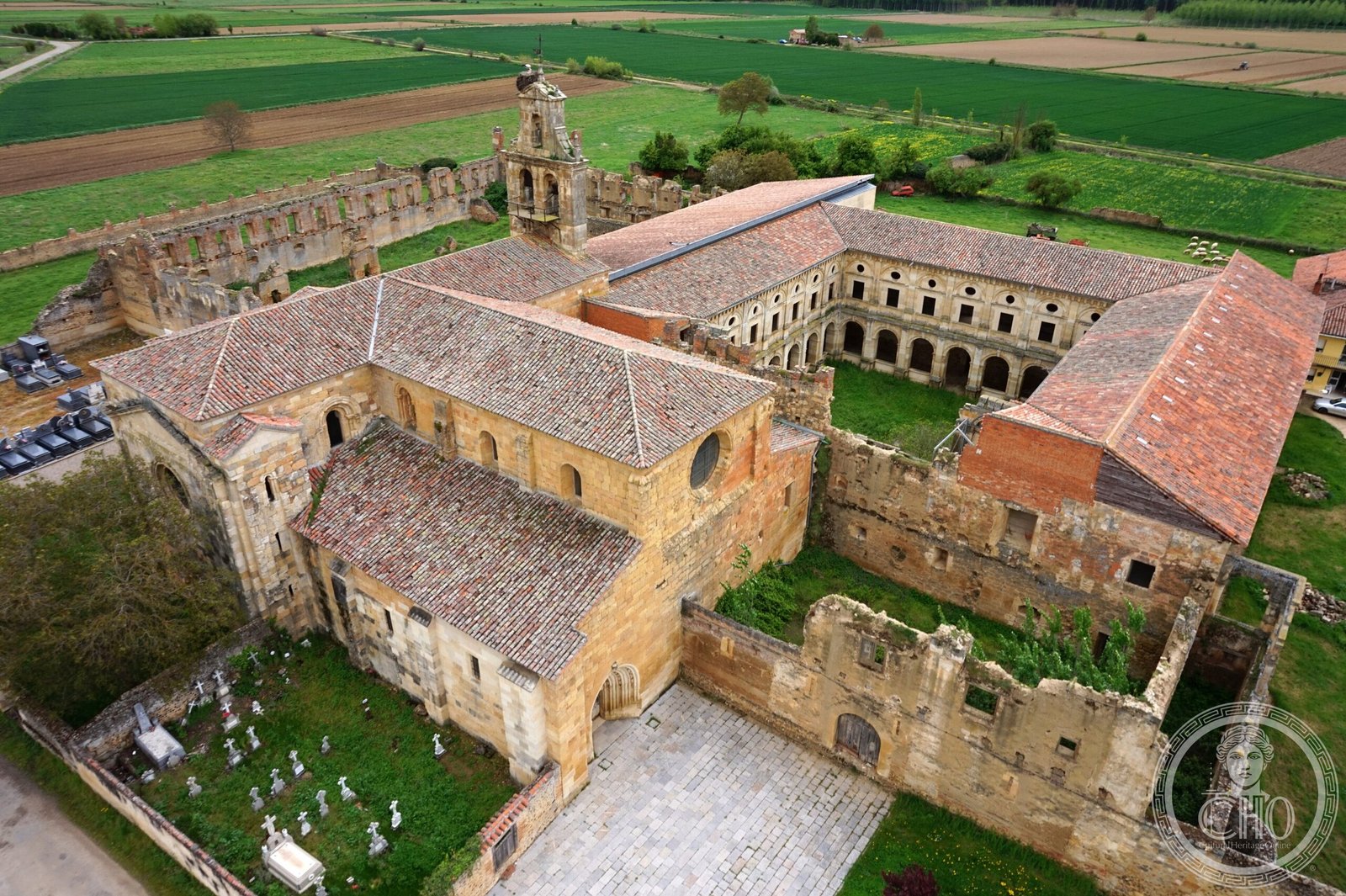
A Cistercian monastery whose Romanesque and Gothic ruins stand near León, Spain, and whose spiritual authority once rivaled its founding house.
At a glance
Santa María de Sandoval was a Cistercian monastery established in 1171 on land near the confluence of the Porma and Esla rivers. Built over seven centuries in Romanesque and Gothic styles, it functioned as a center of monastic life until 1835, when the monks departed during the Mendizábal confiscations. Today its ruins remain in Villaverde de Sandoval, designated a historical artistic monument since 1931 and recognised as an associated element of the Camino de Santiago UNESCO World Heritage Site.
History
In 1142, Emperor Alfonso VII granted land near León to his majordomo, Count Ponce de Minerva. Twenty-five years later, in 1167, Ponce and his wife Estefanía Ramírez—with consent of their children Ramiro, María, and Sancha—donated the property to Abbot Diego Martínez of Santa María de la Santa Espina for a new Cistercian foundation.
Monastic life commenced in 1171 with twelve monks from La Santa Espina under Abbot Diego. Though established as a daughter house, Sandoval swiftly ascended to equal importance with its spiritual parent. Early patronage from Urraca, daughter of Alfonso VII, strengthened the monastery’s position; her anniversary mass was commemorated annually on 25 June.
The monastery acquired substantial holdings through donations—dehesas (pastoral lands) and feudal rights—reinforcing its economic power. In 1222, King Ferdinand III granted additional land. Sandoval itself founded a daughter house at Valdellán. After 1487, the monastery joined the Congregation of Castile, a reformed Cistercian community established by Martín de Vargas.
In 1835, monks abandoned the monastery during the Mendizábal confiscations. It was later repurposed as a parish church where services continue occasionally to this day.
What you see
The ruins display two architectural phases: the oldest sections employ Romanesque style, while later additions adopt Gothic forms. These materials and proportions reflect the monastery’s evolution from its twelfth-century foundation through subsequent medieval expansion.
Cultural significance
Sandoval embodies the Cistercian order’s spiritual and economic influence in medieval Spain. Its rapid rise to rival its founding monastery demonstrates the vigour of monastic expansion during the twelfth and thirteenth centuries. Recognised as an associated element of the Camino de Santiago in 2015, the site remains integral to understanding pilgrimage routes and religious infrastructure in the Iberian Peninsula.
Key facts
- Country: Spain
- Founded: 1171
- Order: Cistercian
- Coordinates: 42.4995, −5.4593
- Historical designation: Monumento histórico-artístico (since 1931)
- UNESCO association: Camino de Santiago element (2015)
Practical information & getting there
The ruins lie in Villaverde de Sandoval, near León in northwestern Spain. Occasional services are still held at the site. For current visiting hours and any access information, consult local tourism resources or the Camino de Santiago foundation.
Sources & resources
Find it on the map
See this place and what’s around it →📷 Become a Cultural Heritage Online photographer
Share your photos of places: they stay published under your name as the author. The more they're seen, the more you get noticed — and soon a contest will reward the most appreciated photos.
Log in or sign up free to add a photoIs this page about you?
This page is read by travellers and heritage enthusiasts who find it on Google. Tell us how you are connected to this place and we will take it from there.