

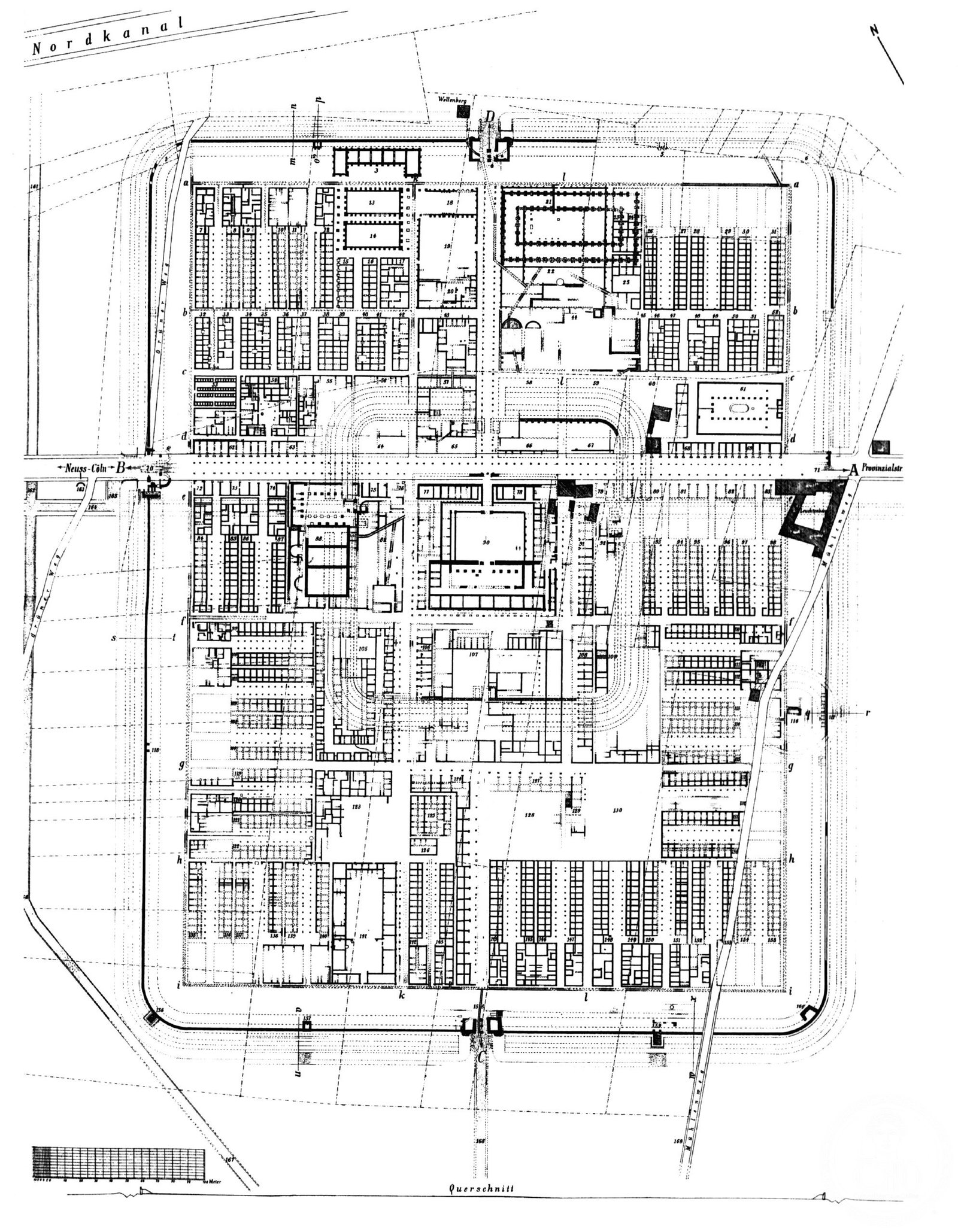
A Roman legionary fortress on the Rhine’s west bank that evolved from timber camps into a stone stronghold, anchoring the empire’s north-eastern frontier for two centuries.
At a glance
Novaesium was Rome’s answer to controlling the Rhine Valley. Built around AD 43 at what is now Neuss, this fortress began as a sprawling military settlement and crystallised into an iconic example of Claudian-era design. Its excavated ground plan became a template for understanding Roman legionary architecture across Europe.
History
The site saw occupation from the late 1st century BC, with successive earth and timber camps housing legionaries in tents. Around AD 43, Roman commanders initiated a large permanent fortress. Stone walls, gates, and turrets replaced earlier defences as the empire’s ambitions shifted from expansion to consolidation. By the early 2nd century, the fortress was reduced in size but remained an auxiliary base. For approximately 200 years, it formed part of the Limes—the Rhine Valley frontier that defined Rome’s northern limits.
What you see
The fortress featured the orderly ‘playing card’ layout characteristic of Claudian fortifications. Excavations revealed permanent barracks, officers’ quarters, and administrative buildings arrayed in disciplined rows. Stone fortifications—walls, gates, and corner turrets—protected the compound. Earlier precursor camps to the west show a progression from temporary encampments to engineered permanence.
Cultural significance
Constantin Koenen’s late 19th-century discovery of the stone fortress’s foundations was transformative. His excavations yielded the first complete ground plan of a legionary fortress, establishing a blueprint for Roman military architecture studies. The site exemplifies how Rome adapted strategy: from aggressive territorial acquisition to sustainable border defence along the Rhine.
Key facts
- Location: Neuss, Germany (51.1839°N, 6.72194°E)
- Occupation: Late 1st century BC – early 2nd century AD and beyond
- Major construction phase: c. AD 43
- UNESCO World Heritage Site: Lower Germanic Limes (inscribed 2021, comprising 102 locations)
Practical information & getting there
The fortress site is now integrated into modern Neuss. Archaeological museums in the region hold finds and interpretations from the excavations. The Lower Germanic Limes UNESCO designation includes visitor centres and marked heritage routes across Germany and the Netherlands, tracing the full extent of the Roman frontier.
Sources & resources
Find it on the map
See this place and what’s around it →📷 Become a Cultural Heritage Online photographer
Share your photos of places: they stay published under your name as the author. The more they're seen, the more you get noticed — and soon a contest will reward the most appreciated photos.
Log in or sign up free to add a photoIs this page about you?
This page is read by travellers and heritage enthusiasts who find it on Google. Tell us how you are connected to this place and we will take it from there.